









May 20 2026 - 4:30pm
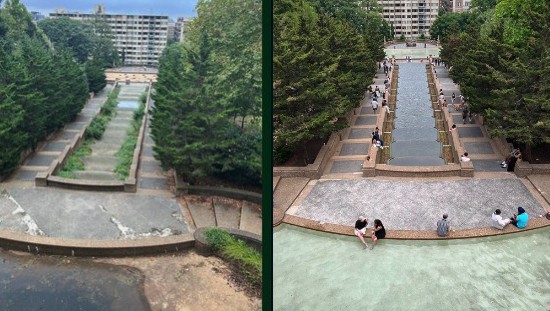
President Trump’s “war room” has been posting on X this week about the restoration of Meridian Hill Park in Washington, DC. The accompanying “before” image shows a derelict fountain and water cascade, weed-choked and dry; the “after” image shows flowing water and visitors sitting, talking and walking through the space. The caption is explicit in its framing: “For years, homeless camps and drug addicts took over the park. Now it’s cleaned up and full of families again.”
Supporters are celebrating stewardship and law enforcement in time for America’s imminent 250th anniversary. Critics, meanwhile, complain about displacement, gentrification and cost. Is this a storm in a fountain? Or does it highlight something deeper about America’s past, present and future?
Once upon a time, the United States was an urban civilization and, briefly, the world’s most significant city-maker. Meridian Hill Park was created at the high noon of America’s urban greatness as part of the Meridian Hill District. The neighborhood is awash with luxuriant and beautiful Beaux-Arts mansions. The streets are tree-lined and rich in enjoyable Victorian details: cornices and corbels, stoops and porches.
The park’s design drew inspiration from Rome’s Villa Borghese gardens. It is centered around an Italian Renaissance-style fountain and cascade with pools, a plaza and formal gardens. Statues celebrate poets, heroes and a president. It also looks forward. When built, it used a new type of concrete to create its rustications and beautiful balustrade.
Then came the fall. During the 20th century, America de-urbanized. Many city centers hollowed out. The middle classes fled to the hugely expanding suburbs, where long commutes and declining neighborly life undermined residents’ connectedness and happiness, as Robert Putnam’s Bowling Alone and many other studies have demonstrated. Increasingly wider freeways cut through city centers. Downtowns declined. Parking lots replaced offices and homes.
Washington, DC and Meridian Hill Park followed the wider trajectory of white flight, suburbanization and disinvestment, which left the surrounding neighborhood poorer and the park in decline, at times among the city’s most dangerous. It became a hub for political organizing, with the Black Panther Party, the Black United Front and the All-African Revolutionary Party holding rallies there, and activists renaming it Malcolm X Park after the Civil Rights leader’s 1965 assassination. Later redesigns were described as more “industrial” in character, prioritizing reassurance over the original Italian Renaissance-inspired design. The fountains have been out of service since 2019.
Many downtowns — including Washington, DC — have been reviving over the past generation, which is why the park’s $10 million refurbishment matters. A growing body of research suggests that well-designed, aesthetically coherent places attract more people, and that higher footfall is associated with greater safety. Safer environments, in turn, tend to command higher value.
This park clean-up should not be a partisan issue. Park use carries clear mental and physical health benefits, provided people feel secure enough to spend time there. It is therefore no surprise that parks in other cities — regardless of political leadership — are also attempting to recover a sense of lost civic elegance.
The lesson for American policymakers, whether Democratic or Republican, is straightforward: invest in parks and public spaces. Avoid transient design fashions. Prioritize beauty, coherence and safety, so that places are genuinely loved. Meridian Hill Park, though rooted in the past, can still help point towards a better urban future.