









October 10 2025 - 6:15pm
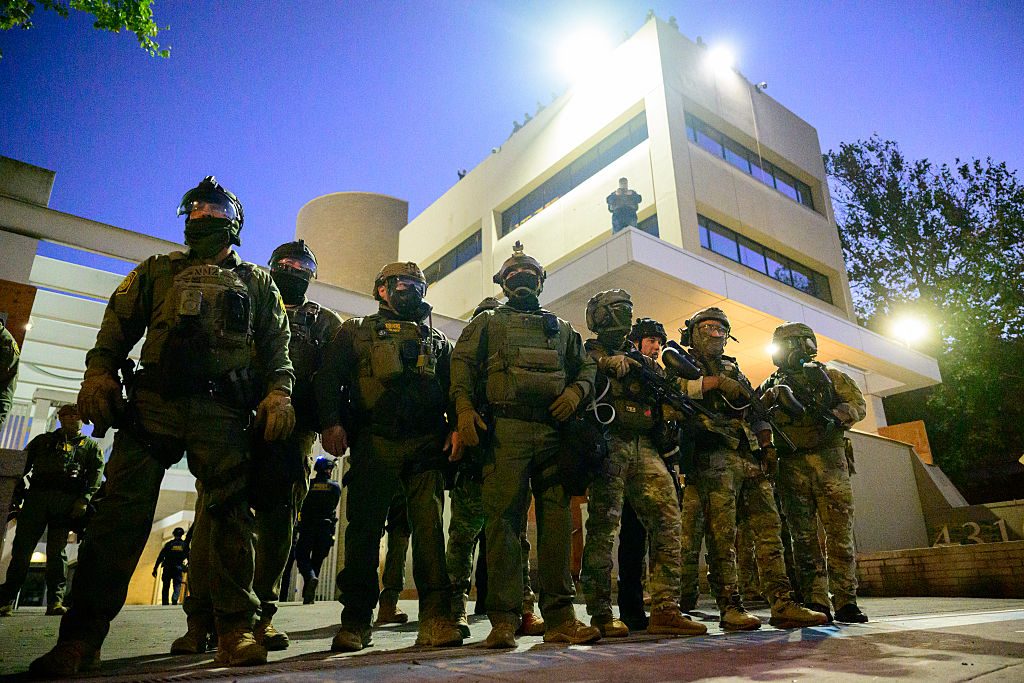
Reports say that Donald Trump is considering using the Insurrection Act as a basis for deploying federal troops across the country, including in cities and states where the local governments do not welcome the interference.
It would be a dramatic — but not unprecedented — departure from recent American history. Even in June, when the President briefly deployed the National Guard to fend off attacks on Immigration and Customs Enforcement officers (ICE), the Insurrection Act was not cited as justification. There, the armed forces were used merely to protect law enforcement officers, not to do their jobs. In a similar way, National Guardsmen in Washington, DC were not called out to defeat an uprising but to assist local cops in getting a handle on runaway crime in the federal capital.
Legally, the Insurrection Act has fairly open-ended conditions — requirements that have not fully been tested in the courts. Some legal experts, like those at the progressive Brennan Center, believe the Act is “dangerously vague”. And even scholars friendlier to Trump, such as James Di Pane at the Heritage Foundation, argue that the 1807 law is “an extreme measure and one that should be employed only if there are no other options”.
Legal challenges could go either way, and will take a long time to pass through the court system. Of more immediate concern are the political consequences, which would likely be very significant. Proclaiming a state to be in revolt against the federal government would be more likely to provoke a deeper insurrection than to control an existing one.
Despite the title, the terms of the Insurrection Act do not require a full-on civil war. But impressions matter. The name of the Act will invite alarm from sober-minded observers as well as from political opponents. And a look at past incidents where use of Insurrection Act authority was justified shows that a situation must be quite dire before the public will accept it.
The last use of the Insurrection Act was in 1992, when President George H.W. Bush invoked it — at the behest of the local governor and mayor — to justify sending troops to Los Angeles during the riots there, in which 63 people were killed. No city in America is currently experiencing that level of anarchy, despite the Trump administration’s claims. Where lawlessness is present — and it is in many neighborhoods — it is the choice of Democratic mayors and district attorneys not to enforce the law to the fullest extent: an unwillingness, not an inability. That’s a real problem, but not one federal troops can solve.
The last time a president deployed National Guard units under the Insurrection Act without a local governor’s permission was to protect civil rights marchers in Alabama in 1965. The last time such a situation involved active duty military units was in 1962, when John F. Kennedy sent troops to put down a riot at the University of Mississippi, part of southern Democrats’ campaign of “massive resistance” to federal civil rights efforts. In both cases (and several others in the civil rights era), presidents faced organized political resistance to lawful federal authority that had, or threatened to, spill over into mob violence and death. That hasn’t happened in America in 2025 — at least not yet.
It may still happen. There are certainly those who would love to target ICE and other law enforcement officers. If the situation does devolve into actual riots or other widespread violence, fair-minded observers would be compelled to see the parallel between those times and our own. But we have not yet reached that level of civil disorder.
ICE officials should be allowed to do their jobs, following the law as they enforce it. State officials cannot be compelled to assist them, but they also must not stand back and let riots happen — as many southern state governments would have done in the Fifties and Sixties, absent federal force. But unless that happens, sending in the troops and declaring an American state or city to be in revolt would fan the flames of lawlessness, not douse them.