









February 18 2026 - 12:30pm
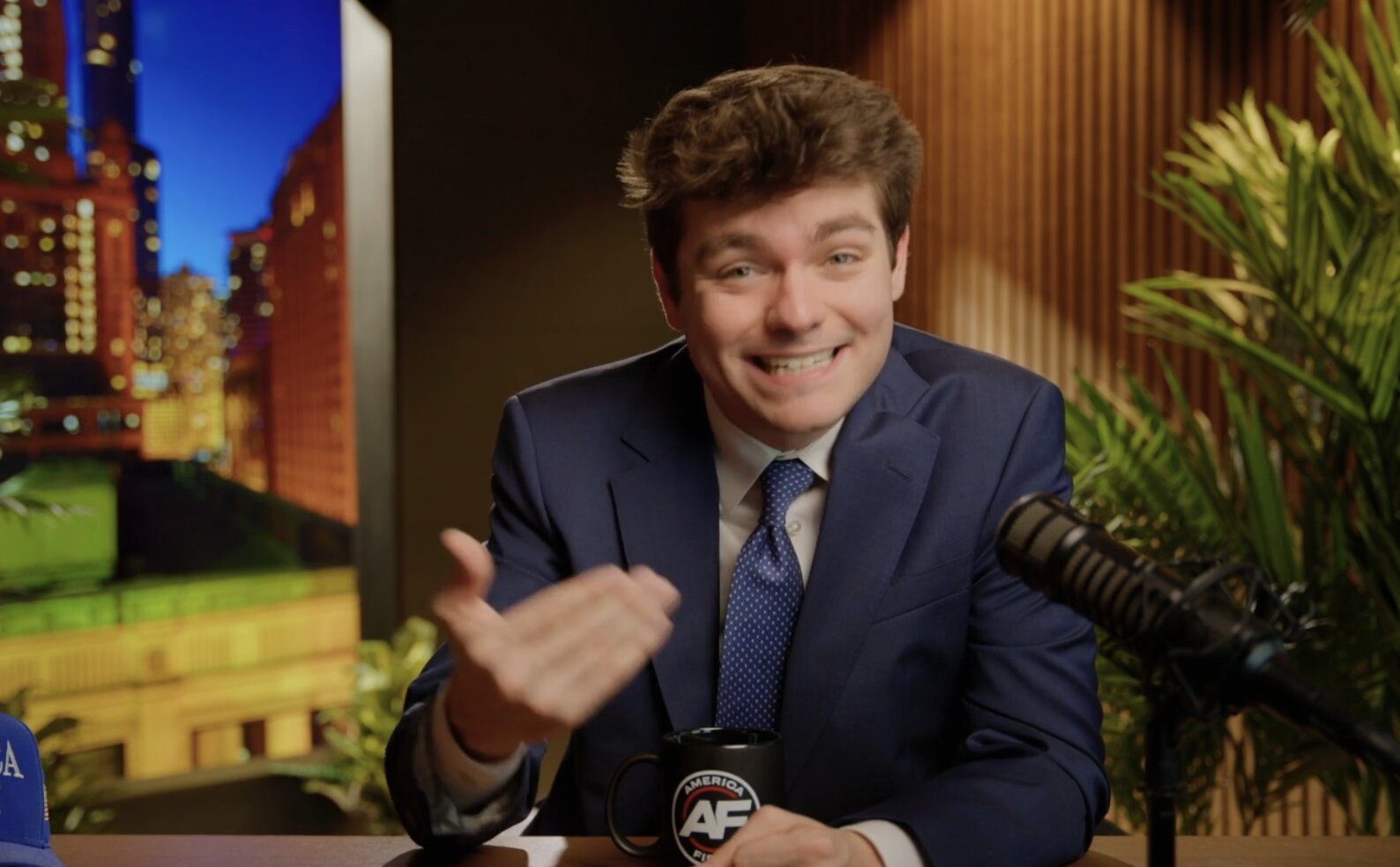
Yesterday, both Chicago Magazine and City Journal published separate pieces detailing the growing influence of Nick Fuentes, the 27-year-old provocateur and leader of the so-called “Groyper” movement.
They follow a litany of articles about Fuentes in the mainstream press over the last few months, along with an appearance on Tucker Carlson’s podcast in November. As Chicago Magazine notes, the streamer is punching above his weight in terms of his influence within the Right-wing media sphere, and his America First livestream on Rumble sometimes attracts 1 million views per episode — although that’s still only about 1% the views of an average MrBeast video.
But it’s also likely that Fuentes is at the absolute peak of his powers. In the volatile digital influencer economy, it almost certainly means there is nowhere to go but down.
He is currently enjoying a strange, artificial longevity, gifted to him by a rare moment of alignment between both liberal and conservative media. Both sides have found it useful to transform him into a permanent boogeyman. Consider that on the same day Chicago placed Fuentes one place below the city’s Mayor Brandon Johnson in its most influential Chicagoans list, conservative journalist Christopher Rufo wrote an investigative takedown of the streamer, peeling back the curtain on the ugliness of people circling in his orbit.
The incentive is obvious: both sides can turn scaremongering about Fuentes into clicks and ratings. For the liberal media, the “Groyper panic” also serves a vital rhetorical function: it allows the establishment to paint any populist or nationalist sentiment with the brush of Fuentes’s specific brand of white identitarianism. A decade ago, this role was filled by Richard Spencer, a (now former) neo-Nazi who was knighted as the leader of the Alt-Right, which was as coherent as calling James “Fergie” Chambers — the wealthy Cox Communications heir-turned-dirtbag Leftist — the CEO of Antifa. Like both Spencer and Chambers, Fuentes is less a leader of a movement and more the figurehead of an online fandom.
On the Right, the divide is more internecine. The City Journal investigation represents a concerted effort by the intellectual Right to excommunicate Fuentes once and for all. Yet the very act of treating him as “the enemy within” gives the streamer a sense of institutional gravity he hasn’t earned. Ultimately, this added attention benefits the liberal-Left, which can parade around a cartoon villain to scare its voters and viewers while the Right appears marginal and unserious.
Consider this study published last month by the University of Buckingham, which argued that Fuentes’s audience is actually smaller than it is hyped to be. The study found that his regular audience is a mere drop in the bucket compared to mainstream giants such as Tucker Carlson or Candace Owens, reaching only about 7% of young Trump voters. These aren’t necessarily hardcore ideologues. The study described them as “recreational’ contrarians: bored, politically homeless, and motivated more by a cocktail of nihilism and “edgelord” humor.
What’s more, research published last year by the Network Contagion Research Institute (NCRI) pointed to a “manufactured virality”. Fuentes’s reach is artificially inflated through coordinated anonymous social media accounts and foreign influence operations — his retweets are heavily concentrated in India, Pakistan, Nigeria, Malaysia, and Indonesia.
Perhaps Fuentes is best understood as a shock jock for the YouTube era. Back in the Eighties and Nineties, these controversial figures were everywhere: Howard Stern, Marilyn Manson, 2 Live Crew, and others in the media whose “power” was derived almost entirely from their ability to command an audience through transgression. Concerned parents and media types back then worried that Manson was turning vulnerable teens into Satanists; now they’re worried that Fuentes is recruiting millions of young neo-Nazis.
However, the influencer model’s life cycle is fundamentally shorter and more unstable than the terrestrial radio empires of the 20th century. While a shock jock could maintain a decades-long career through a syndication deal, a digital-native influencer relies on a constant, escalating hit of “the new”. Once the shock wears off and the tropes become repetitive, the audience — and the influence — usually begins to evaporate.
