









February 21 2026 - 5:00pm
On Thursday, the Wall Street Journal reported that President Trump was debating a limited strike against Iranian military targets. This was in the hope of pushing Supreme Leader Ali Khamenei into signing a nuclear deal on Washington’s terms. Asked the next morning to comment on whether he was indeed reviewing this option, Trump said: “I guess I can say I am considering it.”
Meanwhile, the Trump administration continues to deploy military assets to the Middle East, both to coerce Tehran into an agreement and to ensure the US military has the platforms and enablers needed to execute a weeks-long campaign against Iran if ordered. Iran, which experienced the weight of heavy bunker-busting munitions last June when American B-2 bombers damaged its three main nuclear facilities, is in its most vulnerable position since the eight-year war with Saddam Hussein’s Iraq four decades ago. The Tehran government’s rhetoric masks this reality. If the US attacked Iran, its Ambassador to the UN wrote in a letter, “all bases, facilities, and assets of the hostile force in the region would constitute legitimate targets in the context of Iran’s defensive response.”
But what could Iran realistically pull off in such a scenario?
As they did during the 12-day war against Israel last summer, the Iranians are highly likely to utilize their missile capability in any retaliation. Although Tehran’s missile program was dealt a severe blow by Israeli airpower last year — some estimated that approximately half of Iran’s missile launchers were destroyed at the time — the country has spent the last eight months repairing its facilities and re-stocking inventory. Intelligence estimates suggest that Iran’s missile arsenal is now back to pre-June 2025 levels. If this is indeed true, that means Iran currently possesses up to 3,000 ballistic missiles, all of which can reach US military bases in the Gulf. The Trump administration recognizes this, which is why it has sent more air defense systems to the region and is prepared to evacuate troops.
Last year, Iran decided to retaliate to the B-2 bombing attack by sending a dozen or so ballistic missiles towards the US air base in al-Udeid, Qatar, the forward operating headquarters for US Central Command. The attack was thwarted, in part because the Iranians telegraphed the response to limit American casualties and de-escalate the situation before it progressed to a full-blown war. US policymakers can’t assume a similar response this time around. Multiple American bases, from al-Dhafra in the UAE and Muwaffaq Salti in Jordan to Camp Arifjan in Kuwait, might be on the receiving end of Iranian missile fire — and the scope of this action will depend on how aggressive Trump is willing to be inside Iran itself.
Beyond missile attacks, the Iranian Revolutionary Guard Corps (IRGC) has the option of closing down tanker traffic in the narrow Strait of Hormuz. The IRGC Navy is expert at using small, fast-attack craft to surround and harass larger tankers carrying everything from food to crude oil. Even so, given that the IRGC Navy would likely be a target in any large-scale US attack anyway, there’s a question as to how long the Iranians could maintain this kind of activity. In the end, such a move would be akin to cutting off your nose to spite your face; the Iranians rely on the same waterway to export their own black-market oil, and any attempt to close the strait would undercut the detente Tehran has cultivated with the Gulf Arab states in recent years.
On the American side, one fundamental question needs to be asked: if Trump tries to decapitate the regime, who or what replaces it?
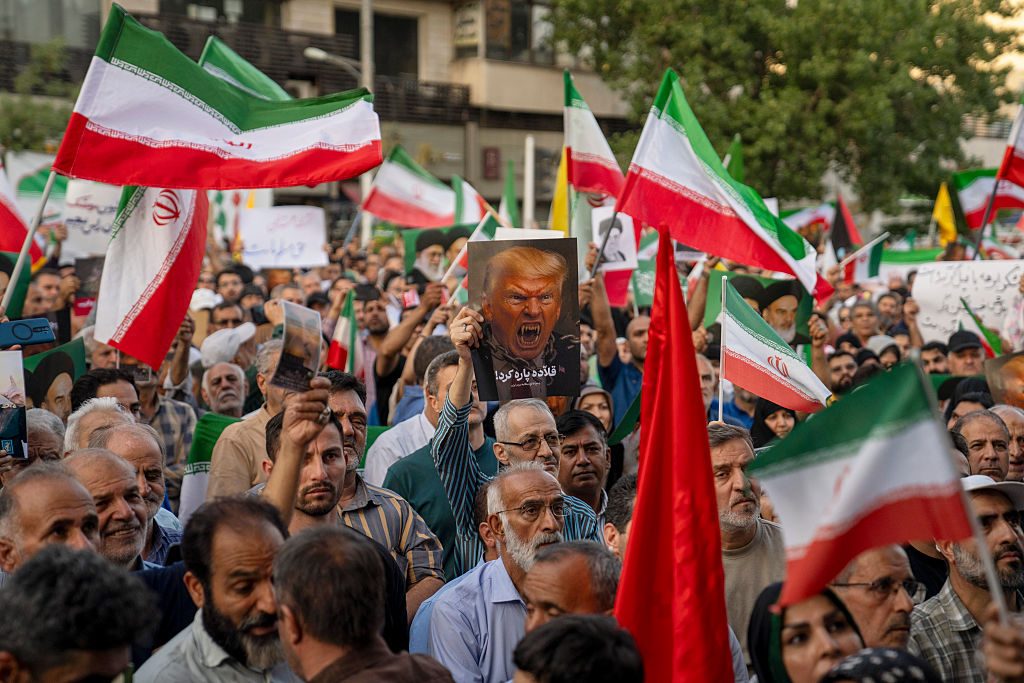
Again, the ideal scenario — a political transition on the road to a pro-US democratic government — is probably the least likely. This isn’t because the Iranian people don’t care for democracy or don’t want a better life for themselves. The nationwide anti-government protest in January was a visible illustration that they absolutely do. The Iranian opposition, however, is notoriously and historically divided against itself. Some are Marxists, others are old-school monarchists who want to resurrect the Pahlavi dynasty, and still others prefer to simply reform the current Iranian political system to make it more representative. Arriving at a coherent, unified post-Khamenei political project is like herding cats. It can theoretically be done, but it will require a degree of extended attention that Trump doesn’t have given all the other priorities on his desk.
Iran isn’t powerless to hit back against American interests. But it’s options aren’t cost-free. Neither are Trump’s.
Daniel R. DePetris is a fellow at Defense Priorities and a syndicated foreign affairs columnist for the Chicago Tribune.
 DanDePetris