









April 26 2026 - 4:00pm
In one of the most celebrated episodes of The Simpsons, Bart’s nemesis Sideshow Bob steps on nine rakes in a row. The idea of the two-minute scene was to linger on the joke long enough that it turns around to being funny again. It takes guts to commit to such a strategy, but the payoff can be enormous.
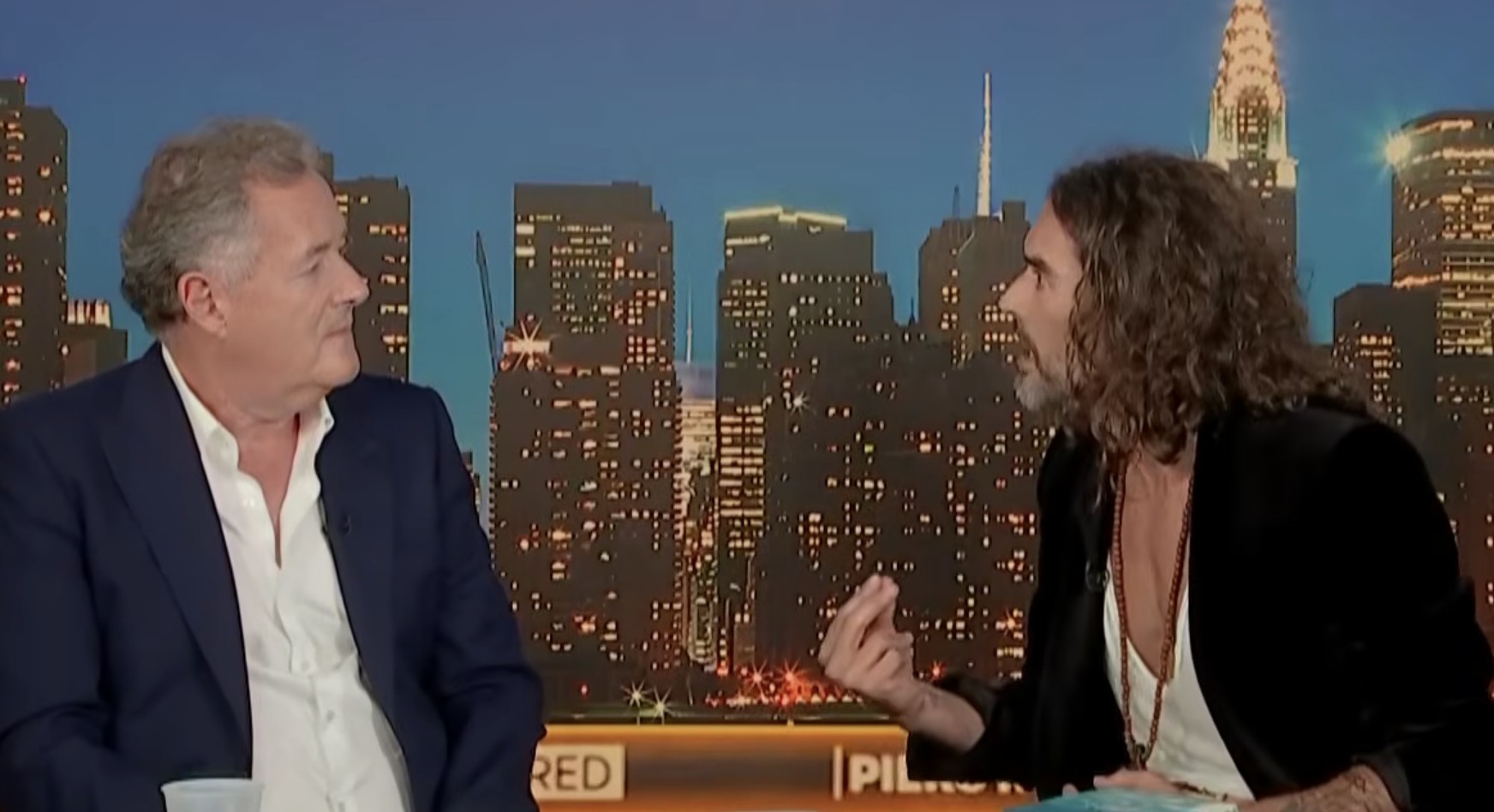
In a similar episode that went viral this weekend, for two brilliantly excruciating minutes in his interview with Piers Morgan, Russell Brand noisily flips through his Bible in search of a meaningful verse, umming and ahhing all the while. The awkwardness, the social pressure, would have gotten to most of us. But Morgan, despite his reputation for not allowing guests to get a word in edgewise, is a professional and knows exactly when to hold his tongue.
At one point in the interview, Brand claims that the old media is falling apart; the pendulum is swinging, he says, towards such cranks as David Icke and Alex Jones. Morgan is one of the few figures who’s managed to straddle both worlds, pivoting seamlessly from ITV and the Daily Mirror to the more anarchic online scene. He is a product of Fleet Street — he still speaks fondly, in the interview, about Rupert Murdoch. And yet he is in his element with the new shock jocks and rabblerousers, grilling Candace Owens and, infamously, Nick Fuentes, while most other media wouldn’t host them on a show.
In 2006, when he first interviewed Brand, Morgan was at the summit of the old media in all its laddish pomp. Much of that interview consists of Morgan needling Brand for information about his liaisons with Kate Moss. “How many?” he asks, over and over again. “How many a week at your peak?”
It is impressive that Morgan has managed to dominate the media landscape for as long as he has. His public persona has remained more or less the same. He is coarse, direct, and annoying, and he likes it that way. It is a point of pride for him that he winds people up. The tagline of Piers Morgan Uncensored is “inform, irritate, and entertain”; irritation is an indispensable part of the formula.
Part of Morgan’s shtick is that he doesn’t care what people think of him. Of course, that isn’t really true. He cares very deeply about being thought of as his own man. The one thing that seems to rankle him, in his interview with Brand, is the latter’s accusation of hypocrisy: Morgan, like the rest of the “mainstream media”, purports to be “neutral” and is anything but. “I’m not neutral!” Morgan protests. “I have a lot of opinions, and I’m not afraid to share them!” He continues, with characteristic hyperbole: “I’m probably the least neutral person on the airwaves in the world.”
Clearly, it matters to Morgan that he is perceived as opinionated and independent-minded. It matters to him that his politics are hard to pin down. The conceit of Morgan & Platell, a mid-2000s talk show, was that he was “on the Left” and Amanda Platell “on the Right”, even if it was admitted that Morgan was probably to the Right of Platell in reality. Now he thinks of himself as a kind of ascended centrist, attacking both sides in equal measure. His preferred mode, acquired in the no-holds-barred world of the British tabloids, is to be punchy, aggressive, adversarial towards anything that comes his way. Morgan has managed to be a good conduit between the old media and the new because it has given him the role he craves — a disagreeable outsider to each.
