









April 26 2026 - 1:00pm
In the end, it turned out there had never been a rape at all. The police first said that a woman in her 20s was followed on 11 April as she walked home from Labyrinth, a nightclub, in the early hours and then attacked by a group of men outside Epsom Methodist Church. Then, they said they did not have “sufficient information” to release descriptions of the suspects.
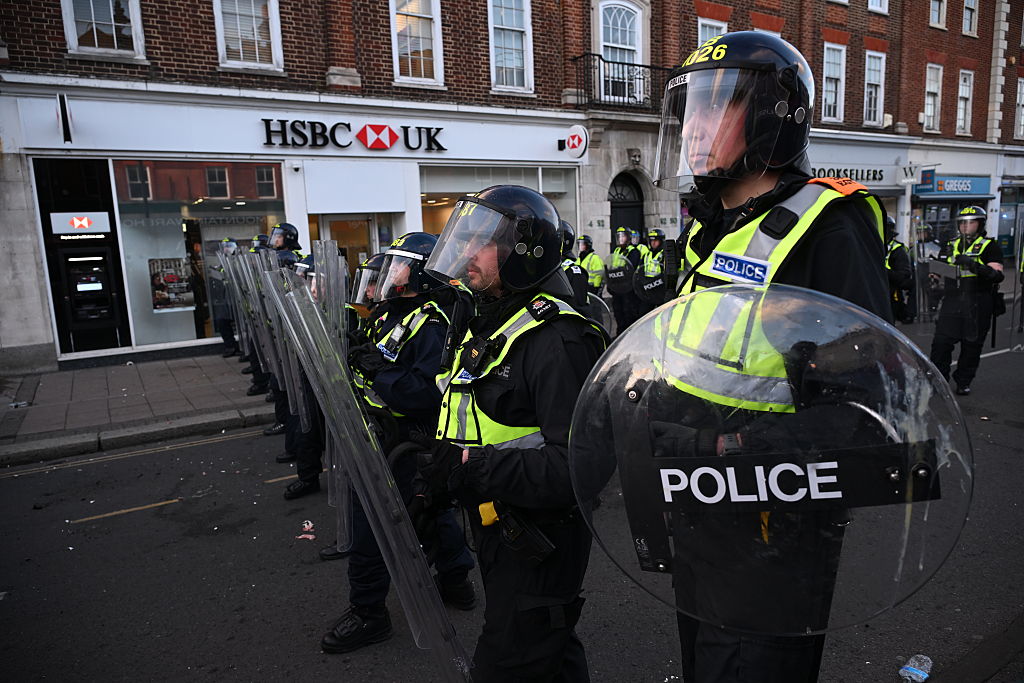
On Thursday, officers closed their investigation and revealed that no sexual offense had occurred. The woman in question had hit her head and made a “confused report” to officers. In the meantime, however, two protests had broken out in Epsom.
This was a strange inversion of last year’s disturbance in Epping. Both were located in relatively affluent towns on the outskirts of Greater London; both were sparked by the belief that an asylum seeker had committed sexual assault; and both culminated in a violent confrontation with the police. Except here, unlike in Epping, no crime had been committed. There was no asylum hotel to picket. First as tragedy, then as farce.
Demonstrators, from the town and elsewhere, seemed to have gathered simply because they did not know what had happened and therefore suspected that migrants must have been to blame, though there was no evidence that they had been. “The police need to speak to the community,” shouted a man to the crowd during the first protest, on 15 April. “If you don’t speak to the community this is what happens.”
They had been urged to turn out by Danny Tommo, a longstanding associate of Tommy Robinson, and others via a Facebook group, Epsom Says No. After the first protest, an AI-generated video of an angel flapping her wings in front of a burning Palace of Westminster was shared by Gary Davidson, who has said he lives in Bournemouth. He wrote: “With the mixed messaging coming from Epsom police, and the lessons we have now been taught by the inquiry into Southport, let there be no mistake, your lies will set this country on fire!”
A poster for the second demonstration, which took place on 20 April, was also shared by Peter Smith, the group’s admin. “We demand transparency,” it said. “We demand accountability.” The day before, he had used the group to share his own updates from the case: “Just had another account from a witness in flats nearby, girl heard screaming for her life.”
As with other asylum protests, attention surged thanks to videos shared online. Posting a clip of a house being vandalized by several boys, Robinson wrote that locals had destroyed “a suspected HMO used for housing unvetted fighting age invaders at the taxpayers expense”.
The first time I covered an asylum protest was in December 2023. It took place in Lincolnshire, where the Home Office had been trying to convert a disused RAF base into accommodation for thousands of small boat arrivals. The site had a particular resonance for locals, because the base in question — RAF Scampton — was the one from which the Dambuster raid had been launched.
At that time, Axel Rudakabana was still a schoolboy, and Hadush Kebatu was likely still in Ethiopia. It would be months before the former stabbed three girls to death and another year still until the latter sexually assaulted a teenager, sparking a national wave of protests against migration and asylum seekers.
In 2023, such demonstrations remained marginal. But the seeds of what would later develop were germinating. Local residents I spoke to insisted they were not bigoted: they were uncomfortable at the idea of men they did not know being moved into their community. Who were they, they asked me. Others unfurled baroque conspiracy theories about secret UN armies, forgotten Magna Carta clauses, and ancient civilizations wiped out by a vast flood.
At RAF Scampton, in Epping and at every other protest I have attended since, this confusion has fueled anger. It was not until August of last year that the police were encouraged to disclose the ethnicity of suspects in high-profile cases. Yvette Cooper, then home secretary, made the change after Warwickshire Police were accused of hiding the identities of two men, later revealed to be Afghan asylum seekers, who had been charged with the rape of a 12-year-old girl. (One was later convicted and the other acquitted.) In the gap between what protesters know and what they wish to know, paranoia has developed.
Even now, many refuse to accept the state’s account of events in Epsom. “After the police corruption exposed by the ‘grooming gang’ inquest, how can we trust them in these matters?” read one Telegram comment.
“This is the problem,” wrote another, in reference to the Surrey Police statement that no rape had taken place. “Our first instinct now is to say ‘they’re lying’, they are covering up because of ‘community tensions’. In this case I’m going to follow the lead of the girl who reported it.”
Writing in Epsom Says No, Nigel Rose added: “There’s a lot more of this than meets the eye! ‘If’ it never happened why is the girl not being prosecuted for wasting Police time… There is a distinct smell of it being brushed under the carpet.”
When I visited a Metropolitan Police training facility last year, officers explained that they hoped to curb future riots by fighting disinformation online. After the Southport attack, a LinkedIn post written by one local man, Eddie Murray, wrongly claimed that the perpetrator was a migrant. Though it was removed by the platform, it was copied elsewhere and viewed millions of times. An Ofcom report later concluded there was a “clear connection” between violent disorder in England and Northern Ireland and posts online.
The authorities hope that by providing more accurate information in future, they will nip disorder in the bud. While they won’t change the public’s views on migration and asylum, they hope they might be able to influence social media reaction. Still, that now seems less likely than ever.
