









February 14 2026 - 8:15am
Yesterday, the High Court ruled that Palestine Action’s proscription as a terrorist organization was unlawful. While the group remains banned for now, three judges have found that the original decision last July, which followed a sabotage attack on the RAF Brize Norton base, went too far in expanding the power to criminalize everyone affiliated with an organization, well beyond the intent of the Terrorism Act 2000.
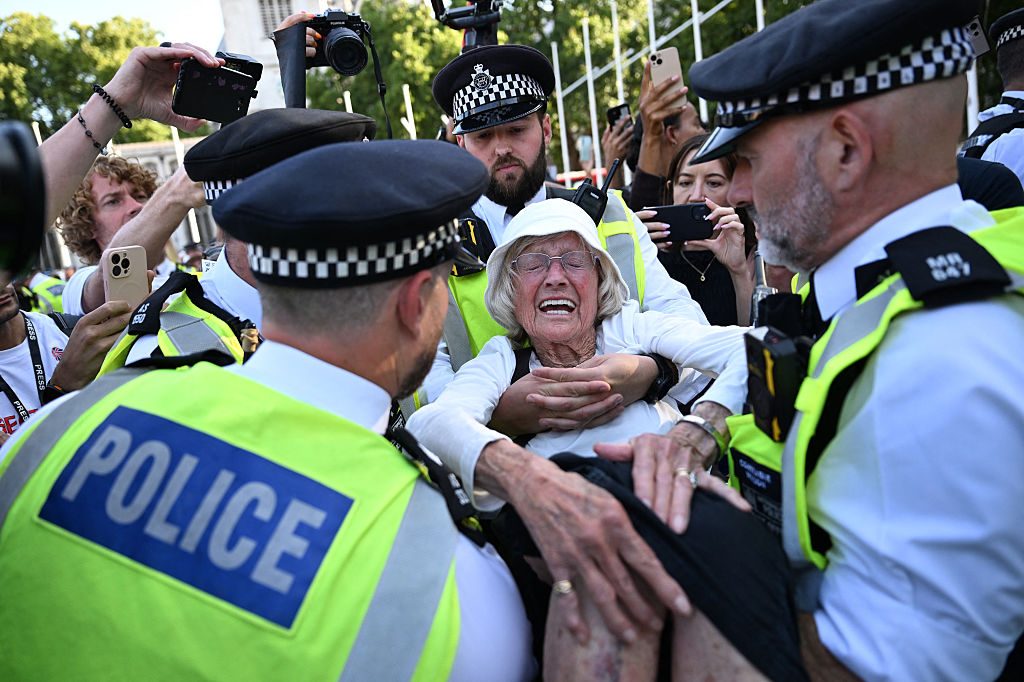
The Metropolitan Police’s response to the proscription was an exercise in confusion. Last summer saw a monthly ritual of police officers shipped in from around Britain to Parliament Square and Trafalgar Square, primed to cart off newly minted terrorist cells made up mostly of bowls players, Women’s Institute attendees and Age UK tea party organizers.
These cells, identifiable by their abundance of blue rinse and walking aids, were equipped with illegal weaponry: paper signs reading “I oppose genocide. I support Palestine Action.”
Then-Home Secretary Yvette Cooper told Parliament that Palestine Action’s activities “meet the threshold set out in the statutory tests established under the Terrorism Act 2000”, and that “this has been assessed through a robust, evidence-based process, by a wide range of experts from across Government, the police and the security services”. So there you go.
By that measure, a granny armed with a biro and some A3 paper could be prosecuted under legislation originally intended for Al-Qaeda suicide bombers. Then, yesterday, the High Court ruled that Cooper was in fact wrong.
Last July’s proscription ruling prompted a torrent of hypocrisy. It has become clear in the months since to whom the idea of liberty and freedom of speech is a fundamental cause, and to whom it is a political tool. The same people who might become apoplectic at citizens being disciplined over social media posts have been remarkably sanguine in response to thousands of pensioners facing prison time for poorly defined crimes. Many now find that the value of free speech as a concept is contingent on how annoying they find the speaker.
One does not have to endorse the vandalism perpetrated by Palestine Action supporters to understand that Cooper’s legislation was fundamentally unsound. It sets a chilling precedent for later governments to charge unrelated actions as joint enterprise, fusing terrorism and protest law in a future likely to be dominated by AI surveillance abilities few of us can currently imagine. If holding up a paper sign with a slogan on it, free of incitement, counts as terrorism, then the definition has surely been stretched too far.
Cooper’s successor as home secretary, Shabana Mahmood, has pledged to fight the ruling. For those of us who care about civil liberties, yesterday’s decision may be a battle won in a war lost.
In her white paper published in January, entitled “From Local to National: A New Model For Policing”, Mahmood lit the touchpaper on widespread police adoption of AI and live facial recognition. At the time, she spoke in glowing terms about her “dream” of creating a giant AI “panopticon” — based on the hyper-efficient form of imprisonment dreamt up by the utilitarian philosopher Jeremy Bentham, in which inmates are disciplined by the constant risk of surveillance. Mahmood said her aim was to make it possible that “the eyes of the state can be on you at all times”.
Given its previous form for fair policing and its proportionate response to social media jokes, at least we can be confident that this government would use any such powers judiciously. They certainly wouldn’t be stretched to fit whatever moment of knee-jerk panic our ministerial caste needed them to… right?