









January 25 2026 - 1:00pm
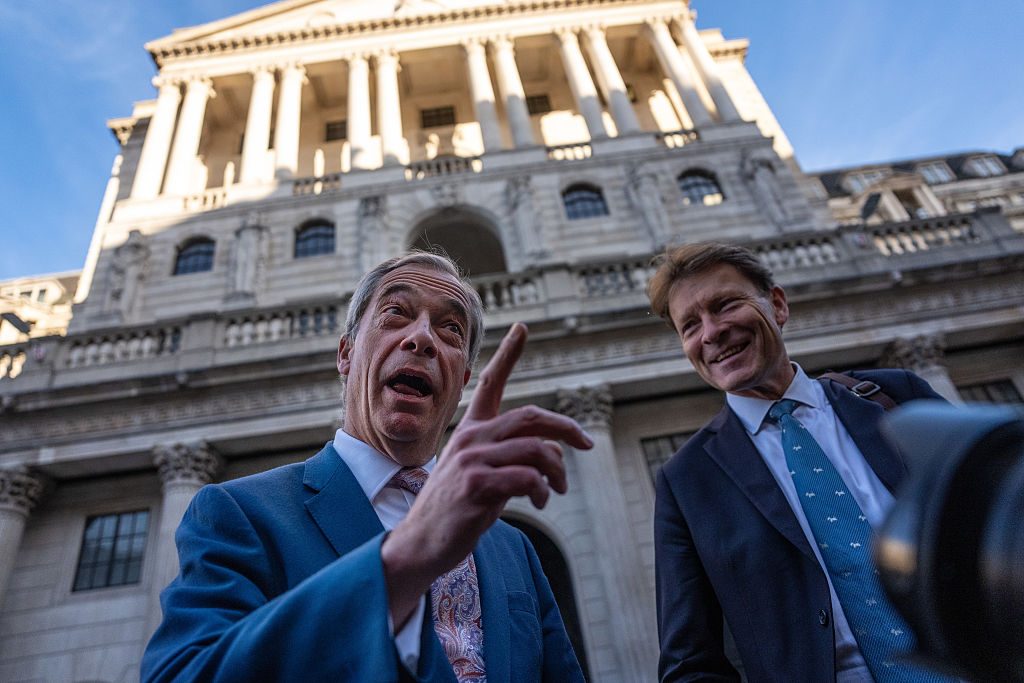
Nigel Farage has pledged to install a Brexiteer at the helm of the Bank of England if Reform UK wins power. This follows US President Donald Trump’s Justice Department opening a criminal investigation into Jerome Powell, the Federal Reserve chairman — retaliation, Powell believes, for refusing to cut interest rates. It seems that both Farage and Trump have arrived at the same conclusion: that central bank independence has outlived its usefulness. They are not entirely wrong.
When, as Chancellor, Gordon Brown granted the Bank of England operational independence in 1997, the bargain was simple: technocrats would set interest rates, free from political interference, and in return would keep inflation on target. For nearly a generation, this compact held. Inflation stayed low; governments could claim credit for stability without bearing responsibility for unpopular rate rises.
But that settlement assumed a world which is rapidly disappearing. Both the financial crisis and the pandemic revealed that when things go seriously wrong, central banks cannot remain above the fray. They become instruments of crisis management, making inherently political choices about who bears the costs of adjustment.
At Davos earlier this week, IMF head Kristalina Georgieva warned that artificial intelligence would be a “tsunami hitting the labor market”, with young people worst affected. Similarly, French President Emmanuel Macron recently argued that the ECB must “broaden its horizons beyond inflation alone”. Even Ed Balls, the architect of the 1997 compact, said several years ago that central banks could stand to “sacrifice some political independence”.
They are gesturing towards a truth which defenders of central bank orthodoxy prefer to avoid: the coming decade will force choices that monetary authorities cannot make on their own. How should the gains from automation be distributed? What does the state owe to those displaced? How should monetary policy coordinate with industrial strategy, or with the fiscal response to structural unemployment? These are political questions. The answers cannot be delegated to unelected technocrats, however competent they may be.
Farage has stumbled upon a genuine problem, if perhaps by accident. His vision of a governor who regards Brexit as “an incredible opportunity” tells us nothing about monetary policy. Likewise, Trump’s demand for rate cuts before the next election is straightforwardly self-serving. Neither man is proposing a new institutional framework, the goal being to run the economy hot while in office and leave the consequences to their successors.
But Britain is not the United States. Whereas Trump can browbeat the Federal Reserve because the dollar remains the world’s reserve currency, British gilts must still compete for global capital. A government seen to have subordinated the Bank of England to political whim would alarm bond markets and pay dearly for this mistake.
Former prime minister Liz Truss discovered this in September 2022. Her mini-Budget offered unfunded tax cuts. Days later, bond markets collapsed her government, the market functioning as a check on fiscal recklessness. One can find this outcome reassuring or alarming, but debtors are never truly sovereign.
And this, ultimately, is the constraint Farage refuses to acknowledge. You cannot “take back control” of monetary policy when your government borrows hundreds of billions each year from investors who do not vote in British elections and do not care about Brexit. Sovereignty, in this context, is not his to reclaim. The bond market has already claimed it.
What comes next is genuinely unclear — perhaps some form of enhanced coordination between the Treasury and the Bank, along the lines that worked during the postwar decades of high debt. What is clear is that the status quo cannot hold. A serious discussion is required about institutional design, about what central banking should look like in a world that no longer resembles 1997. Central banks will have to coordinate with elected governments on questions that transcend inflation targeting.
Who is making this argument? Not Labour, which treats the Bank’s independence as an article of faith. Not the Conservatives, who immolated themselves on the gilt market three years ago and have been in no position to discuss it since. The only politician willing to say the system needs rethinking is Farage.
Central bank independence was never a natural state of affairs. It was a political choice, made for particular reasons, in particular circumstances. Those circumstances have changed. The question is not whether to revisit that choice, but whether we do so thoughtfully or recklessly. On current evidence, recklessness is winning.
