









September 19 2026 - 1:00pm
There are some news stories that, if they came from the pen of a Right-wing satirist, would be considered a bit too on the nose. The revelation that on the 25th anniversary of 9/11, Sarah Mullally, the first female Archbishop of Canterbury, gave an award for interfaith work to a Muslim cleric, only to withdraw the award a week later after the cleric in question was found to have praised Osama bin Laden, is firmly in that category.
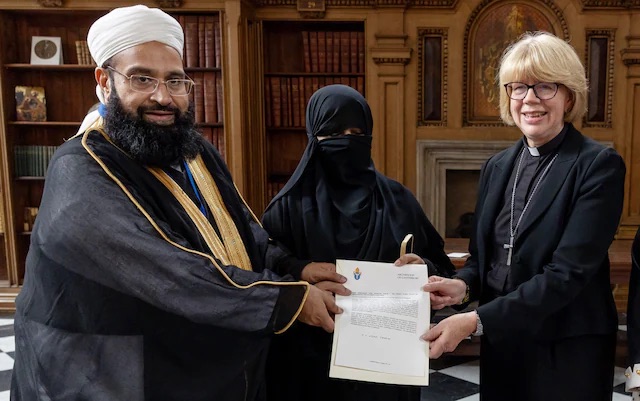
The accompanying photo, showing a somewhat uncomfortable-looking Mullally handing over the certificate next to Ashrafi’s wife, who is wearing a niqab, is unavoidably redolent of a kind of cringing liberalism. There is a whiff of hypocrisy in the air, given Mullally’s professed commitment to “combating misogyny”.
Interfaith dialog and cooperation are a necessity in a religiously diverse country such as modern Britain. That is especially the case when it comes to Christianity and Islam — by far the two most widely practiced religions in the UK. St Paul himself told Christians: “If it is possible, as much as it depends on you, live peaceably with all men.”
Problems start to arise when the dialog is a one-way street, when the admirable instinct to maintain civil peace and an atmosphere of tolerant pluralism mutates — on the Christian side, at least — into a habit of self-abnegation. We see this, for example, in the growing trend for churches and cathedrals to host iftar ceremonies during Ramadan. This is defended as simple neighborliness, but the iftar is not merely a shared meal or an opportunity for community conviviality. It is a specifically religious ceremony.
The accompanying prayer, the Adhan, incorporates the Shahada, one of the most important credal statements in Islam, naming Muhammad as God’s messenger and directly attacking the doctrine of the Trinity. There seem to be very few examples of mosques allowing Christian liturgies or devotions to take place — and quite right, too. Presumably, Muslims would not want the elegant and austere purity of their faith dissolved into a syncretic mush, to make it more congenial to modern Westerners.
Contemporary liberal-minded Christians — who tend to flatten the spiky and uncomfortable parts of the faith into metaphor, allusion and poetry — sometimes have a hard time grasping that many adherents of other religions do not see their own belief systems in the same way.
For the Church of England in particular, there is also the difficulty that by its very nature, it tends to reflect the culture and the priorities of the educated English middle class. As a result, interfaith work, especially the kind which tends to downplay Christian distinctives in the service of a woolly can’t-we-all-just-get-along universalism, easily becomes an adjunct to the essentially political projects favored by that class: multiculturalism, the DEI regime, and an insistently liberal approach to controversies around immigration and identity.
In this politicized view of Christianity, a reflexive anti-conservatism dominates. Giving an award to an imam with robust views, and not bothering with any due diligence on his past statements, is considered commendable — at least in part — because it is one in the eye for Nigel Farage and Rupert Lowe. The same goes for not making any meaningful criticisms of Islamic attitudes to women, and passing over in polite silence the alarming ambivalence of a significant minority of Muslims towards religiously-motivated violence, and their belief in antisemitic conspiracy theories. To do so is to give succor to hate, or Islamophobia, and is therefore verboten.
So by all means let Christians attempt to live in peace with everyone else. But that should not result in relentless self-effacement and a refusal to raise uncomfortable issues.
