







 Prefer us on Google

September 8 2026 - 1:00pm
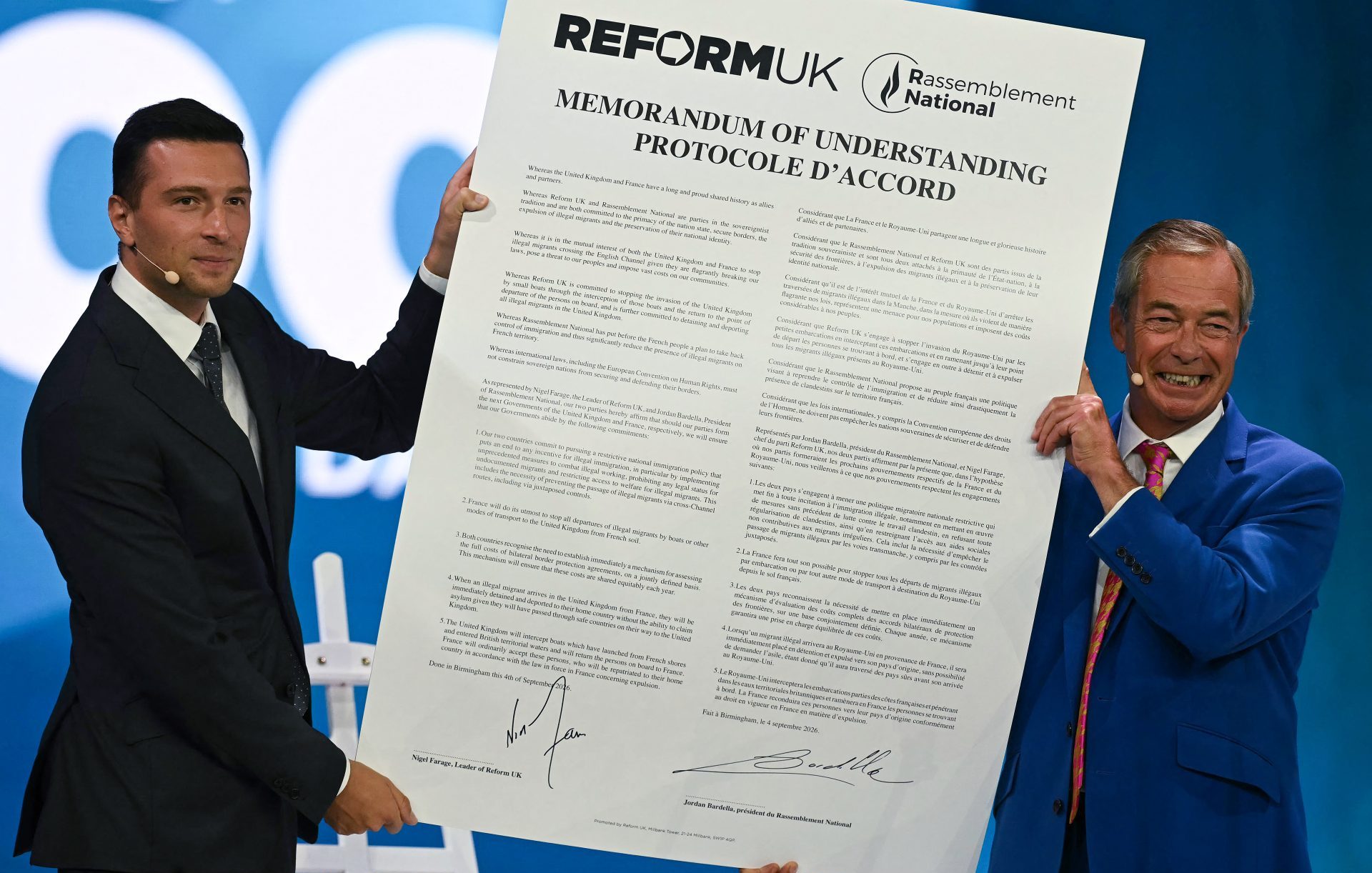
For a non-binding agreement that does little more than further the status quo of migrant crackdowns in the English Channel, there was probably no need for the grandiose, large-format poster laying out the “memorandum of understanding” between the British and French Right. At last week’s Reform UK conference, Nigel Farage and the Rassemblement National’s Jordan Bardella unveiled an agreement on how their parties would police small-boats migration in the Channel, long a point of tension between London and Paris. Most notably, the deal commits a potential RN government to accepting the return of migrants arrested in British territorial waters, before their final expulsion from France.
The Reform-RN deal is hardly a breakthrough. Short on specifics, it is predicated on numerous conditionals, including the not-so-small stipulation that the two parties hold power at the same time. For Bardella, the RN’s president, the rapprochement with Farage was no doubt supposed to stand as an example of the more cooperative, pan-European nationalism that he has tried to cultivate in the shadow of the party’s unquestioned powerbroker, Marine Le Pen. The 30-year-old Bardella, who assumed party leadership in 2022, has vied to present the RN as an amenable governing force. His inspiration is often said to be Italy’s Giorgia Meloni, who has won plaudits from mainline conservatives and Europe’s governing elites.
Back in France, however, the “memorandum of understanding” received widespread condemnation, as figures from across the political spectrum denounced it as the groundwork for French capitulation on the Channel question. Part of the uproar is over a discrepancy in translation between the French and English versions: the latter includes the stipulation that France will “ordinarily accept” migrants arrested in British waters before returning them to their home countries, the meaning of which is left unclear and is not included in the French version. Presidential candidate and former Emmanuel Macron premier Gabriel Attal denounced Bardella’s “total submission” to Farage. “Is our country to become the gatekeeper for the English? Not voting for Le Pen in 2027 is becoming a matter of national dignity,” replied the Left’s presidential frontrunner Jean-Luc Mélenchon.
Bardella has specified that the agreement would ultimately be of little burden to the French state given that it would be obviated by a steep decline in migrants entering France in the first place. Speaking on Saturday, he said that quite simply “there will be no more migrants who will be crossing the Channel”— and therefore no returns to French soil, a line rehashed by RN spokespeople who for now are rallying behind him.
Still, there are grounds to wonder, as presidential candidate and Macron’s first prime minister Édouard Philippe has speculated, whether Le Pen and the broader RN are really in full support. “I’ll discuss [this agreement] when I’ve decided to do so,” a laconic Le Pen told reporters with France Télévisions in a snippet aired on Monday evening.
Bardella is already reeling from a summer of political setbacks, as he finds himself increasingly marginalized within his own party. Cracks in his meteoric rise started to show in early July, when the Paris Court of Appeal struck down Le Pen’s ineligibility to run in the 2027 presidential elections, bringing an end to the growing assumption that her lieutenant would take up the party mantle.
That surprise decision, over Le Pen’s 2025 conviction in an EU parliament embezzlement scandal, is restoring the RN old guard. Bardella’s authority, conversely, has been noticeably eroding since, as he faces mounting pushback on a number of issues from support for Ukraine to his attempt to encourage a more traditional pro-business economic stance. In late August, Le Pen pushed out François Durvye, Bardella’s economics whisperer and an advocate for unapologetic public austerity on pensions. She has since reaffirmed her support for retirement at 62 or even 60.
Bardella may want to turn the RN into a more conventional Right-wing force. But if the last few months have revealed anything, it is the limits of his control over the party of which he is technically leader. Farage also might want to be wary of placing too much faith in his French friends.