









March 7 2026 - 8:00am
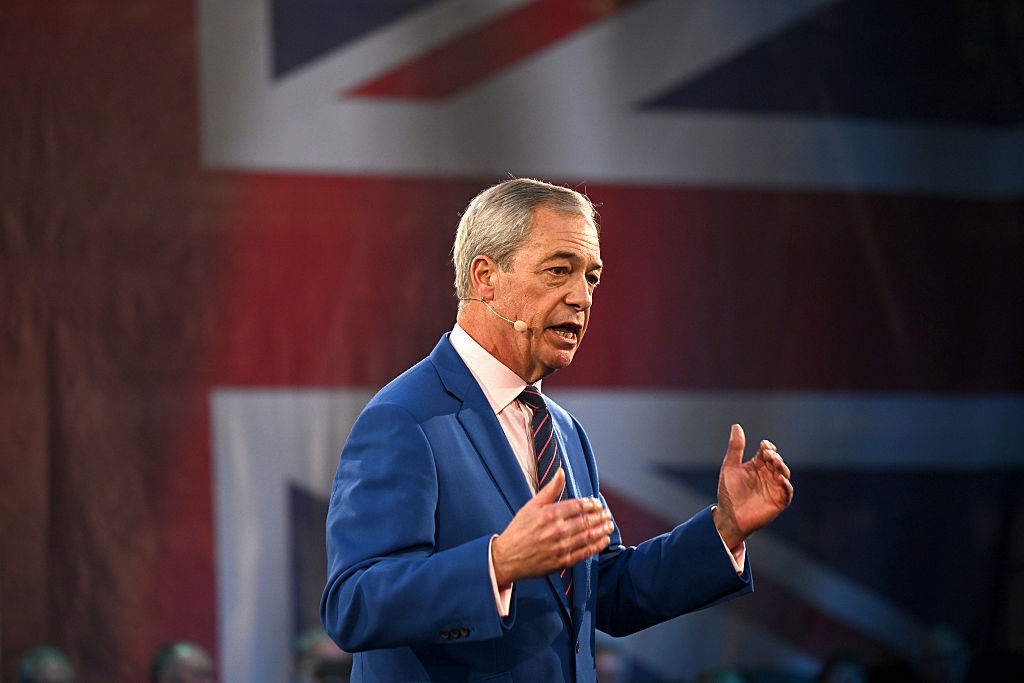
Keir Starmer has been the target of criticism for a string of recent policy U-turns, including his initial support for and then retreat from Donald Trump’s new war on Iran. Yet the Prime Minister is not alone in making dramatic reversals in response to a new conflict in the Middle East. The party currently riding highest in the polls, Nigel Farage’s Reform UK, has also broken with its leader’s previous record on foreign policy by coming out in favor of Trump’s latest military intervention.
Snapping a long chain of skepticism about militaristic foreign policy, Farage has criticized Starmer for his alleged inaction, calling the Labour government’s response “pathetic”. His fellow Reform parliamentarians have gone further. Farage’s deputy Richard Tice spoke earlier this week at a rally of Iranian exiles outside Parliament, calling for regime change to restore the Iranian monarchy. Suella Braverman, Reform’s education spokesperson, has said that Britain has imperiled its “special relationship” with the US by refusing to join Trump’s war on the Islamic Republic. What accounts for the change?
Right-populists across Europe, including Farage’s earlier Ukip and Brexit parties, were long obstructed by the electoral firewalls of the established political parties. These insurgents then carried their approach over to foreign policy, criticizing the forever wars of the era of globalization in what seemed an easy fit for their oppositional stance. On the one hand, the Left was committed to defending human rights; on the other, the established Right was committed to the military defense and extension of economic globalization.
In opposing this overlapping consensus, the populist Right could make the case for voters left behind by the elite concern for governing distant lands. This was as true of Britain’s Faragists as it was of Trump. Farage suggested in 2024 that Nato baited Russia into invading Ukraine. He has urged concessions from both Kyiv and Moscow to ensure a negotiated peace deal, and was skeptical of Western adventures in the Middle East, stating his “total opposition” to the 2003 intervention in Iraq and the 2011 Nato campaign against Libya. Over a decade ago, Farage observed that “in almost every country in which the West has intervened or even implied support for regime change, the situation has been made worse and not better.” He added: “This is true of Libya, Syria and of course Iraq.” Why would this not be the case in Iran?
On Iran, Farage has claimed that it is the Islamic Republic’s support for the Hamas attack on Israel on 7 October 2023 that makes this conflict different from the benighted 2003-11 war on Iraq. He argues that terrorism funded by Iran has fundamentally changed Britain since the start of the Gaza War, and that stopping Tehran securing nuclear weapons is worth the military effort. Yet it is unclear which specific acts of Iranian-supported anti-British terror from the past couple of years Farage has in mind. His new support for interventionism allows insurgent parties to the Right of Reform to seize the territory of anti-war opposition, while at the same time giving the otherwise hapless Starmer an opportunity to posture as a restrained and sober statesman.
The risks for Reform are considerable: in following Trump’s embrace of forever war, Farage risks being held responsible for the political consequences of the conflict, such as spiraling energy costs and a new refugee crisis. Simultaneously, he has no influence or claim over the actual conduct and outcome of the war. Having squandered the national independence that he championed for so long and so assiduously against Brussels, Farage’s loyalty to Washington risks undercutting the entirety of British Right-populism.
Philip Cunliffe is Associate Professor of International Relations at the Department of Risk and Disaster Reduction, University College London. He is the author of seven books, including, most recently: The National Interest: Politics after Globalization.
 thephilippics