









March 10 2026 - 1:00pm
Germany’s Alternative für Deutschland (AfD) has a complicated relationship with Donald Trump. While latent anti-Americanism runs through its ideology, the hard-Right party considers the MAGA movement a force for good. US military strikes against Iran are bringing this conflict to a head, forcing the AfD to rethink its ties to Trump’s America.
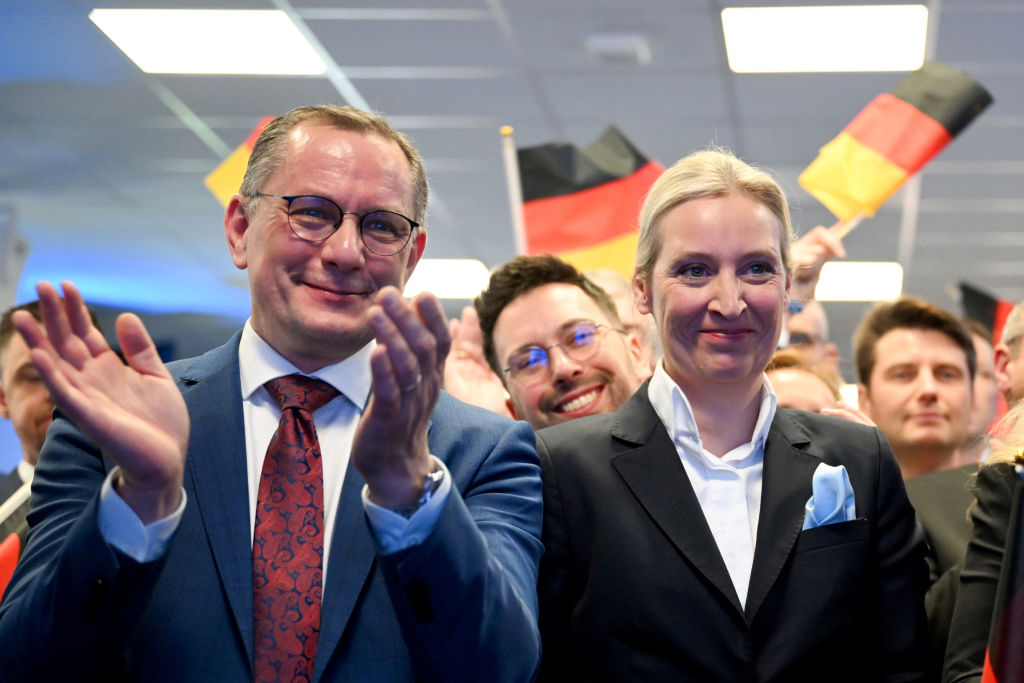
The AfD’s response to the war in Iran was stark. Co-leaders Alice Weidel and Tino Chrupalla issued a statement on the first day of strikes, declaring that the “renewed destabilization of the Middle East is not in the German interest and must end”. In a TV interview several days later, Chrupalla attacked the US President directly. “Donald Trump started off as a peace president,” he said. “He will end up as a president of war.”
It’s not the first time the AfD has been sharply critical of US foreign policy. In January, the party leadership condemned American aggression in Venezuela and Greenland. Weidel said that “Donald Trump has broken a fundamental election promise, namely not to interfere with other states.” Chrupalla spoke of “Wild West methods”. The estrangement between the AfD and the Trump administration is well underway.
And yet it’s not so long ago that the AfD was keen to subdue its anti-American instincts in favor of building an alliance with the MAGA movement. Vice President JD Vance has repeatedly expressed support for the AfD, and party representatives were invited to the White House. The new US National Security Strategy called for a “cultivation of resistance to Europe’s current trajectory within European nations”. AfD foreign policy spokesman Markus Frohnmaier welcomed this as tacit support for his party, confirming that “the AfD is fighting alongside its international friends for a conservative renaissance.”
Many, including Frohnmaier, consider US support a kind of life insurance policy for the party. The threat of an AfD ban is real. One of the two parties in the ruling coalition, the center-left SPD, has even passed a motion calling for the initiation of legal proceedings towards a ban. The AfD harbored hopes that if it came to that, the Trump administration might intervene, perhaps with economic sanctions.
Frohnmaier, who spends a lot of time in the US networking with Republicans, wants to continue this strategy irrespective of recent developments. He published his own Iran statement on the AfD website, saying: “the Trump administration has acted with surgical precision and clear aims.” Chrupalla openly rejected this, telling German media that “one can certainly question how surgical warfare is when you hit an Iranian girls’ school, killing 120.” (Western reporting since then has put the casualty figure as high as 160.)
This internal rift on AfD-Trump relations escalated quickly. In an online chat group of AfD parliamentarians, an acrimonious debate reportedly broke out over the Iranian question. One MP is said to have demanded that “the foreign political baseline” of the party finally be hammered out. But this is exactly the problem: the AfD has no uniform position on external matters.
In the party’s stronghold of the former East Germany, there is widespread anti-American sentiment. Citizens want closer relations with Moscow and a restoration of gas imports from Russia to lower energy prices. In the West, a transatlantic outlook is part of the DNA of Right-wing politics. The AfD has long tried to concentrate on the domestic issues which drive its growth: immigration and the economy. But Iran has revealed a crack that’s increasingly difficult to paper over.
Many AfD voters are not only US-skeptic in general, but hostile to Trump specifically. The latter point also applies to most Germans. A recent YouGov survey on Western European countries found that while all were overwhelmingly critical of Trump, Germans stood out. Only 10% of its citizens had a positive attitude towards him. Another survey indicated that most Germans condemn the attacks on Iran and Venezuela. There is no electoral gain to be had from endorsing Trump.
In addition, a recent court ruling has issued a temporary injunction to stop Germany’s domestic intelligence service from classifying the AfD as “Right-wing extremist” until the final ruling settles the matter. Weidel celebrates this as “a major victory” because the label is seen as a crucial legal step towards a party ban. AfD leaders may now feel they’ve stepped back from the brink of organizational extinction and don’t need US backing anymore.
Either way, Iran has forced the AfD to confront a question that goes right to the soul of the party: what is its relationship to America? To prevent this internal rift from causing electoral damage, the AfD may well decide to shift its stance further away from Washington and towards a position that most of its supporters can agree on: Germany First.
Katja Hoyer is a German-British historian and writer. Her latest book Weimar: Life on the Edge of Catastrophe will be released in May 2026.
 hoyer_kat