









January 24 2026 - 8:00am
If America is the brash upstart, Europe is, by comparison, an Old World grande dame. Bejeweled, cultured and still retaining much of her former hauteur, she is nonetheless forced to trade on past glories and unable to move at the pace she once did. And, like all ladies over a certain age, she does not care to have her fragility mentioned in public.
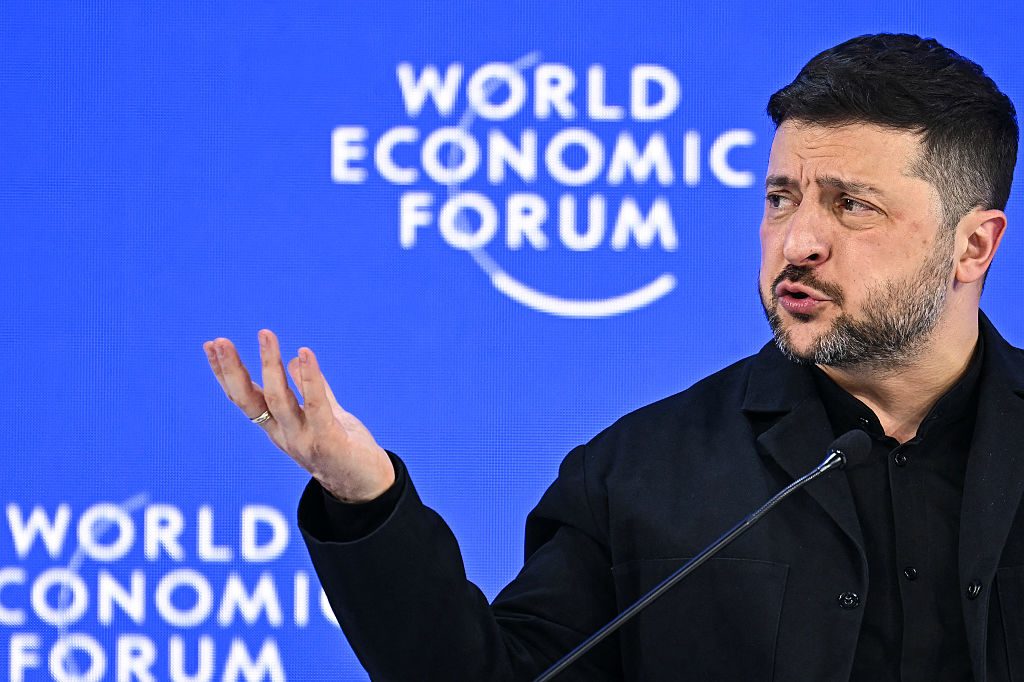
Yet that is exactly what Volodymyr Zelensky did yesterday at the World Economic Forum in Davos. The continent is, the Ukrainian President bristled, at risk of remaining “a salad of small and middle powers, seasoned with enemies”. Meanwhile, he claimed, working with Europe has become so mind-numbingly repetitive and fruitless as to resemble the film Groundhog Day. Although Zelensky may have ostensibly been fulminating against European disunity, passivity and indecision, the true cause of his ire was revealed by his complaint that “everyone turned attention to Greenland” and associated criticism of the mission dispatched to the island.
Attention is drifting from Ukraine even as its people freeze under Moscow’s bombardment. At the same time, European leaders have shown they are capable of standing up to Donald Trump over Greenland, while opting instead to coax and placate him on Ukraine. To Zelensky, they stood firm to defend the survival of Nato but have balked when his own people are concerned.
Why else is he upset with European allies? Perhaps because he suspects they may be his only defenders before long. After Trump’s re-election, the continent deftly switched from supporting Kyiv for “as long as it takes” to thanking the US President for ending the conflict. Ukraine realizes that Vladimir Putin is in no hurry to end this war, and that Trump is reluctant to take the substantive action which would force the Russian President to the negotiating table. Zelensky needs to know not only if Europe could support him in the event of US abandonment but if it would. In that case, what would be an acceptable final settlement from the continent’s perspective?
A difficult conversation about the future is, however, an entry-level ask from Zelensky. For someone who has so eagerly assumed the mantle of defender of democracy, he showed striking impatience with its day-to-day realities, griping about Europe’s “endless internal arguments” and how “leaders, parties, movements and communities turn against each other”. He further derided the continent as a “fragmented kaleidoscope of small and middle powers”. That is less a flaw than a fact. It is a collection of states with divergent politics and interests, a situation that will persist unless those countries rapidly dissolve more of their sovereignty than their publics would tolerate.
Across a sprawling geopolitical wish list, Zelensky further demanded that Europe create unified armed forces, establish a Special Tribunal on Russia, tighten sanctions, halt Taiwan’s components to Moscow, support Iranian protesters, “scare bad actors”, assist with strikes on Russian factories and — retrospectively — that it should have helped overthrow Belarusian dictator Aleksandr Lukashenko in 2020. All of this, moreover, was framed as Europe’s responsibility regardless of the position of the United States, the very power underwriting the continent’s security.
European armies are undermanned and underfunded, while only two possess nuclear weapons and one of those relies on American support. Such issues take years to resolve, yet Zelensky expressed disappointment at how little progress had been made in one. When the bar is set this unrealistically high, is the Ukrainian leader rallying Europe for success or setting it up for inevitable failure?
Perhaps Zelensky needs a scapegoat for difficulties in the war and ensuing negotiations. See how he praised Trump’s decisiveness in Venezuela and “effective” US sanctions. There was criticism of European but not American inaction over a Special Tribunal. Even Trump’s intransigence was the fault of the continent because “he will not listen to this kind of Europe”.
Such is Europe’s vulnerability that it has now been attacked by Ukraine. While criticizing Trump would provoke a visceral reaction, Zelensky knows that most European leaders will not fight back. It would only upset their domestic populations and delight Putin. He even admitted how much the continent had done for Kyiv, from the Coalition of the Willing to air defense missiles, increased defense spending and rebuilding Ukraine’s shattered energy system. But still it is his “Groundhog Day” scapegoat, in part because he knows this criticism plays well in the US. Though framed as a call to empower the continent, this address was a sign not of Zelensky’s need for Europe to be strong but of his need for it to be weak.
