









Nov 1 2026 - 6:45pm
Going off current polling, the Democrats appear to be coasting towards a healthy victory in the midterm elections. Nate Silver puts the party’s odds of regaining the Senate at 79% and a 54-46 majority is not inconceivable, according to some estimates. So what could possibly go wrong?
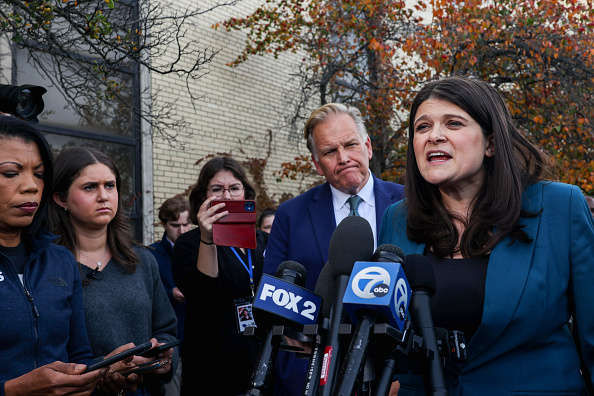
Today, centrist congresswoman Haley Stevens, who lost the Democratic Senate primary for the state to Abdul El-Sayed, endorsed his Republican opponent Mike Rogers. Stevens had endorsed El-Sayed after the primary and was slated to appear in a campaign function alongside him on Sunday. Yet in a statement posted online on Friday, she demanded that he disown the content of a controversial PAC ad linking the high price of groceries to US support for Israel’s military, alongside an array of other requests. Her fiancé, Jason Turkish, announced his support for Rogers earlier in the week, and Stevens has now followed.
Before her endorsement of Rogers, El-Sayed chastised Stevens for “relitigating a primary that ended three months ago”, accusing her over the weekend of undermining his campaign. Other Democratic figures, who really just want to win the midterms, are dumbfounded by the dust-up. Congresswoman Debbie Dingell, who had assiduously tried to broker the unity event, admitted: “This isn’t working.” Mallory McMorrow, who also ran in the Democratic primary, said on CNN: “I have no idea what the hell Haley Stevens is doing. This is a moment where we have to recognize the stakes.”
Some of Stevens’s qualms are understandable. The ad in question is sponsored by Cenk Uygur, the founder of The Young Turks news program and incidentally the uncle of ultra-popular streamer Hasan Piker. It really is remarkably tasteless. A man in a supermarket is buying groceries for his kids, and his partner tells him that he has to put the eggs back. “We have to set that $7 aside for killing Palestinians,” she tells him. The two go on to complain about US foreign aid paying for Israel’s universal healthcare.
While El-Sayed distanced himself from the ad, it still connects to some of the major talking points of his campaign. “I don’t pay my taxes thinking: man, I can’t wait for Israel to get another tank,” he said in July. During the primary, some of his campaign rallies featured Piker, who has called Orthodox Jews “inbred”, referred to Israel as “Jewish Isis”, and described Hamas as “a thousand times better” than Israel.
El-Sayed has been far more temperate. But, in a March video statement following a terror attack against a synagogue in West Bloomfield in Michigan, he moved the conversation back to Israel, saying of the attacker’s motivations that “hurt people hurt people”. In April he characterized the Israeli government as being as evil as Hamas. And in July he said: “I don’t believe in ethno-states and I don’t believe that our country is responsible to sustain ethno-states.”
What makes this complicated is that El-Sayed would seem, in many ways, to be the ideal candidate for a new generation of Democrats. He is a Rhodes Scholar and former college athlete, a doctor who worked as an epidemiologist overseeing tough public-health challenges in Detroit and Wayne County. After his college commencement address, Bill Clinton encouraged him to pursue a career in politics. He is well-spoken and has that “Senate sheen” to him.
The issue clearly goes beyond El-Sayed. In his case, he could have been more aggressive in distancing himself from campaign surrogates but, simply put, Democrats are not ready for the civil war that seems to be breaking out in the party over Israel. There is something poignant about Stevens — such a team player that she organized an event for Joe Biden on the morning of 21 July 2024 and, when he dropped out that day, held an event for Kamala Harris in the evening — suddenly forgetting about party discipline. “I am the weirdest loser in this country,” she acknowledged on CNN. But that’s what internecine conflict looks like.
Democrats still have enough of a tailwind that they may be able to withstand this explosive split. El-Sayed is several points ahead of Rogers. A new coalition arrangement in Israel may result in less aggressive policy than occurred under the latest Netanyahu administration, which may in turn dial down the anti-Israel rhetoric on Israel among American Leftists. But, unless something drastically changes, Democrats are going to keep hitting the same iceberg — and, as likely as not, at the worst possible time.