









July 7 2026 - 2:15pm
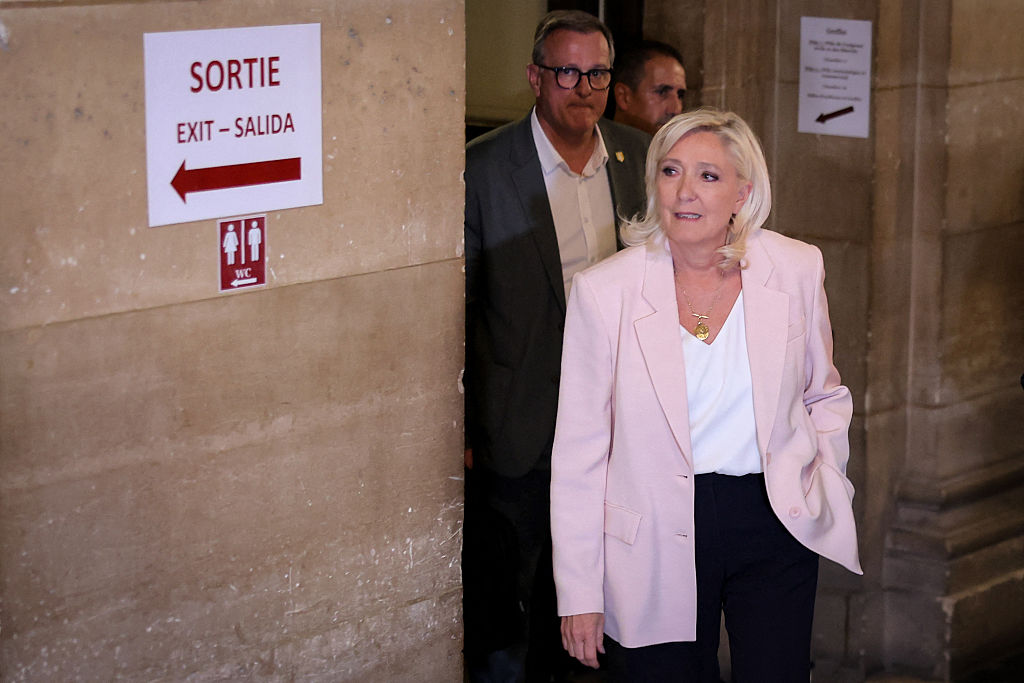
France’s appeals court has this afternoon found Marine Le Pen guilty of misappropriation of public funds and sentenced her to three years in prison, including two suspended years and one to be served with an electronic bracelet. But perhaps more consequentially, Le Pen faces a 45-month ban on standing for election, with 30 months suspended, technically allowing her to campaign for the presidency with an electronic bracelet.
The trial found that, between 2004 and 2016, Le Pen and 24 other members of the National Front (later renamed the National Rally) operated a scheme to divert European Parliament funds intended for parliamentary assistants. The money was instead funneled back to the party’s French headquarters.
This ruling will come as a surprise, as the initial trial verdict effectively barred her from standing in the presidential election. Le Pen is expected to clarify her intentions this evening, but a campaign conducted while wearing an electronic bracelet would be both logistically challenging and politically damaging. She had previously said she would not seek office under such circumstances.
She has spent the last year anticipating that blow. Last month, when asked to speculate on the verdict, Le Pen stated: “We’ll see… the most important thing is that [our] ideas are defended, and defended by a good person.” And that “good person” is her political heir, Jordan Bardella. In other words: The Queen is dead, long live the King!
This trial both symbolizes and hastens the next transformation of the RN. The party that siphoned off funds between 2004 and 2016 was chronically short of money and scrambling for questionable foreign funding. A marginal force in French politics at the time, it was still weighed down by the legacy of Jean-Marie Le Pen, the founder of the National Front, whose career was defined by repeated racist controversies.
The political movement that Bardella is inheriting is a completely different beast. It has held two consecutive runoffs in the presidential election, and it now boasts the largest parliamentary group in the National Assembly. With those electoral successes came a considerable influx of public funding, demonstrated by the party’s new five-story HQ in the chic 16th arrondissement of Paris. As for the party’s image, poll after poll has shown that voters have gradually come to accept it as a mainstream political force — a transformation helped by La France Insoumise taking on the role of the country’s most polarizing and controversial party.
Most importantly, Le Pen’s decade-long detoxification campaign has produced a new generation of smooth nationalist leaders. While the party still has trouble finding presentable candidates across the country, its front bench is now largely populated by men and women who act like normal politicians. In that context, Bardella is Le Pen’s greatest success.
The 30-year-old Bardella has been among the frontrunners for the 2027 presidential election for months. One of France’s most popular politicians, he consistently leads many polls and often performs strongly in projected run-offs against centrist rivals. Bardella also resembles the version of Emmanuel Macron who won the presidency in 2017: voters can project their own hopes onto a relatively blank canvas. The question is whether he can withstand a grueling presidential campaign. Le Pen often underperformed her polling numbers but repeatedly showed remarkable political resilience.
As for Le Pen, it remains to be seen what her political future looks like. She ruled out serving as Bardella’s prime minister — something she floated previously. She could still run for the presidency in 2032 at the age of 63, but that prospect would look far less likely if Bardella wins in 2027. She remains a powerful figure within the National Rally and could become a thorn in Bardella’s side, especially as policy differences over the economy begin to emerge. For now, however, she appears content to hand the mantle to her protégé.
François Valentin is a political analyst and co-host of the Uncommon Decency podcast.
 Valen10Francois