









July 1 2026 - 6:00pm
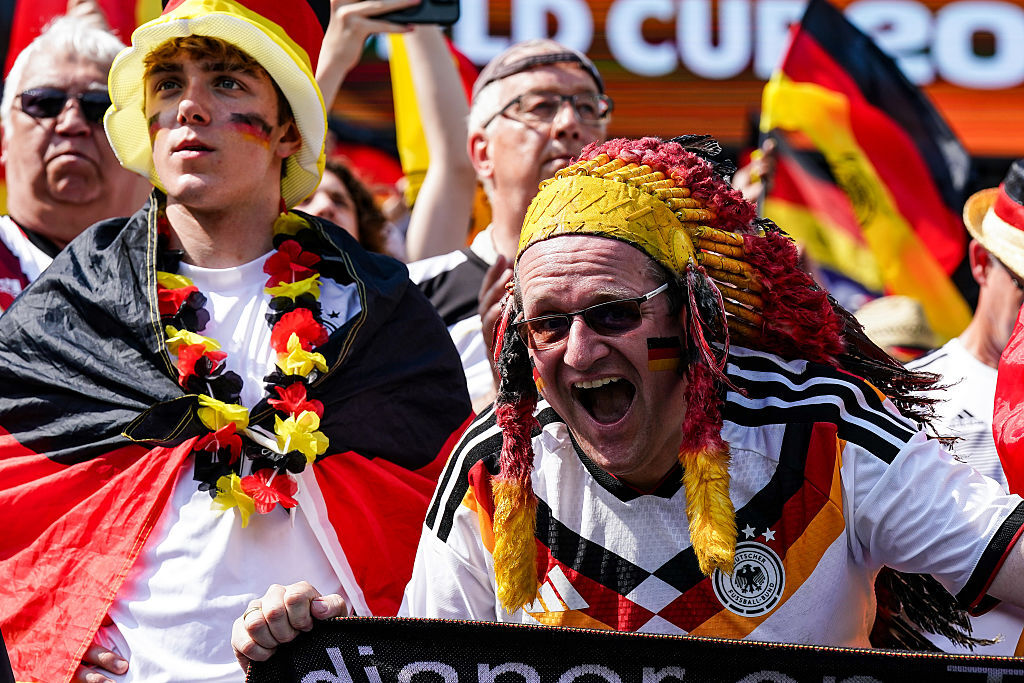
For a few glorious weeks, Americans had everything they wanted a foreign tourist to be: awestruck, innocent, and grateful. His name was Freddy — @FreddyLA7 on X — an anonymous German football fan who was touring America for the World Cup with his mates. His viral ascent began around a pre-tournament friendly at Auburn’s Jordan-Hare Stadium, which he called “the craziest stadium I’ve ever been to”. He then posted wide-eyed dispatches from Taco Bell (“the Holy Land,” he called it), Buc-ee’s, Bass Pro Shops, and the other lowbrow cathedrals of contemporary Americana.
Freddy’s appeal had a faint whiff of Yakov Smirnoff’s old “What a country!” routine, only translated from Reagan-era stand-up comic to contemporary World Cup tourist. Smirnoff made American abundance feel comic and miraculous against the gray backdrop of the late Cold War-era Soviet Union. Freddy did something similar for a more insecure America: he made ordinary stadiums, fast food, and interstate sprawl seem somehow wondrous. Soon, he was given free hotel rooms by J.J. Watt and Gordon Ramsay, met country singer Ella Langley, and FaceTimed astronauts. It was, by the debased standards of the platform formerly known as Twitter, wholesome.
But this week, the feel-good story of the summer came crashing down. Germany lost their knockout round game to Paraguay in excruciating fashion, and within a day, Freddy had deleted his X account. In a subsequent post on Instagram, Freddy claimed that he had always intended to delete his account after Germany exited the World Cup, and added that “too many people have a problem with us genuinely having a good time”.
The trigger for his exit, it turned out, was a 2022 tweet unearthed by a college-football newsletter writer named David Covucci, in which Freddy defended white people singing along to the N-word in rap lyrics. Once that tweet hit two million views, the wider digging-up operation began: old posts fawning over Saudi Arabia in language identical to his American gushing, and inconsistencies in his supposed Ronaldo superfandom. Within hours, the German naif who’d charmed a jaded country had been reclassified as a marketing plant, a psy-op, or simply a fraud.
If this all feels familiar, that’s because it is. This is a case of Milkshake Duck — a term coined to describe the now-familiar arc of a figure becoming briefly beloved by the internet, only to have their reputation come crashing down after old and unsettling posts resurface almost immediately. It described a mid-2010s pathology, when the online mob’s appetite for wholesome virality was matched only by its appetite for tearing that virality down, usually within the same news cycle.
In the old days, the betrayal was that the internet’s lovable main character turned out to be less lovable than advertised. Now, internet users have trouble trusting the main character in the first place. He had to be an op, a tourism-board psyop, a gambling-market activation or a brand-safe hallucination conjured by the engagement economy.
This suspicion was not totally irrational. In the age of AI, nothing feels real, and everything that isn’t audit-proof is up for suspicion. But the theories were mostly wrong, Covucci’s own reporting suggests Freddy is simply a guy who got lucky and did some dumb or careless stuff. So Freddy’s hero-to-zero arc is somehow more depressing than the original. The 2010s gave us the quick joy-to-cancellation cycle. The 2020s added a preemptive conspiracy spiral on top of it.
