









January 21 2026 - 7:45pm
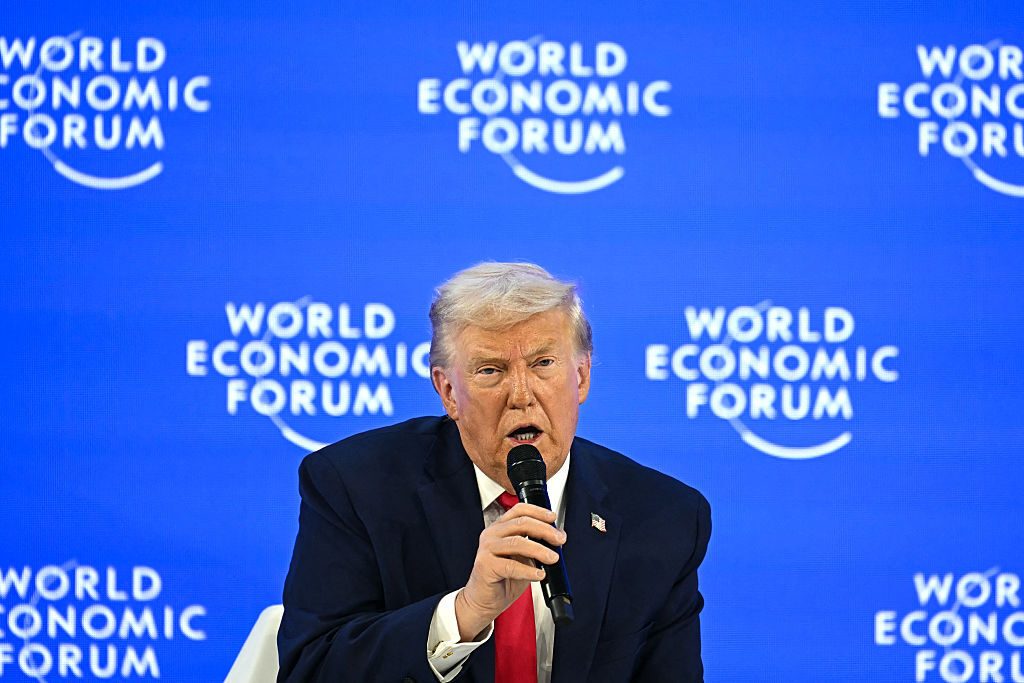
In his Davos speech today, President Trump moderated his aggressive rhetoric, declaring that he has no intention of using the American military to conquer Greenland and make it a US territory: “I don’t have to use force. I don’t want to use force. I won’t use force,” he said.
But he showed no sign of abandoning his goal of pressuring Denmark to agree to the US acquisition of the frozen island. And he used the occasion to remind Europe and Canada of the real imbalance of power between the US and its allies.
“We want strong allies, not seriously weakened ones,” said Trump. “We want Europe to be strong. Ultimately, these are matters of national security, and perhaps no current issue makes the situation more clear than what’s currently going on with Greenland.”
This echoed Trump’s long-standing message that America’s European allies should stop relying on the US for military protection, assuming that Uncle Sam will always come to their rescue. In a characteristically crude dig, Trump remarked that without US participation in the Second World War, the Danes would be “speaking German and a little Japanese, perhaps.”
Trump can be faulted for undiplomatically saying what many Americans privately think about trans-Atlantic relations. But in Realpolitik terms, he is at least consistent: seeking to expand US hegemony in North America while shifting more of the burden of European defense onto Europe, without necessarily dismantling the Atlantic alliance.
In contrast, European critics of Trump and American Atlanticists can only make weak arguments against edging Denmark out of Greenland to make it a nominally sovereign US protectorate or the 51st state. To begin with, it is difficult for Europeans to condemn American imperialism while defending a colonial possession of the Danish Crown. The US recognized Denmark’s sovereignty over all of Greenland only in 1916, just a year before Denmark sold the Danish West Indies — now the US Virgin Islands — to the United States in 1917.
Nor were the Virgin Islands the only colonial concessions made by the kingdom of Denmark. Denmark sold the Tranquebar (Danish India) to the British Empire in 1845, coastal forts in Ghana in 1850, and the Nicobar Islands in 1868. It seems peculiar, then, that Denmark would choose to defend Greenland — at a cost of half a billion dollars a year to its taxpayers — as a remnant of its unjustly acquired colonial empire, all in the name of the rules-based global order.
Most of America’s major Nato allies want to maintain the present alliance system, in which American taxpayers pay for Europe’s defense, while European countries maintain or increase their economic integration with China. Denmark, like the EU, runs a trade surplus with the US and a trade deficit with China, and Chinese components are necessary for many Danish exports to the US.
In a trade war, those hardest hit are usually the nations with trade surpluses whose markets shrink, not those with trade deficits whose domestic businesses can replace foreign imports.
To be sure, Trump’s gratuitous insults and arrogance may backfire by hardening European attitudes against him. He is, after all, a bully. But bullies tend to be stronger than those they harass, and except in heartwarming fiction, they often get their way.