









January 28 2026 - 7:00am
Earlier this month, Canadian Prime Minister Mark Carney traveled to Beijing to forge a new strategic partnership that would open up his country’s market to Chinese goods. Last week, he used his well-received speech at Davos to call for allies to diversify from the US in the wake of Donald Trump’s volatile tariffs and foreign policy.
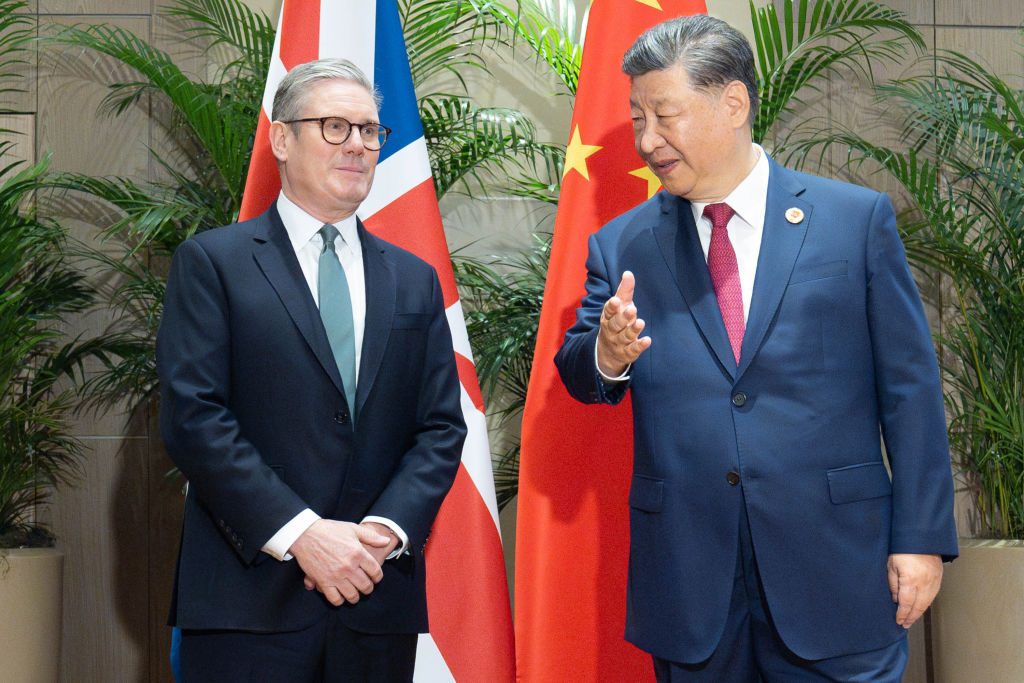
In Britain, similarities are emerging. Faced with persistent economic stagnation and increasing calls for greater autonomy from the US, Prime Minister Keir Starmer has just set off for China. When Rachel Reeves visited Beijing last year, she described deepening economic ties as “squarely in our national interest”, a line the PM is likely to repeat.
Starmer’s visit comes in the wake of two major security developments involving the Chinese Communist Party (CCP). First is the decision to greenlight China’s controversial “super-embassy” in the City of London. The second is the exposure of Chinese espionage campaigns that go, according to the Telegraph, “right into the heart of Downing Street”, seeking to undermine British democracy and compromise Government plans. Rather than strengthening Britain’s position, seeking out greater ties with China risks leaving the country weaker and more exposed in a world defined by raw power.
Beijing has often been framed as an economic opportunity or a competitor. The assumption is — sticking to a belief that a liberal global order still exists — that deeper engagement with China offers nailed-on benefits. That has always been naive; persisting with it today is dangerous.
Britain urgently needs to rebuild its industrial base to underpin deterrence, defense, and resilience. Opening the door to a surge of Chinese exports and investment — as Carney has been seeking to do — would suffocate any industrial revival and entrench structural dependence on an adversary. Britain, for example, has the highest industrial energy costs in Europe, and one in every 10 new cars sold last year was Chinese-made. This is not an easy environment in which to re-energize industrial manufacturing. For China, this is all part of the plan. Across the West, Chinese state-led firms are creating strategic dependencies, hollowing out domestic capacity, and consolidating Beijing’s control over the global economy.
Many are beginning to see the danger. The European Commission is introducing more stringent FDI (Foreign Direct Investment) screening and is funding projects that reduce dependence on external powers, particularly China and the US. The logic for doing so is straightforward. When failing to align with Beijing’s interests, economic coercion follows. Japan experienced this in 2010, and the US under both Biden and Trump was also subject to restrictions which threatened a breakdown of the defense-industrial base.
China has been steadily reshaping the global order. Chinese state media have celebrated overseas investment reaching record highs of $214 billion in 2025, enabling greater control of critical supply chains. These investments only serve to create a stranglehold on Western industry. Indeed, almost three-quarters of African exports to China originate from five mineral-rich nations in Southern Africa, while mine ownership has also seen a boost. How can Britain expect to build a resilient industry without secure access to minerals?
Meanwhile, the CCP’s state-led development assistance is helping the Chinese military’s global power projection, with the Pentagon suggesting that Beijing’s military installations could soon be found in the Atlantic, not just in the South China Sea. Losing the Chagos Islands would seem rather trivial by comparison. Rather than traveling cap-in-hand to Beijing, Britain should be coordinating with allies to stand firm. Industry must be shielded from cheap Chinese goods and ownership. Likewise, the country’s leaders ought to align development spending with strategic competition, diversifying supply chains and preventing Chinese global power projection. None of this will be cheap, but security never is.
Above all, Starmer likely knows in his heart that Beijing is not an altruistic partner — he just shows no sign of being prepared to say so. The hacking of mobile phones at the heart of the British Government is not an isolated incident, but rather evidence of sustained and deliberate daily interference in the country’s policymaking. This malign activity will only intensify, and no trade deal will stop it. British businesses, soldiers, parliamentarians and Government departments will all be targeted to undermine the UK’s security, resilience and position on the world stage. To overlook that in pursuit of trade and investment would not be taking a pragmatic approach to China: it would be an act of weakness and strategic short-sightedness.
As Winston Churchill once warned, the appeaser hopes that “if he feeds the crocodile enough, the crocodile will eat him last.” Hedging against American unpredictability by embracing China would merely place Britain on the crocodile’s plate, accelerating national decline and leaving the country weaker than ever in an age of strategic competition.
