









March 30 2026 - 7:00am
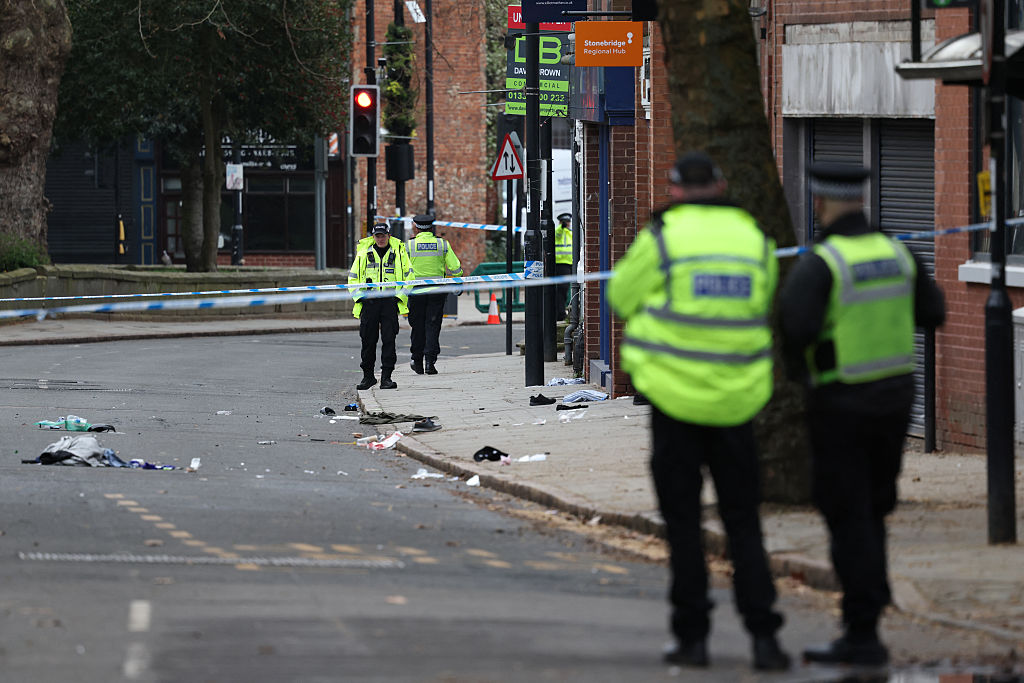
Saturday night’s vehicle-ramming incident in Derby resulted in seven people suffering serious injuries. Witnesses reported that the collision occurred in the city’s Friar Gate area, known for its pubs and bars. They described how a black Suzuki Swift “deliberately” mounted the pavement, knocking down a number of pedestrians. A 36-year old man, reportedly of Indian origin, was subsequently arrested on suspicion of several charges, including attempted murder. Police, as careful as ever to avoid inflaming local tensions, said they were keeping “an open mind” as to the suspect’s motive.
Like many English provincial cities, Derby has increasingly faced concerns around crime, drugs and immigration. Derbyshire Police later revealed that counter-terrorism officers are assisting the investigation, raising suspicions of an ideological motive. Indeed, officers may face the usual accusations of opacity around the incident, but in this instance an open mind is especially appropriate: violent, non-terror-related attacks involving cars outside pubs and clubs are hardly unheard of.
Counter-terrorism officers will quickly seek to either prove or disprove a terror-related motive, via the usual fast-tracking of intelligence and data communications analysis. Even if the suspect has no pre-existing intelligence traces, it’s increasingly common for lone-wolf terrorists to have stayed off the police radar. Indeed, Islamist terrorist organizations have instructed would-be “martyrs” to use vehicles, knives and other improvised methods to carry out attacks. As a security report by the Rand Corporation commented, “for such attacks, the barrier to entry is remarkably low; the main skill required is the ability to drive. Citing a separate report, it said: “No community, large or small, rural or urban, is immune to attacks of this kind.”
As such, motor vehicles have long been a favored terrorist weapon across Europe, especially among lone attackers. It’s now been just over nine years since the vehicle-ramming attack on the Houses of Parliament, when the Islamist-inspired terrorist Khalid Masood killed five people and injured at least 50 more. In the aftermath of the Westminster attack, bollards — known in the sterile language of security professionals as “Hostile Vehicle Mitigation” measures — became commonplace around shopping centers and pedestrianized areas. Sceptics on the political Right, alleging political cowardice around issues of immigration and radicalization, began referring to them as “diversity barriers.
As police and local authorities strove to prevent terrorism through the use of physical security measures, officialdom’s employment of political tools seemed less effective. For every set of HVM barriers, critics argue, there’s an instance of failure by initiatives such as Prevent. Physical reminders of terrorism have become a contentious issue, as Christmas markets and outdoor events increasingly require armed police patrols and public awareness campaigns. Official gaslighting of once-unthought-of measures as “routine” merely hardens suspicions of a lack of political nerve to address the underlying issues.
In Derby, despite the serious injuries sustained by victims, police will be relieved they aren’t dealing with an act of mass murder. Senior officers and Government officials will hope the incident is demonstrably non-terror related, whereby it will slip off the news agenda like the Liverpool car-ramming incident. If it does prove to be terror-related, official and unofficial narratives will inevitably clash, raising tensions in Derby and beyond. The narratives are familiar: “Don’t look back in anger,” if you will, versus simmering cynicism and resentment that successive governments have failed to grasp sensitive issues of counter-terrorism, integration and the downsides of Britain’s increasingly multicultural society.