









July 6 2026 - 10:00am
East London
During a steel drum rendition of Bob Marley’s “Is this Love” in the Saturday evening heat in Shoreditch, a ponytailed young Marxist is discussing the future of Britain’s Marxist movement. “I’m not sure if we will see socialism in my lifetime,” he says, “but if a revolution is just around the corner, there needs to be a body ready to direct it to victory.”
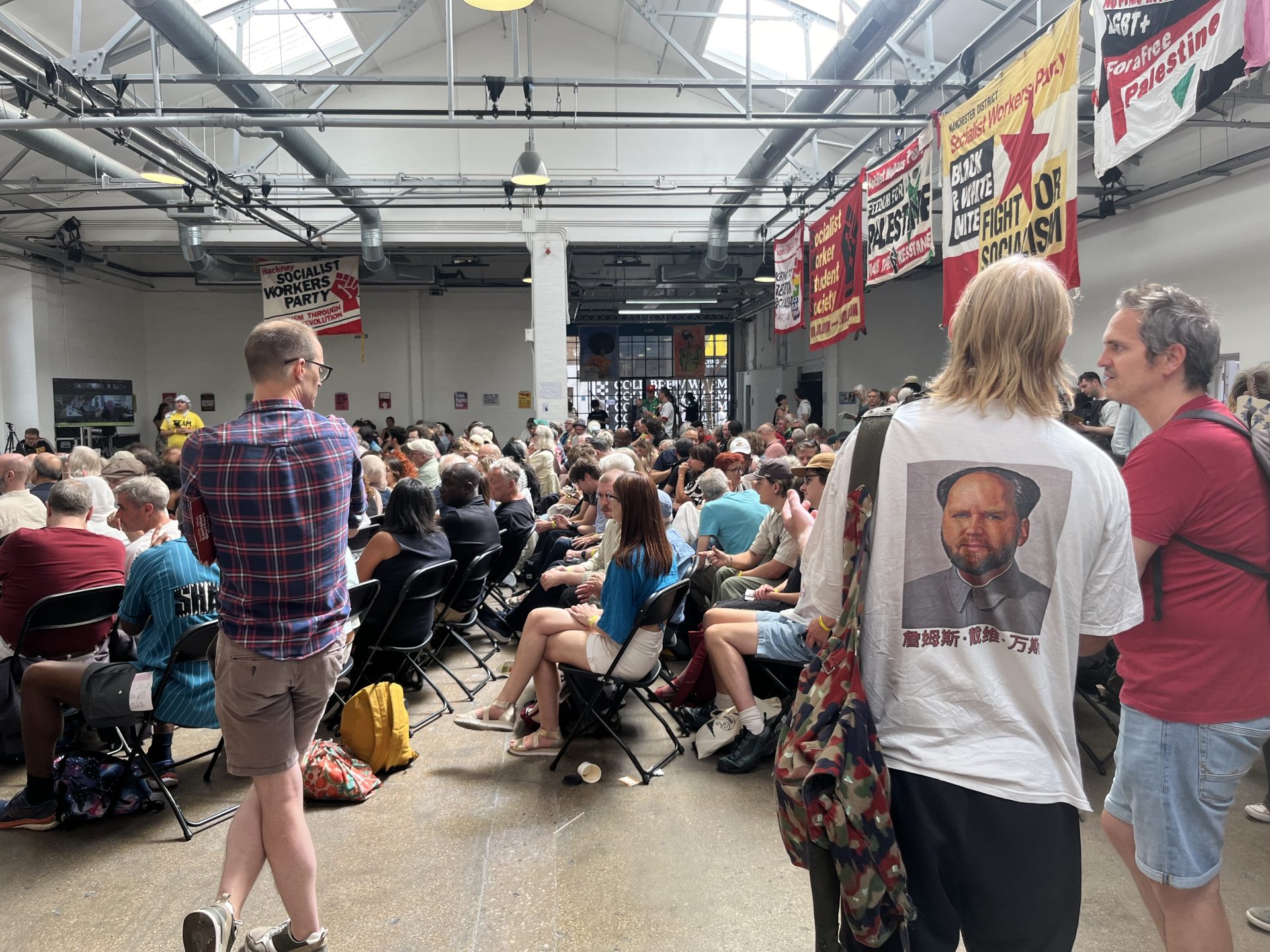
This is why Steven joined the Socialist Workers Party, a few-thousand-strong Trotskyist party founded in Britain in the Fifties, though one that typically fields few candidates in elections. Gathered this week for Marxism Festival 2026, the SWP has rounded up Britain’s socialists to discuss the future of the movement and the world. It’s like a theme park for Leftists: books on anything from Britain’s complicity in the war in Gaza to the politics of Antonio Gramsci for sale, stalls offering competing revolutionary newspapers, and talks ranging from “Do we need a blacker Marxism?” to “Your Party: a modern day tragedy?” Such heady debates take place in appropriately-named “Lenin Room” and the “Marx room.”
But what is on the agenda for the Marxists of today, and how close is that revolution? The rise of Nigel Farage’s Reform UK is on people’s minds, and is repeatedly described as the “greatest threat” Britain faces. There is little love for Andy Burnham either, who, in a talk on Islamophobia featuring Green Party Deputy Leader Mothin Ali, is described by the moderator as a “nativist” pushing a racist immigration policy.
Attendees span Britain’s radical Left: hordes of young SWP volunteers are joined by Green Party members, a smattering of former Your Party footsoldiers, and a larger mass of unaffiliated but disaffected radicals hoping to change the country. But while Farage and Burnham battle for the ear of Britain’s downtrodden workers, this coalition of Marxists have their sights set elsewhere.
The specter that most haunts this festival is that of Palestine. The superstar names, the peak weekend slots, and the biggest crowds are dedicated to the topic. During the talk “In the shadow of genocide: the struggle for solidarity with Palestine”, a member of the Filton 25, “political prisoners” who received jail time for destroying arms equipment linked to Israel in an Elbit Systems factory, is greeted with a hero’s welcome. A speech by punk singer Bobby Vylan begins with cries of “Death to the IDF” taking over the crowd. “I did not chant that,” Vylan cautions to the “undercover police” who he says are “definitely” in the room. Irish politician Richard Boyd Barrett declares Israel as part of a broader Western colonial project “which uses genocide in order to dominate and control the world”. Chants of “Free, free Palestine” punctuate the gaps between speakers.
Palestinian flags are waved with gusto across the packed room. Meanwhile, above the heads of those in the main hall, decorated banners in the old trade union style — featuring the raised fist of the worker and the calls towards “socialist revolution” — evoke memories of the Eighties labor movement. The word “comrade” gets the occasional mention, but it is largely an antiquated nicety. The expression of the modern movement is the keffiyeh and chants to “globalize the intifada”, rather than renditions of “The Internationale” or “The Red Flag”.
Some older attendees remember a different kind of movement. Sally, a former trade unionist who worked among the miners’ strikes of the Seventies, laments that the working-class “struggle” has largely died out in the years since. The labor “tradition”, she says, was broken by Margaret Thatcher, never to recover. The void was then filled by the new attention given to the politics of “identity”. Roddy, who joined almost 50 years ago, wistfully remembers the days when “strikes could bring down a government and the Labour Party was monolithic.” Organized labor today, he suggests glumly, is much weaker than it once was.
If Thatcher broke the Labour tradition, it seems like Britain’s socialists have yet to come up with a plan to bring it back. Where once the liberation of the workers fueled this movement, the goals today are much larger. One speaker declares that their work will be done “not only when Palestine is liberated, but when the world is free of all oppression”.
One Green volunteer, Megan, recounts uncomfortably how the issue of Zionism derailed the party’s spring conference and threatens to do the same to its next. The issue was “morally urgent”, she stressed, but could drown out other problems affecting the working class.
When the working class receives a look-in across the weekend, it is within an “intersectional” framework: the worker can only be freed if Palestine is liberated. The youth here seem more at home with postcolonialism than trade unionism.