









January 30 2026 - 10:00am
If Australia found itself in a job interview, it might describe its cultural and political latency as both a strength and a weakness. The latest trends and ideas still seemingly come by tall ship, our distance serving as a kind of ballast that limits the wild political swings and upheavals felt elsewhere in the world. It’s the beach for us — until people start shooting us on it.
December’s Isis-inspired Bondi Beach terrorist attack has rapidly turned Australia into the global populist vibe shift. Until then, the country had been in a slow-motion version of the Western political realignment, its political duopoly bleeding support from a few scratches rather than an open vein. Now, however, the Right-populist One Nation party has climbed to 26% in some polls, up from just 6% support at last May’s election. The center-right Liberal Party, which was last part of a government in 2022, has a vote share as low as 14% in some polls. In decades of polling, never has a member of the two-party duopoly polled third. What, then, is behind this realignment on the Australian Right?
If the country’s populist shift had previously been concealed, it was in part because of high living standards and a conservative coalition that took a robust approach to illegal immigration in the early 2000s. But the conservatives also catalyzed mass legal immigration, a policy later enthusiastically embraced by their Labor counterparts. This reached a record high in the year ending September 2023, with more than 500,000 arrivals, in a country whose total population was around 26 million at the time.
In poll after poll, a strong majority of Australian voters express a desire for far less immigration. And despite the luxury of being able to observe the predictable impacts of mass migration in other Western countries, the Australian political class has dialed down the program only slightly. Now, One Nation is reaping the benefits from this development, its rise turbocharged by the Bondi attack and then the Liberal Party’s backflip last week from opposing to supporting radical new hate speech laws. That about-turn resulted in the Liberals’ junior National Party partner — which is at risk of losing almost all its seats to One Nation — quitting the multi-generational alliance.
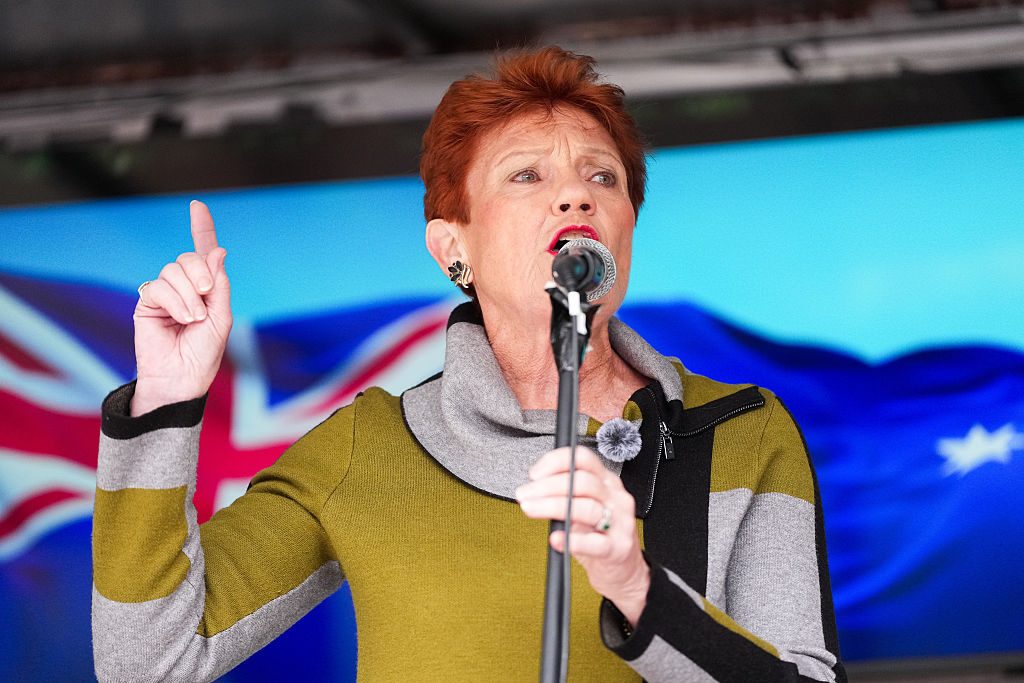
If you have to hold your nose to vote for Donald Trump, voting for One Nation leader Pauline Hanson requires a hazmat suit. In 2022 she told the Greens’ Pakistani-Australian senator Mehreen Faruqi to “piss off back to Pakistan”. In November 2025, she entered the Senate in a burqa as part of a campaign to have the garment banned. In another era, her support would have collapsed. Instead, her popularity has shot up.
One Nation has also been boosted by the defection late last year of former deputy prime minister Barnaby Joyce from the Nationals. Besides being filmed lying drunk on a Canberra footpath in 2024, Barnaby brings much-needed professionalism and discipline to what is an often chaotic and cultish party. In any case, such behavior may well help bring in votes in an era of overly stage-managed politics.
This, however, is not the One Nation of old. Political adviser James Ashby is steering the party’s rise, while this week One Nation released a feature-length cartoon lampooning woke culture. The film has packed out theaters, while its theme song hit number one on Australia’s iTunes chart.
Comparisons to the British Right may appear obvious, yet One Nation is no Reform UK and Hanson is no Nigel Farage. The field remains wide open for a better organized, less crude but still authentic populist party to emerge. Much like the Tories in the UK, the Liberals are a dead brand — torn between their blue-ribbon heartland and the working- and lower-middle-class constituents who are rapidly abandoning them. A comeback isn’t impossible; but if they were sensible they would cut their losses, be happy with 15% of the vote, and focus on representing upper-middle-class moderates who want lower taxes and climate action.
The soil has been turned over, and all manner of critters are now crawling around in the fertile mess of Australia’s political landscape. What seeds take hold long term is anyone’s guess.