









November 1 2025 - 8:00am
Nigel Farage is the enemy of the Scots. At least, that’s what John Swinney would have you believe, going off a speech the First Minister made earlier this week to the think tank IPPR Scotland. “The Scottish Parliament is not strong enough to withstand a Reform government,” Swinney said. It would, he declared, be “the most damaging and divisive UK government since Margaret Thatcher”.
Farage may have given no indication that he intends to reverse devolution, but the First Minister doesn’t believe him. “He’s coming for the powers of the Scottish Parliament,” cried the First Minister. Indeed, the planet itself is at risk. “You’ll be asking later, how distant is Net Zero? Well, if Nigel Farage becomes prime minister, I would contend out of sight.”
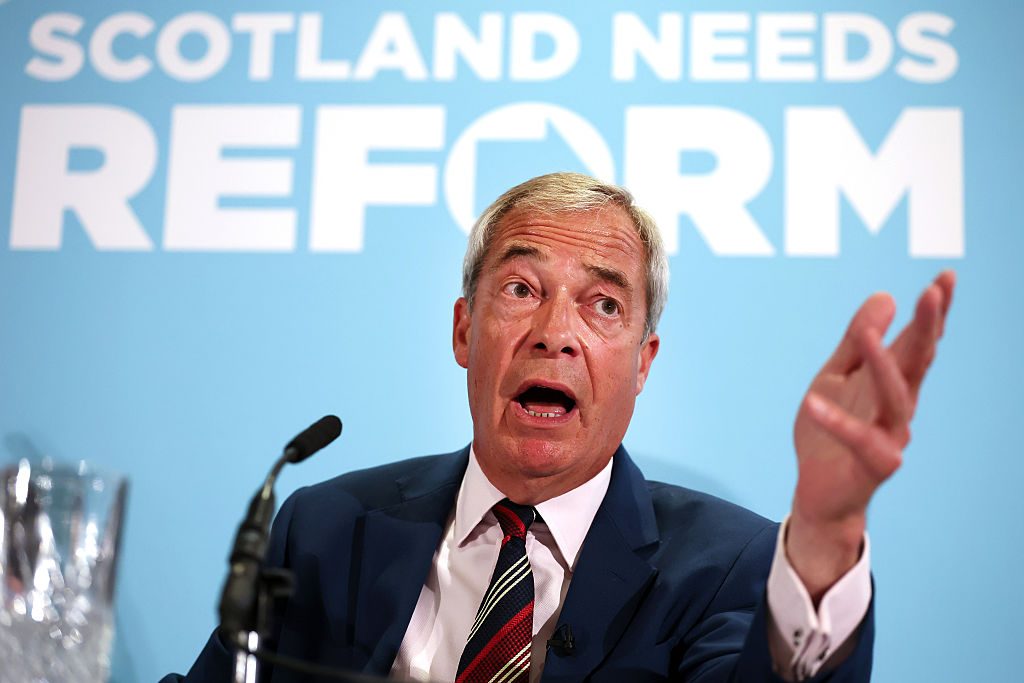
Clearly, the gloves have come off in the race for the Scottish Parliament. But why is the SNP leader committing the classic error of name-checking his political rival? And, come to think of it, isn’t a Reform government a threat rather closer to home than merely at Westminster? For, according to the polls, Farage’s party is set to become the official opposition in the Scottish Parliament. Indeed, the latest poll in the Sunday Herald commissioned by IPPR Scotland has the SNP leading on 34% of the vote, followed by Reform UK on 22% and Labour on 18%. North of the border, the momentum is all with Farage.
According to IPPR analysis, Reform is on course for 22 seats in the Holyrood Parliament in May, ahead of Anas Sarwar’s Scottish Labour Party on 19. The Scottish Tories, who are currently the official opposition in the Scottish Parliament, would be reduced to a humiliating 12 seats from the 31 they returned in 2021.
The real threat, surely, is Reform winning in Holyrood, or at least becoming a significant force in Scottish politics. Swinney’s claim that an independence referendum is the only way to keep the Faragist wolf from Scotland’s door rings hollow, given that the wolf is already through the door and making himself at home in the Scottish political parlor.
Many may wonder why a party led by a quintessentially English nationalist is winning any votes at all in Scotland. Only 12 years ago, when he led Ukip, Farage famously had to be rescued by police from an Edinburgh pub where he was hiding from anti-racist demonstrators. Clearly, times change, and dissatisfaction with the status quo has taken hold. Making outdated threats about the return of Thatcherism cuts little ice with Scottish voters who are, to use a Scots word, simply “scunnered” with the performance of the establishment parties.
It’s notable that Swinney inadvertently highlighted Reform’s main policy offering in Scotland: opposition to Net Zero. During a June visit to Aberdeen, home of Scotland’s increasingly crisis-stricken oil and gas industry, Farage described the current Net Zero policy of the SNP and Labour as “complete and utter madness”. He’s not alone in his view.
His concern for the fate of the 100,000 or so jobs in the industry was echoed by the GMB trade union and Aberdeen and Grampian Chambers of Commerce. The thousands of “green jobs” that were supposed to replace high-paying energy jobs in the “just transition” to renewables have yet to materialize.
Polls have long indicated that Scots do not support the policy of halting development of the North Sea while relying on oil and gas imported from abroad. Voters are as concerned about global warming as anyone, but they could not see the logic in closing down Scotland’s only oil refinery, Grangemouth, earlier this year, reportedly in order to turn it into an import terminal for liquefied natural gas.
In his IPPR Scotland speech, Swinney also rashly called for the Scottish Parliament to have new powers over immigration. The SNP has long argued that Scotland needs more immigration, but national sentiment tells a different story. A Norstat poll in the Sunday Times earlier this month recorded that only 8% of Scots actually agree with the First Minister. Indeed, a majority support Reform’s plan for mass deportation of illegal immigrants.
The SNP is still on course to be the largest party in Holyrood after the May elections, largely because of Labour’s continued unpopularity. But if Swinney keeps handing ammunition to Reform, he may be in for a shock.
Iain Macwhirter was political commentator for The Herald between 1999 and 2022, and is the author of Disunited Kingdom: How Westminster Won a Referendum But Lost Scotland. He was Rector of the University of Edinburgh from 2009-12.
 iainmacwhirter