









February 22 2026 - 1:15pm
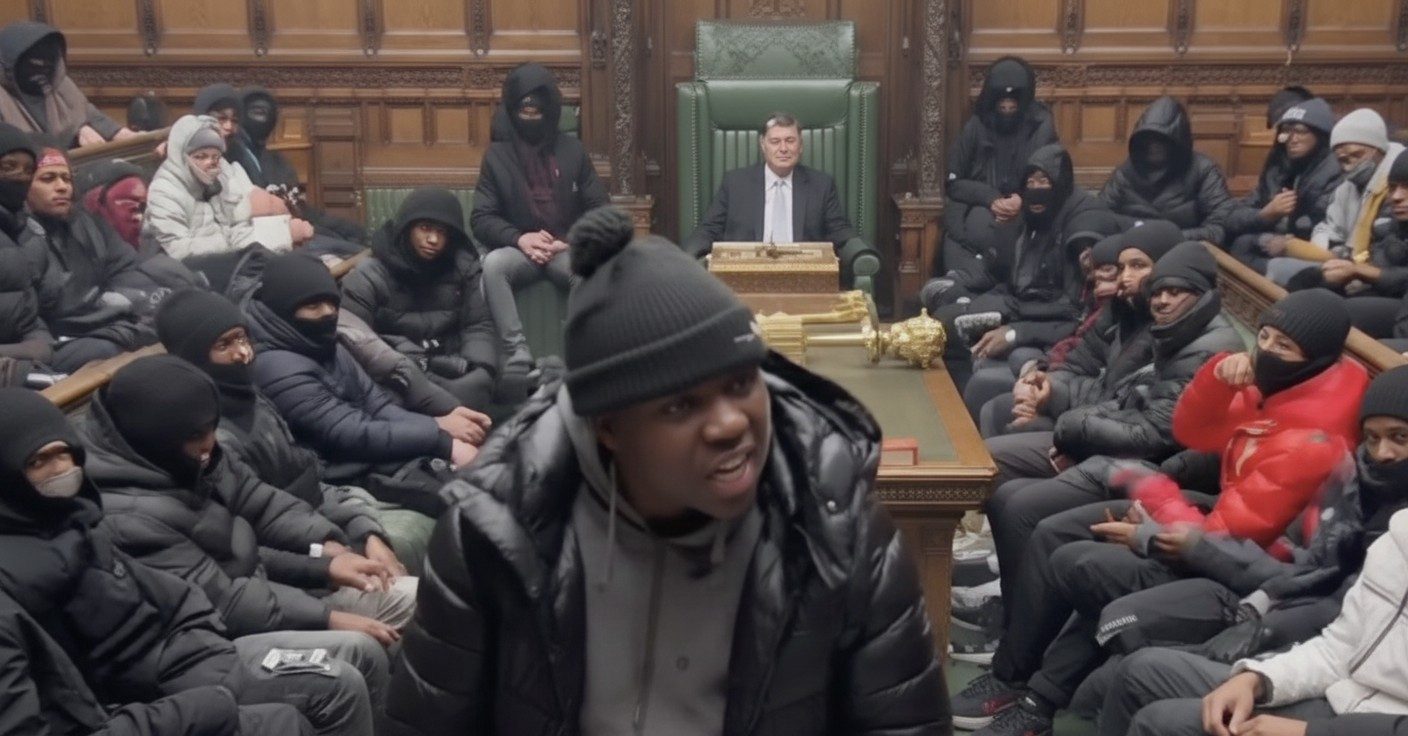
In the 2000s, Britain laughed at the “chav”. Now, it scrolls past AI-generated roadmen sliding into dystopian swimming pools. A new BBC article charts a strange online trend, in which accounts on social media create fake videos of the UK’s urban decline. Surreal, satirical and often racially loaded, these clips range from an arcade machine dispensing machetes to young men in balaclavas debating in the House of Commons chamber. What looks like a change in social type is really a change in medium. The country has not stopped caricaturing its unfashionable classes; it has simply learned to do so digitally and at scale.
To understand why, we must recall the atmosphere of early-2000s Britain. On the surface, it was an era of macroeconomic calm: steady growth, low inflation, falling unemployment. There was a sense that the country had successfully navigated the transition to a post-industrial economy and that things could only get better.
Yet beneath this stability lay a quieter fragility. The industries which once structured working-class life were not replaced by equally rooted forms of production, but often by low-productivity service work. Material life stabilized, but the frameworks that had conferred dignity, identity, and belonging did not return.
Into this gap stepped the figure of the chav, less a sociological reality than a cultural character. He became the human face of a post-industrial order that no longer knew how to explain itself. For a confident metropolitan Britain, the chav functioned as a symbolic counterpoint, a way of dramatizing what the new nation was not and a scapegoat onto whom anxieties about class persistence could be projected. Tabloids, comedy shows, and broadsheet commentary all participated in the construction.
Today, the “roadman”, along with the broader “Yookay” genre of commentary, has emerged as a new symbol for familiar anxieties, particularly online. The roadman is stylized, hyper-visible, and endlessly memed, a stock figure through which fears about crime, disorder, and cultural fragmentation are expressed. There are obvious differences. The image is more overtly racialized and decisively urban in a way the chav stereotype was not. Yet, structurally, the role is much the same. Parts of urban Britain are turned into a symbolic explanation for national unease — a backdrop against which decline can be narrated. The roadman, like the chav, is a character in an ongoing morality play about the country’s future. The object of caricature has changed, but the habit has not.
Where mockery once spread socially, it now spreads technologically. Digital platforms collapse satire, commentary, and fabrication into a single stream, turning what would once have remained fringe imagery into something ambient. It’s now everywhere and we can’t escape it. Algorithms reward the shocking over the typical, the extreme over the ordinary, and the emotionally charged over the accurate. The more lurid the portrayal of urban Britain, the more engagement it generates, and engagement in turn is monetized.
Many of the loudest depictions of Britain’s supposed decline are produced by accounts with little connection to the places they portray. Foreign creators and anonymous content farms can quickly fabricate scenes of social collapse and distribute them globally, not because they believe them but because such images perform well. Britain is quickly becoming a place imagined more intensely online than experienced in life.
Beneath these technological shifts lies an older cultural loss, the weakening of what earlier generations called the moral imagination — the capacity to recognize dignity across differences of class, culture, and taste. The lack of this empathy now means that populist rhetoric names real experiences of alienation, yet often reproduces the same caricatures it claims to resist. Meanwhile, cultural discourse oscillates between romanticizing and disdaining the communities it seeks to describe.
The journey from chav to roadman therefore charts more than a change in slang or streetwear. It traces how a society has lost confidence in describing itself without irony or embarrassment. Until Britain recovers the ability to imagine itself as a shared moral project which transcends both race and class, each new caricature will simply replace the last.
