




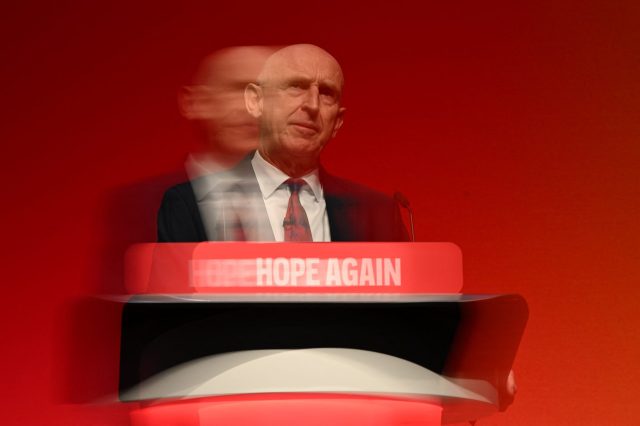
“The backdrop to this week’s Budget is gloomy.” (Oli Scarff/Getty)





There is a tradition of British chancellors drinking at the dispatch box on Budget day. Disraeli favored brandy and water; Gladstone preferred sherry mixed with a beaten egg. The last chancellor to drink on the job was Ken Clarke, with a whisky in 1996. After that, Gordon Brown poured cold mineral water over the ritual. Yet if ever a chancellor had cause to restore it, it’s John Healey.
The backdrop to this week’s Budget is gloomy. Britain’s high streets remain a grim collage of betting shops and vape stores. Public services that were outdated a decade ago now groan under their own bloat. Prices rise and pay packets stagnate. Young people go without work or training, opportunity drying up as the cost of creating it climbs. Two-thirds of British adults think today’s children will be worse off than their parents. In such a country, narratives of doomerism and decline are all too easy to reach for.
But I for one am optimistic about Britain’s future. Our country has the capability not just to survive in our radically changing world, but to thrive in it. It has endured seven shocks in 18 years — two of which were self-inflicted — and yet it is still standing. Britain’s economy is clearly resilient. The question now facing John Healey is how to grow it.
The answer is AI. Love it or hate it, it doesn’t matter: because AI is “the thing” and trillions of dollars are being poured into it for good reason. It’s a transformative technology that is here to stay, whether or not the bubble surrounding it bursts, just as the railways and the internet outlived the bubbles that built them.
Clearly, AI presents profound challenges. It will change the labor market, destroying jobs and creating new ones. It threatens the climate but could also heal it. And it throws open the question of sovereignty: which values will govern the world when a handful of American and Chinese firms own the models remaking it?
So it is not AI in and of itself that fills me with optimism, but Britain’s ability to shape it. The technology will create and it will destroy. But of all the countries it will transform, few are better placed to harness it to bring about progress and prosperity than Britain. The Chancellor’s Budget this week must recognize this. It should be a watershed moment that ends the old political imprisonment of tax and spend — now busted, as taxes reach postwar highs, and spending eye-watering levels — and ultimately secures Britain’s place in our new AI world.
Just think about how AI could transform the NHS, which already holds the cradle-to-grave records of almost 70 million people, built over decades. This data is as valuable as any tax rise or spending cut. And, powered by AI, it is a stepping stone to creating a truly preventative health service. Yes, the politics of using it are hard (google Palantir and you’ll understand why) but we shouldn’t cower from making the argument for a data-driven, cheaper, better NHS. Health spending has grown by 3.6% every year, on average, since the NHS was founded — which is much faster than the economy that pays for it. Britain is fatter and sicker than its neighbours, with 2.5 million people out of work due to ill health. This is an economic and moral crisis, and yet we are still debating spending levels, watching as game-changing weight-loss drugs improve the lives of those who can afford them and struggle to reach those who need them.
A preventative healthcare system, powered by AI and able to capitalize on the latest scientific discoveries, will be able to stop a heart attack or a stroke before it happens. It should be central to the Chancellor’s Budget, and offer a template for wider public-service reform, with every government department seeking to accelerate AI-enabled transformation.
A similar approach could be taken to the Prime Minister’s proposed national care service. There is a risk this becomes yet another burden on Britain’s finances. So it would be better to look at the root of the problem — dementia — which affects around four-in-five care-home residents and costs the country £42 billion a year. Just 1.4% of NHS spending on dementia goes to diagnosis and treatment — this proportion should be far higher. Britain’s science and technology sector is powering a revolution in dementia treatment. The first drugs that slow Alzheimer’s already exist and the next generation can be cheaper and better. DeepMind, which was founded in London, cracked protein folding, contributing to the transformation of medicine development; its spin-out, Isomorphic, now designs medicines with its tools.
No other country apart from the US is better placed to seize this moment. AI is an expertise accelerant and Britain has an economy built on expertise. We could train AI on the best legal system in the world — English law governs around 40% of global business and financial transactions — or on the Premier League’s data, the BBC’s archive, the City’s markets or the research of our top-tier universities. It’s a recipe for wealth-creating unicorns.
We are on our way already. British start-ups raised $23 billion in the first nine months of this year, more than a third of everything raised in Europe. And our manufacturing base, which we often bemoan as a shell of its former self, is now churning out cutting-edge equipment. Rolls-Royce builds the reactors for our submarines in Derby, while Broughton builds the wings for Airbus. These are rare, best-in-class products, and making them here is a boost to our sovereignty and power. These are products most countries can’t make and none can go without.
This is why the Budget should encourage even more innovation, particularly in the defense industry. It should, for instance, lay the groundwork for manufacturing AI robots with arms and legs, which could be used for both civilian and military purposes. Or it could back apprenticeships at scale, to teach young people how to build the defenses our country and its allies need. This would be as good an answer to a million young people out of work and training as any benefit reform. But for this, the Chancellor would need to prioritize defense spending in the interest of national security.
Meanwhile, Britain has quietly built leverage in the AI race. The world’s frontier models are tested at our AI Security Institute before they are released, putting Britain in the room where the rules are written. As Britain’s very able AI minister Kanishka Narayan told me recently: we build “capability tonight, convening tomorrow, leverage the day after”.
The biggest barrier to this future? Us. We are our own worst enemies. Sure, a yawning deficit and astronomical debt don’t help, nor does the fact that the UK’s investment levels have been the lowest in the G7 in 24 of the last 30 years. But if we choose to embrace the AI revolution rather than continuing with the status quo of decline, we will have greater influence on our future.
It’s not the easy choice. If the Chancellor does make this the Budget that harnesses AI’s potential, he will face a British system built to say no: a broken planning regime; a civil service too scared to act; pension funds that won’t back the country they operate in; a dysfunctional energy system pushing bills through the roof.
He will need to fix the energy system first: we are paying almost £2 billion a year to switch wind farms off because the grid can’t carry their power to the places where it’s needed, leaving us with some of the most expensive electricity in the world. Investors make decisions worth billions on that fact. The approval of the Jackdaw gas field was a flicker of pragmatism, and Rosebank should follow. But clean power, rather than cheap power, remains the overriding goal of energy policy, even as the facts scream at us to change course. Only this month, Microsoft pulled out of a landmark deal with a data center in Essex because the site couldn’t access electricity before 2030. The goal of Cheap Power 2030 should therefore replace Clean Power 2030 on Wednesday.
If this Budget falls short of being the first step in reversing Britain’s decline, then doomerism will evolve from mood to habit. People will hesitate before starting a business or backing one. They will think twice about retraining or upskilling because they no longer believe a better future is possible. The temptation for political leaders may be to adopt easy retail politics, or to retreat into nostalgia, pointing to those better days gone by. But leadership of the highest order — which we need now and haven’t seen for some time — isn’t about trying to work out what voters want and giving it to them, but working out what the country needs, convincing voters it’s what they want, and taking them into the future.