




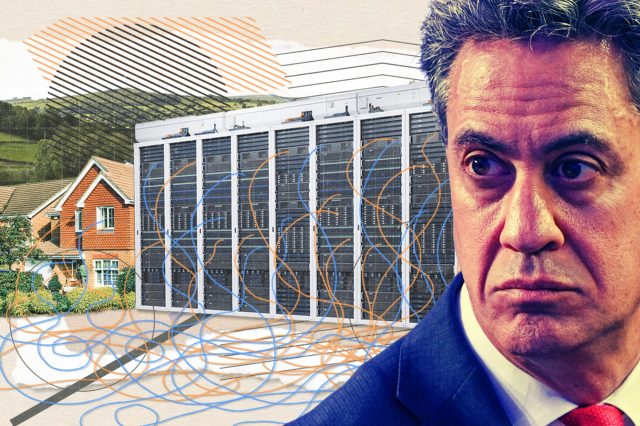
Net Zero legislation, championed by Ed Miliband as Energy Secretary, has made it harder for data centers to run on gas. (Getty)





Born in the misty hills of technical abstraction, nursed on trillions of dollars of investment, the beast that is artificial intelligence has come down like the wolf on the fold. It gorges on math problems that had eluded humanity; it leaps into forbidden enclosures; it gnaws on the extremities of the jobs market. Much technical and legislative effort has been expended on attempts to tame the beast. But perhaps AI’s apex predator was with us all along. The unstoppable force of techno-capital, it transpires, is no match for the immovable object that is British dysfunction.
A little over a year ago, a deal was struck to underwrite Britain’s biggest data center. Nscale, a British company that builds and operates data centers on behalf of software companies, had made Microsoft its anchor tenant at a site in Loughton, Essex. Comprising 23,000 Nvidia chips at an initial capacity of 50 megawatts, the £2 billion data center would be large by European standards, but middling in American terms. Nonetheless, it was an agreement significant enough to be bundled into the package announced by the British and American governments during Donald Trump’s most recent state visit. “What a day,” said Keir Starmer, sitting alongside the President at a press conference. The suite of deals, said the then Prime Minister, was “the biggest investment package of its kind in British history”.
Last week, however, Microsoft pulled out of the data center agreement, depriving Nscale of its lead tenant. The project’s failure augurs poorly for Britain. AI is not solely a force of wolfish destruction; it is also an economic tool of immense promise. The frontier models, of course, are owned and operated by American and Chinese companies, but there are plenty of benefits, economic and otherwise, to hosting some of the associated infrastructure. British data centers don’t generate many jobs in themselves, but they allow us to store sensitive data on these shores rather than elsewhere; to support industries, such as banking, whose success depends on being closely connected to servers; to maintain something of a bargaining chip, even if only a small one, in the hyper-competitive new AI economy; and to create more capacity, at least in theory, for the training of British frontier models.
Whatever its faults, Starmer’s government acknowledged this reality, not only in that press conference with Trump, but also in the ambitious AI strategy, authored by the entrepreneur Matt Clifford, that it published in January 2025. Among other measures, the plan called for a twentyfold increase in public compute capacity, partly through the creation of deregulated AI growth zones. The Loughton data center was not situated in one of those zones, but it had government support all the same: ministers are reported to have lobbied local councillors to push through Nscale’s planning application.
The lobbying worked. Early last year, Nscale said the data center was to be opened toward the end of 2026. In February this year, though, visiting Guardian journalists found that the site was still a working scaffolding yard. In July, it was reported that the data center would be delayed; in mid-September, it emerged that delay might last until the mid-2030s. That Microsoft lost patience should be unsurprising. If a week is a long time in politics, a decade is an aeon in artificial intelligence.
So what went wrong? The answer, it seems, is that Nscale has been unable to secure a timely connection to the national grid. Data centers aren’t plug-and-play; instead, they need a small town’s worth of electricity, with the infrastructure to match. The power arrives at a high voltage that must then be brought to a lower voltage by bulky equipment including transformers. This process takes place in a substation, and substations cannot be rammed into a grid, or a neighborhood, overnight. It might take years for a project to obtain planning permission, and that’s hardly the finishing line: the blueprints must then be implemented by electrical engineers who, given the fast approach of 2030 and its target of 90% clean energy, are thinly stretched.
To make matters worse, a nominally completed substation must not be plugged straight into the grid. Instead, it must be plugged into a temporarily isolated portion of the grid when power demand is low. Those slots are booked years in advance, meaning that one delay can cascade into further delays. In these dangerous times, UK Power Networks (UKPN), which handles such work in the South-East, tends not to share with inquisitive journalists the finer details of its physical infrastructure, but we can safely assume that Loughton is short of a gleaming new substation.
The Government, then, is now discovering that announcing plans for an exciting new data center is very different from actually cutting the ribbon. Loughton, alas, is not a one-off: earlier this year, for instance, OpenAI paused a comparable project in the North-East. One of the problems was the speed, or otherwise, of connecting to the grid, but another — one whose effects every Briton encounters daily — was the country’s industrial energy prices, which are the highest in the developed world. Under Starmer, AI was a high priority; but Net Zero, which has hoovered up the electrical engineers while continuing to discourage the use of gas, is so deeply plumbed into our laws and regulations as to make data centers all but unbuildable. Ed Miliband, it has been alleged, continues to block investment in data centers, even as foreign secretary — though he denies it.
We can expect that civil servants, under duress from ministers more sympathetic to AI, will find enterprising ways to make the grid-connection process marginally less ineffective. Perhaps some legislative jiggery-pokery will enable sites like Loughton to jump the queue for UKPN’s attention. And maybe data-center developers in growth zones, which already have queue-jump privileges, could be empowered to build their own connection under Ofgem supervision.
But most of these measures would amount to a rearranging of finite resources rather than the introduction of new ones. Elsewhere, though, others are more muscular in their approach. China, whose data center capacity far outstrips ours, upgrades its power grids in anticipation of increased demand rather than in response to it. It purchases transformers in advance and in bulk. And though it encourages its data-center providers to use renewable energy, China permits them to use baseload power, which is largely dependent on coal, if they must.
The US, meanwhile, being composed of varying regulatory polities, has no single answer to the question of how to rapidly build data centers. Because the internet’s earliest users included the American government, the state of Virginia, being close to Washington, has historically had America’s largest data center capacity. But Texas, whose deregulated power grid stands alone from the other, much larger, multi-state grids, is forecast to overtake Virginia by 2030. Texas, in short, offers cheap land, cheap gas and solar, and a nimble regulatory regime — all of which are highly attractive to data center builders.
The lesson here is not simply that gas is a vital stopgap in the quest to harness AI. Paradoxically, an explosion of data centers ought, in the round, to be helpful for decarbonization. American hyperscalers, far too impatient to wait for grid upgrades, are now some of the most generous investors in clean power. Google has invested hundreds of millions of dollars in geothermal, a bet that might ultimately make this hitherto unreliable method of power generation readier for commercialization. Microsoft is helping to underwrite the revival of the Three Mile Island nuclear plant, and Amazon is investing in small modular reactors. Technocapital has never before been so ravenous for energy, irrespective of where it comes from.
Even on environmentalist terms, then, the hunger for reliably-powered data centers ought to be harnessed rather than fought. It is also possible that the current construction boom might contribute to breakthroughs in nuclear fusion, in which AI is a promising fit for what is partly a fluid dynamics problem, or in materials science, where AI might help us discover crystal structures of use in batteries or solar cells. Intelligence, after all, is a resource that we can apply to any field of endeavor we choose. Thinking in those terms, Dario Amodei, the CEO of Anthropic, has envisaged that a single data center will one day be the equivalent of “a country of geniuses”.
One need not agree with Amodei’s forecast in order to bemoan Britain’s inability to get things built, be they data centers or otherwise. We have neither the wide regulatory menu of the US nor the world-historic ambition of the Chinese state. Instead, as our governance deteriorates, we are veering from prime minister to prime minister, each with their own pet projects, with the main constant being the continued shirking of overdue reform. Factories and refineries are shutting down, while airports, railway lines, motorways and power stations remain unbuilt.
The transformative technology of the day has not escaped the chaos. Starmer, in addition to commissioning the AI strategy, set up a council whose job it was to prepare Britain’s grid “for the AI revolution”. Andy Burnham, more interested in trivialities such as private parking fines than in leading that revolution, appears to have let the council slip into abeyance — though he has promoted Kanishka Narayan, the well-regarded AI minister, to his Cabinet. Meanwhile, the engineers who run Britain’s power systems complain that the rush to Net Zero is compromising their ability to keep the lights on.
We can still hope for better. A more aggressive planning philosophy, resembling those that work best abroad, could both accelerate grid connection and enable easier in-house power generation. In the short term, data centers would use gas, but in time, renewables would take over. We can imagine Cornish geothermal energy powering the data centers of the South-West; legions of batteries, made cheaper by deep-sea mining, balancing the vicissitudes of wind and solar. Hyperscalers’ nuclear projects, too, could provide reliable baseload power to both data centers and the grid at large.
The data centers might even be beautiful. In this richer, wiser Britain, anything is possible — even, by the mid-2030s, the opening of the data center in Loughton.