




Are you ready for the Normie Yoke? (Phil Noble/Getty)





Entertain the thought, if it isn’t treasonous, that King Charles dies some time in the next few years. Hungry for more royal souls, Paddington Bear whisks him off to Valhalla. The queue snakes along the Thames. The great and the good assemble at Westminster Abbey: the king is dead; long live the King! Long live the king, upon whose bald head St Edward’s Crown now descends. Long live the king, in whose veins flows the blood of Odin, Cerdic, Robert the Bruce, and Lady Di. “Isn’t he relatable?” they say, as they tune in for the Accession Council. “Isn’t he just like us?” they ponder, as Archbishop Mullally smears the unction over his breast.
And every Wednesday, the King of the North will have his audience with His Majesty. “Hell of a game on Saturday, mate”, says Mr Burnham; “up the Toffees!” he chortles. “Alright, mate, don’t rub it in,” William V winkingly replies. Their conversation proceeds to Men’s Mental Health and Climate. The war in Ukraine rumbles on; the country shows no signs of escaping its not-so-managed decline; the AI apocalypse looms overhead. In past crises providence gave us a Nelson, a Churchill, an Alfred the Great. Now, in the crisis to come, we will be in the chokehold of the blokeocracy.
It used to be said that, when Queen Elizabeth II died, the monarchy would die with her. Nothing of the kind happened. Charles shut up the doubters and rose to the challenge. His mother’s longevity came in handy; by the time of her death, sordid memories of tampons and anni horribiles had faded away. Only a few months before Queen Elizabeth’s death, it was announced that Camilla would be Queen Consort — a sure sign that the public had come around to the “fairy tale for grown-ups” view of their adulterous romance. As king, Charles has become what he never was as Prince of Wales, a figure of universal affection.
Predicting that the monarchy’s fortunes will dip when the present monarch dies is, as experience shows, a fool’s errand. Yet there are good reasons to think that, with Prince William, the process that occurred with his father will play out in reverse. He is popular now, as Prince of Wales: he is smiley and inoffensive. But, as Charles presciently remarked on a BBC documentary in 2018, the heir and the sovereign have “different functions”.
Charles has managed to make a success out of being king because he possesses some gravitas. His gravitas consists in his strangeness. Listen to the way he talks. It’s not quite the otherworldly voice of his late mother, which sounded like it was plucked from a different age (her private tutor growing up was born in 1872), but it is still sharp RP. Earl Spencer, Charles’s former brother-in-law, doesn’t sound like that, and neither really does Camilla. But at least they’re vaguely posh in the good, old-fashioned way. William’s accent, though, is pure Made in Chelsea. Are we really ready for a Made in Chelsea King’s Speech?
Charles also has a hinterland. Nobody would claim he is a genius. But he is intellectually curious, and possessed of a lively mind. He has interests, and with interests comes personality. He has a strong aesthetic sense, lovingly given shape in Poundbury. He nurtures a kind of agrarian romanticism, bordering on the anti-modern. He is reportedly happiest in the farmhouse he bought in rural Transylvania; one of his favorite books is William Blacker’s Along the Enchanted Way, a paean to the “almost medieval world” of Romanian rusticity, tinged with regret over its gradual disappearance. Towards football and other such vulgar things he maintains a dignified disdain. He once claimed to support Burnley FC, but only due to its charitable work.
Some segments of the online Right accuse Charles of being a secret Muslim. The kernel of truth here is that, not unusually among upper-class Englishmen of a certain generation, he admires Islamic spirituality. He is a devotee of the Iranian metaphysician Seyyed Hossein Nasr; one can imagine him as a Sufi mystic, but no more than one can imagine him as a Buddhist monk. His religious ideas are, if not heretical, at least somewhat heterodox: he seems not to think that Christianity has a monopoly on meaning and salvation. When he vowed to be a “Defender of Faith”, rather than the Faith, this represented the monarchy’s commitment to Britain’s future as a multi-faith democracy, now that the Established Church has lost much of its relevance. But it was also, less cynically, a statement of deep conviction. Charles is “Defender of Faith” because he is a man of “Faith” as much as of “the Faith”.
Another aspect of Charles’s appeal is that he has inherited some of his father’s cantankerousness. That he is not especially agreeable caused him some problems as Prince of Wales, but now it gives him a curmudgeonly charm. It’s hard to imagine him cavorting with Graham Norton, as his eldest son does, but this adds to his regal dignity. I doubt he would want to go on Graham Norton, and I doubt many of his subjects would want him to, either.
There are persistent calls to “modernize” the monarchy, calls with which William seems to sympathize. But to modernize the monarchy would be to consign it to irrelevance. Nobody wants a scaled-back, focus-grouped coronation: if we are to have a monarchy, we ought to go the whole hog. The bells and whistles of monarchy are obviously out of step with today’s egalitarian ethic. But the British public can stomach such things, even take pride in them — if they’re knowingly antiquated and arcane, if they’re weird. The monarch has to seem in some way apart from the profane world. If we are to bow or curtsey to some other person, that is the least we should expect.
William, however, is “normal”: he is “relatable” and “down to earth”. What people mean when they say this is that he is an empty suit (and an ill-fitting one, according to the menswear guy). With him there is no life of the mind. There will be no Transylvanian darkness, no spiritual hunger. Prince Phillip made the late Queen more interesting, in his rousingly unfiltered way; there’s no hope for this from William’s well-polished wife. There is no reason to doubt that William’s loves in life are what he says they are: Aston Villa, Batman, and Celebrity Traitors. The invitations to Charles’s coronation featured the Green Man, in a nod to his enthusiasm for British folklore and symbolism. One can readily imagine the invitations for William’s being in claret and blue.
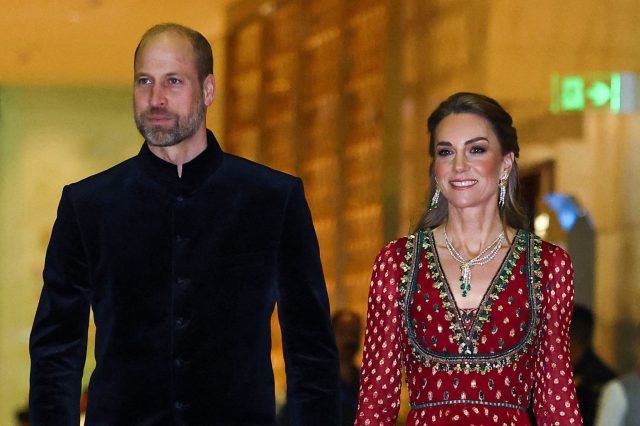
Will and Kate have spent the last week in India. There was a “soft power” motivation for the trip, as well as a suitably anodyne desire, apparently, to “celebrate young people”. But the main point was to present some prize for environmentalism alongside Rami Malek, who has described our future king as “just a regular bloke”. There will inevitably be an absurdity to “Your Majesty”-ing a “regular bloke” that no amount of Palace PR can wash away. Perhaps the reign of William V would suit the Burnham era: they could double up on Gogglebox. But what we might tolerate or even want in our prime ministers, we will not tolerate or want in our kings.
Happily, there is a spare. As William was glad-handing in Mumbai, his younger brother, the prodigal son, was in Ukraine. He has many of William’s problems, too, of course: the Sloaney accent, the heavy hint of woke. When Meghan said something to him about Eat, Pray, Love, he confessed he’d never heard of it, because he is “not really big on books.” And he has one big disadvantage which escapes William: he is unpopular. But he has never been boring — not when he was dressing up as a Nazi, nor playing strip billiards in Vegas, nor hanging his family’s dirty laundry out to dry in his autobiography. Harry is comfortable enough in his poshness to prefer rugby to football. Though it’s too often mediated through Californian therapy-speak, he clearly does have an inner life. At least his wife has an edge to her. And, most importantly, he is a patriot. He fought valiantly against the Taliban; he claims to have killed 25 of them. “I’d rejoin the military to fight Russia”, he says. “I would 100 per cent be there to serve my country”. Can the same be said of most young Britons?
Primogeniture is not sacrosanct. Our sovereign Parliament can dictate the line of succession as it will; and, anyway, there is precedent for favoring a younger to an older son if the circumstances demand it. In the two successions that followed the Norman Conquest, the younger sons of William the Conqueror, William Rufus and then Henry I, took precedence over poor Robert Curthose. And, of course, the unsuitability of the elder son for the throne was the proximate cause of the accession of Charles’s own grandfather, George VI, in 1936. Harry, less “normal” than his brother, is more worthy of the crown. And when Putin comes, or the AI robots, Henry IX can do what none of our kings has done since George II — he can lead our troops into battle.
