




Gone is the summer’s disaffection with Edi Rama, replaced by a burning, visceral hatred. (Aris Roussinos)





Outside the locked gates of Tirana’s Catholic Cathedral last Saturday, a riot policeman ran towards me with his club upraised to bash me on the head. When I shouted that I was English — it was not the moment for the interminable navel-gazing of current British political discourse — he wavered for a second, then shoved me out of the way instead. Camera in hand, I had interrupted him and his colleagues as they attempted to beat, through the railings, a handful of teenage protesters who had run through thick clouds of choking tear gas into Church grounds for sanctuary. A few moments earlier, black-clad rioters outside the cathedral had hurled petrol bombs at the policemen, as they tried to charge across the pedestrian Vodafone Bridge. After the police withdrew, to chase other protesters, I spoke to a crying teenage girl, being comforted by a gray-haired nun beneath the bronze statue of Mother Teresa. “They have such hatred in their eyes, we are just protesting for our rights, we have done nothing wrong,” the girl said, shaking. “This is all because the government is not listening to us, is not doing anything to help us, to help any of the poor people of Albania, in any way,” said the nun, visibly furious, her eyes red-rimmed from tear gas. It was the fifth, and most violent day so far, of the student-led protests that have plunged Albania’s capital into chaos for over a week.
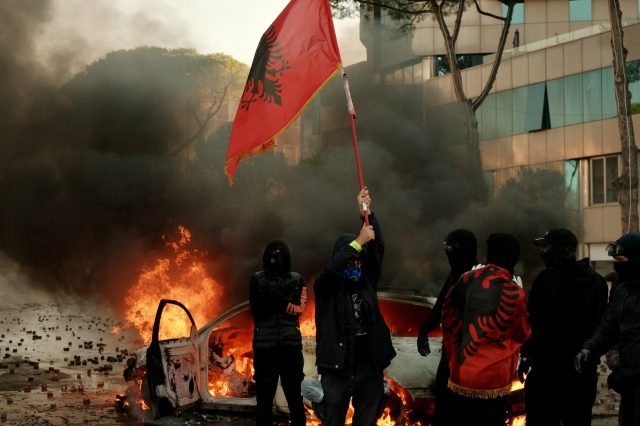
Since May, Tirana’s central boulevard had been the scene of the peaceful, and joyful “Flamingo Revolution” protests, named after the animals supposedly threatened by the Kushner-led coastal development project in the southern village of Zvërnec. But if the “Flamingo Boulevard” of the summer was a protest movement that styled itself as a revolution, what is happening now is an attempted revolution that styles itself as a student movement. The demonstrators are attempting to overthrow Edi Rama’s Socialist Party government, elected for a fourth consecutive term only last year, with the aim of installing a caretaker technocratic government before new elections. On Saturday, it looked for a dramatic few hours like they might succeed. Thousands of protesters had filled Tirana’s main boulevard, pressing right up to the Prime Minister’s Office, Albania’s seat of government. Masked and black-clad youths kept pushing forward with howls of joy and rage against the water cannon and shield walls of riot police, cheers going up as petrol bombs exploded in flames against the armored trucks, forcing them to retreat. If the underlying causes — an end to political corruption, greater social spending, an entirely new political system — are the same as before, the mood among the protesters has become newly fierce. Gone is the summer’s disaffection with Edi Rama, replaced by a burning, visceral hatred.
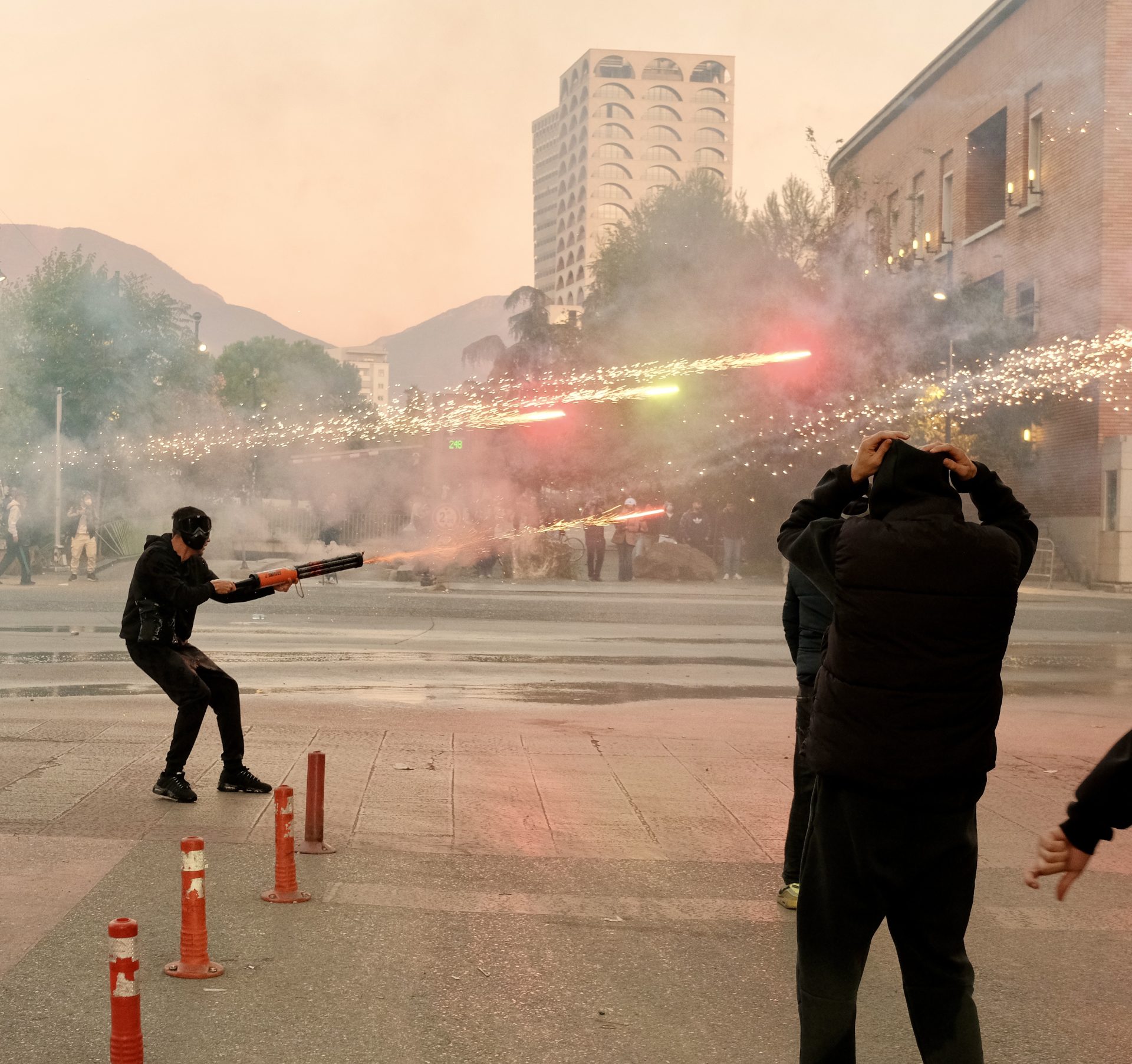
Whenever the rioters wavered, chants of “Down with the dictator, Down with the communists” rang out, motivating them to push forward once again into the thick clouds of tear gas, hurling back the CS canisters, and aiming fireworks at the police ranks. Hijacking a parked car, the protesters rolled it towards the police lines and set it aflame, forcing the police to retreat. Young women in gym wear and Covid masks, and young men in black tracksuits and ski masks ran as close to the police as they could to hurl their missiles, jeering and cursing at them, the men often thrusting their groins at their opponents to indicate, in a manner it does not take a fluent command of Albanian to understand, what they wished to do to the officers. Dozens of times that Saturday night, I had to escape from the choking tear gas; every time, within seconds, a volunteer ran up to squirt distilled water in my eyes, an indication of the impressive and seemingly organic level of student organization behind the protests. Tea, a 21 year old math student, asked me where I was from as she squirted water into my eyes. England, I spluttered. “Then you don’t know us Albanians, we are crazy as fuck,” she laughed. “He is going, and we are going to make him go, as quickly we can.”
At a pavement cafe near the protests, I met Genc Pollo, a prominent conservative intellectual and politician, and a strong critic of Rama’s government. An urbane figure, it was a surprise to see him with swimming goggles perched on top of his head, an attempt to keep out the tear gas from the protests he now observes nightly. If the Flamingo protests had been listened to by the government, he told me, all this violence could have been avoided. “But the answer from the government was mostly derision, mockery, calling them foreign spies, calling them algorithmic manipulators, and the usual stuff.” Instead of concessions, “immediately, with the police, replying with tear gas and batons, and now rubber bullets, it turned into a violent confrontation. That is “a very logical evolution of the situation. Should the frustration, and the discontent, and the legitimate grievances have been really dealt with, not with decoys, not with propaganda, and on the top of that, derision for the protesters, it could have been channeled into peaceful ways, peaceful solutions, and arrangements.” Was there a solution that ends with Rama still in power? “I don’t think that’s possible,” Pollo told me. “Since it has become tense and also violent, I don’t think it will last as long as the Flamingos. By the nature of it, I mean if it’s either way, it will be decided in a shorter time frame.”
Back on the boulevard, beneath the din of the tear-gas grenades, I asked Jurgen, a 20-year-old law student, why he was here. “Because of the corrupt government and everything that has been happening in the past 13 years,” he told me “The PM will resign, hopefully this weekend, because of the mass protests, he should reflect on that. We gave him 140 days of just asking nicely, he didn’t listen, so now things took a turn. This is the result of not listening to the people of Albania. I cannot name a single thing he’s done that has benefited me as a student or as an Albanian.” Behind him, a group of older women, one in a hijab, were busy tearing up the cobbled pavement and filling a wheeled shopping trolley with rocks to be trundled towards the young men at the front. Indeed, for a Gen-Z protest, there were a surprising number of men with gray hair at the forefront of the clashes, hurling rocks and metal poles at the police lines.
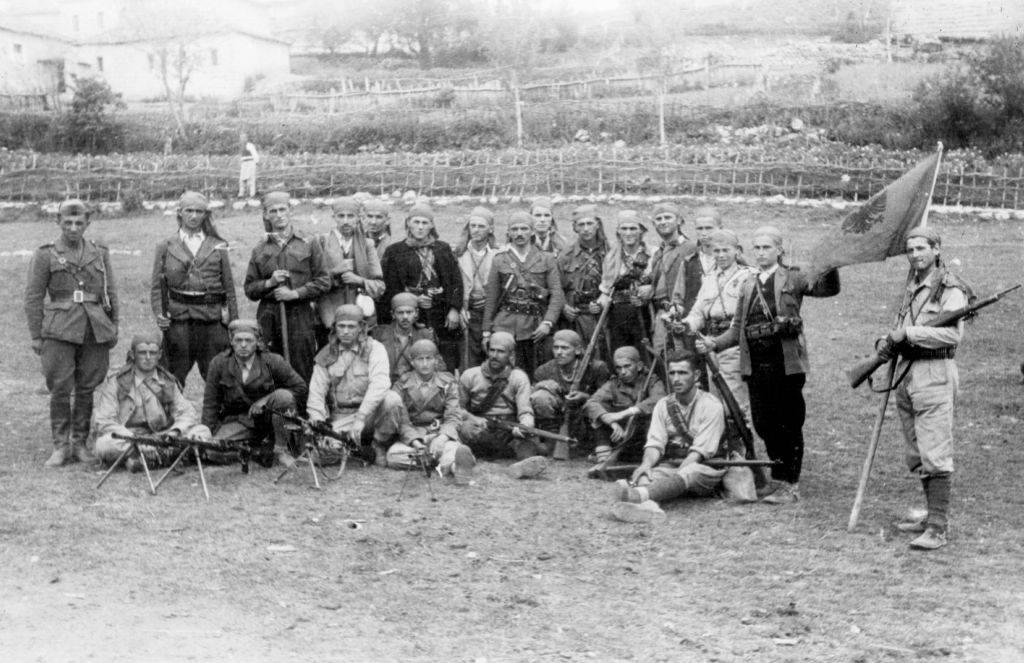
While the violence is led by students and schoolchildren, the polite middle-class protestors of the summer have been joined by older toughs, with indications that ultras from Tirana’s football firms have set aside their rivalries to unseat their embattled Prime Minister. To the chants of “Rama resign” and “Rama to jail, Berisha to jail” from the peaceful summer protests have been added a new one: the slogan of the Balli Kombëtar, the Right-wing Second World War resistance movement: “Albania for Albanians, Death to Traitors.”
For many protesters, however, it is contemporary geopolitics that most concerns them. “Rama will go,” one man in his 30s told me, “but he will only go when other nations, America and Europe force him to go, because he has a bad personality, he is difficult, and also because he is implicated with criminal gangs, and with Israel.” If the Kushner-led Zvërnec project was the spark for the summer Flamingo protests, a broader sense that the Rama government is too close to Israel has led to widespread conspiracy theories that Tel Aviv has sent reinforcements and crowd control equipment to the Albanian police, and that Rama has sold the country out to Israeli interests. Among the many demands for revolution scrawled along the walls of the boulevard was the terse spray-painted message: “Fuck the Jew Rama.” In a country that is fiercely nationalistic even by Balkan standards, multiple shades of political opinion, both Left and Right, have now converged on a joint struggle to overthrow the government. I asked Eldison, a 20-year-old software engineering student, if the Flamingo protests had become a revolution. “It was always a revolution, because we are fighting for our future, our rights, our country,” he said. “Rama won’t resign, but he will kill himself.” Why, I asked. “It’s kind of Jewish stuff,” he shrugged.
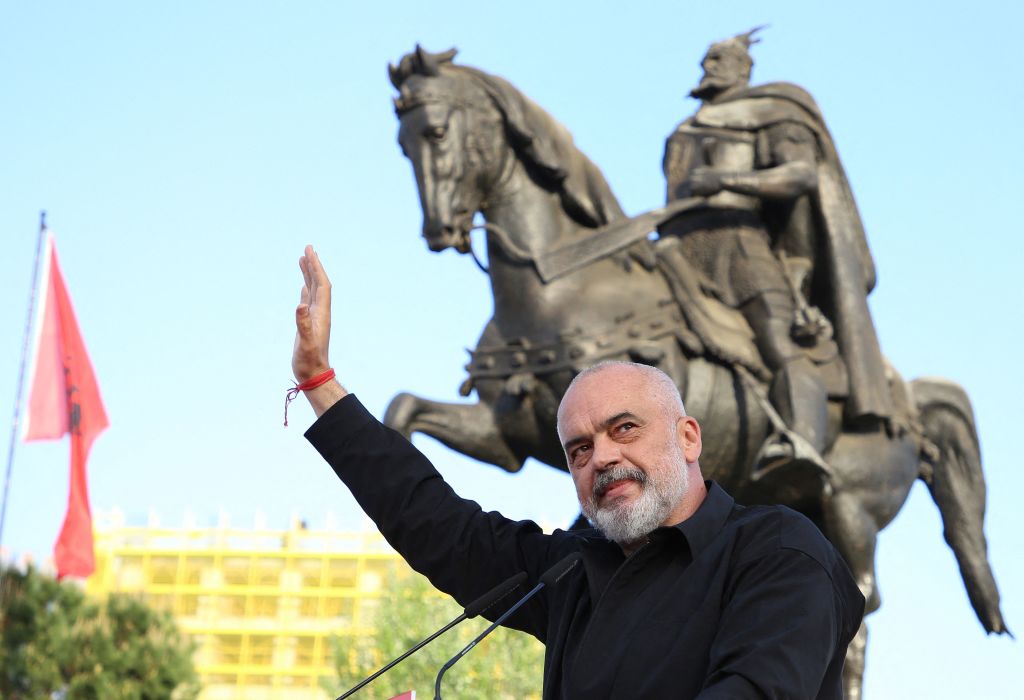
The Albanian government did not grant a request for an interview, instead offering to respond to a set of written questions. When I sent a detailed list, it didn’t answer them, instead forwarding me a transcript of Edi Rama’s television address in which he blamed antifa, “neo-Communists”, “neo-Ballists”, the political opposition and Iran for the disturbances. At a café in a shopping mall, I met a prominent Socialist Party insider who granted me an interview on the condition of anonymity. “What is new now is that there was this very sudden explosion in terms of attacking public institutions, destroying public offices,” the insider told me. “But I guess there’s also the element of the police doctrine linked to it, in the sense that there was an effort in the very early days, at least, to sort of let them let steam off.” The explosive rhetoric, meanwhile, which the insider blamed on “bots,” was also apparently new. “What do the bots say? You have sold this country to Israel. You are all thieves, that’s the second element. And we are gonna kill you and burn you. So these are the three overarching themes.”
The rhetoric was becoming increasingly dark, my interviewee told me. “The last time Albanians have called other Albanians traitors, it was in 1943, 1945, 1944. And it’s so out of context now, but again, this is a generation that does not understand the specificity of that word in Albanian history. And for me, it’s very dangerous.” Indeed, “there are three things I fear in terms of keeping me up at night,” the insider told me. The first was rising inflation of essential goods, carried over from Albania’s main trading partners Italy and Greece. The second was that the heightened rhetoric might cause a death, after which things could spiral out of control. The third, they said, was an unwillingness to explore constitutional means of resolving the impasse, in favor of absolute victory. “That’s why I’m a bit bemused by them saying, like, ‘We need a political answer to this crisis’, I mean, if you go to the government and say, ‘Look, before we talk, you should step down’, it’s a diktat. It’s not a political solution, right? It can be a political outcome, but it’s not a political beginning of the sentence.” Will Rama step down? “No, but there are discussions in terms of what’s the method forward.” The interview over, our smalltalk was abruptly ended by their driver coming up to warn them that protestors had reached the area, and that they should leave. This protest, like almost all the protestors’ gatherings now, was quickly dispersed by the police’s liberal deployment of tear gas and water cannon.
At the headquarters of Albania’s conservative opposition Democratic Party, I met Belind Këlliçi, the party’s young and American-educated vice-chairman. In his office, with signed photographs of Donald Trump and JD Vance framed on the wall behind him, a jumble of gas masks and plastic body armor sat on the floor. The night before, police had fired volleys of tear gas into the compound, in what Këlliçi told me was part of a plot to have agents provocateurs burn it down and blame it on rioters. I asked Këlliçi what he meant by his tweet the day earlier, which said that: “This monster who demands blood at any cost deserves the fate of every dictator who has been dragged away by his own people.” “[Rama] is a dictator, and he’s the head of the first narco-state in Europe,” he answered. “I say that the Socialist Party is not my enemy. It’s my political opponent, but for what Edi Rama has done to the Socialist Party, and if you can check the records in the last decade, you have dozens of ministers, mayors, members of parliament, and high-ranking officials that are in jail for either corruption, drug dealing, stealing money, money laundering, and other affairs.”
I asked Këlliçi what will happen next for Rama’s government. “I cannot tell you within this month or within this calendar year, but I’m very positive that within a very short period of time, in the next few weeks or months, it will be forced to leave,” he said. “There is no way that people can go on with this. There is no way that we will go in parliament and pretend it’s business as usual. We will not do it. We will stand by the students. We will stand by the protesters. We will do everything in our capabilities to support and protect them.” In terms of the coming days, Këlliçi claimed, “We have received a tip from his closest team within the Prime Minister’s office that he’s trying to have a fatality in the protest. It doesn’t matter if it’s from the students or from the police forces. He’s trying to use it as a justification to stop immediately the protest and to find a way to come to an agreement with the students and to say that this is enough, you cannot take it anymore, one fatality is enough, and we have to find a political solution.” But, Këlliçi added, “I don’t see the students stopping. I don’t see the civilians, the people of Tirana and other cities stopping.”
Certainly, the street violence, which now comes in waves of lulls and escalations, has not ended, and neither have the mass rallies, which have now been joined by striking university lecturers and teachers. On Friday, I’d joined the protesters outside the Ministry of Education on Durrës Street, which has become the hub for morning protests, before a far larger crowd gathers later in the day along the government boulevard. The police assumed a defensive posture, huddled around a water cannon whose nozzle twitched and dripped in anticipation of the violence to come. A line of schoolgirls linked arms and pushed to the forefront, daring the police to blast them away, which, after male protesters ran from behind them and began to throw stones, they did, first with blasts from the water cannon, and then with volleys of tear gas. I asked one of the girls for an interview. “My parents would not be happy,” she said, lowering her Covid mask. It would be anonymous, I said. “Oh, OK,” she replied, “We are here to bring down the dictator Edi Rama,” smiling happily before running away at the next round of gas.
Women were as prominent at the forefront of the fighting as men, one woman in her 30s wearing pink angel wings running right up to the police to hurl a rock into their faces, another young hijabi in modest clothes smashing a cobblestone against the curb then throwing it at the police, skittering away laughing. Later that evening, as the crowd of protesters outside government buildings on the boulevard morphed into a riot, I watched as a few hundred protesters began ripping up the cobbled pavements and hurling the stones at police. Some climbed onto the parliament building and smashed the windows with steel bicycle racks, trying to batter down its thick wooden doors before being dispersed with volley after volley of tear gas in fighting that went on through the night. In the first days of the riots, the government tried to project an air of normality, sending in overnight teams to clear away the wreckage and paint over the slogans on the walls, no doubt hoping that the protests would fizzle out naturally. Yet at the very least, large crowds smashing the windows and doors of parliament and the Prime Minister’s palace to burn them down is surely a distraction from normal parliamentary procedure. For over a week, Parliament was suspended as the riots overtook the capital’s daily life.
Each side, government and protesters, blames each other for the violence. On Friday and Saturday, it appeared from the scene that the police used force only defensively, after coming under sustained assault, or in an attempt to prevent the storming or destruction of government buildings. But in an attempt to prevent an Albanian Maidan in the capital’s seat of power, the police have evolved new tactics of dispersing attempted concentrations of protesters with water cannon and baton charges, rubber buckshot fired from shotguns, and constant volleys of tear gas, which hangs around the city center like a thick Dickensian fog. Potential rioters are pre-emptively arrested by police snatch squads, sometimes seemingly at random. At night, operators from the elite police special forces unit RENEA surround the Prime Minister’s office, where they make their disinclination to be photographed assertively clear. But if the police’s new tactics have eased the threat to government buildings, the result, so far, has been to push the violence into surrounding streets, as knots of rioters fight evening running battles in the main shopping boulevards and narrow alleyways in between, smashing up banks and CCTV cameras and erecting impromptu barricades of burning bins and street furniture to slow down the police vans chasing them, and throwing firecrackers and pyrotechnics into government buildings along the way in an attempt to burn them down.
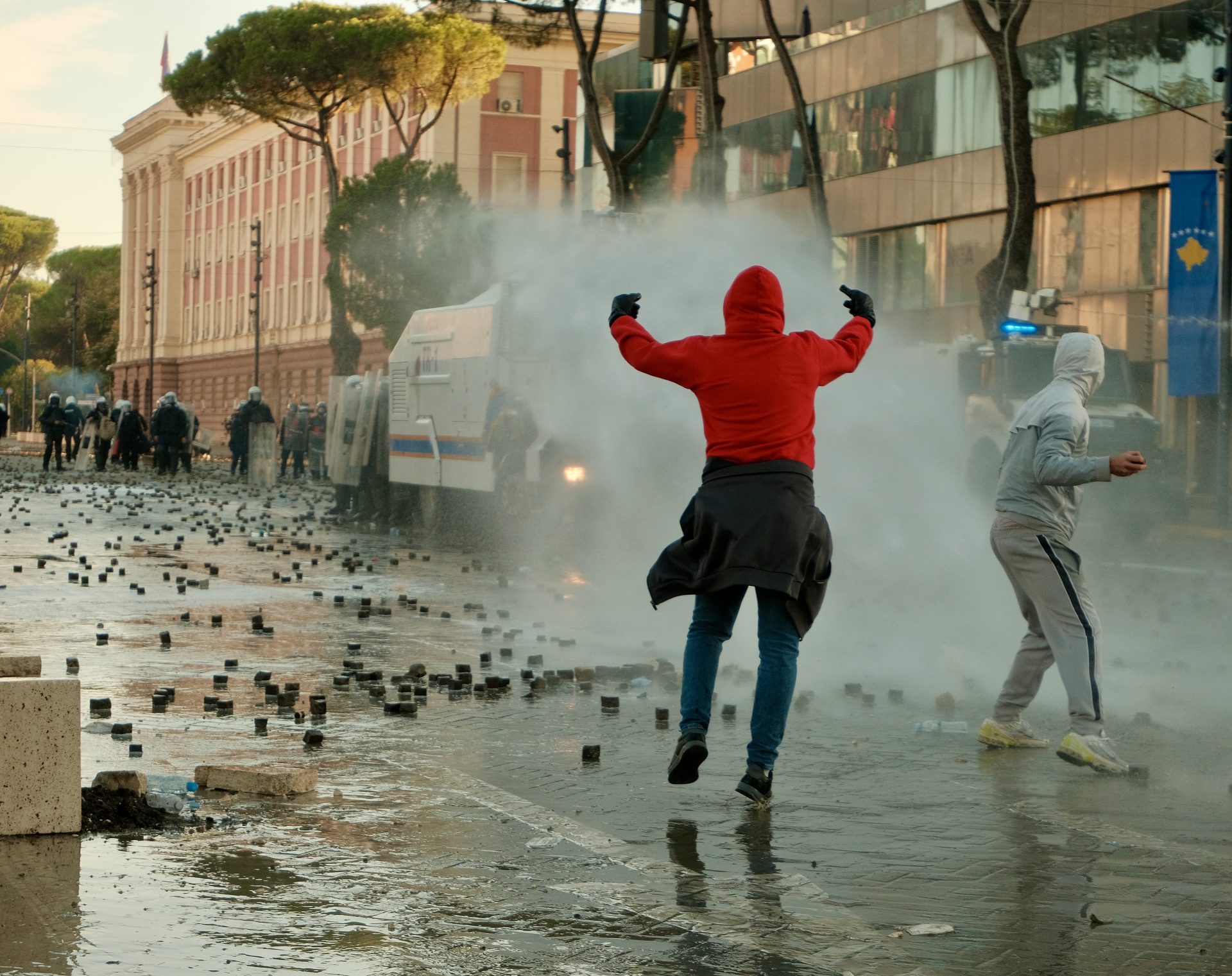
The protests, and riots, have swiftly evolved from a shock event into part of the fabric of Tirana’s daily life, a new normality for Albanians to navigate, with all its inconveniences and strange advantages. The kiosk where I was accustomed to buying my preferred local cigarettes has been burned down, like many others in the city center. On the other hand, crossing the road, a hazardous enterprise in ordinary times, has been made easier by the destruction of all the center’s traffic lights, forcing drivers to begrudgingly stop for pedestrians. The television news channels are now devoted to rolling coverage of street battles, filmed by gas-mask wearing cameramen perched atop vans. Pavement diners in restaurants and cafés watch the disorder like football fans, restaurant owners hand out bottles of water to passing rioters to shouts of “bravo”, and confused tourists choke at the tear gas as they leave their hotels, trying to make their way between the clashing lines of demonstrators and police.
Along Mine Peza Street, one of Tirana’s main thoroughfares, almost all the shops are shut, with A4 signs proclaiming “We are with you! Please don’t destroy our business!” taped to the metal shutters. At the landmark Taiwan cafe, in a park beside the main boulevard, I watched burly security guards order away riot policemen attempting to enter to arrest protesters. When the police gave up and trooped away, the park erupted in cheers and clapping. With both sides digging in for the long haul, the battle to come is for the patience and goodwill of Tirana’s wider population. In one busy shopping street, I saw passersby remonstrating with rioters attempting to burn down a bank, gesturing angrily at the occupied apartments above. “I’m disgusted at this,” a café owner told me, “Burn down all the ministries, sure, good, but leave private property and small businesses alone. Rama will never leave. I’m 40 years old, and I know Albania will never change.”
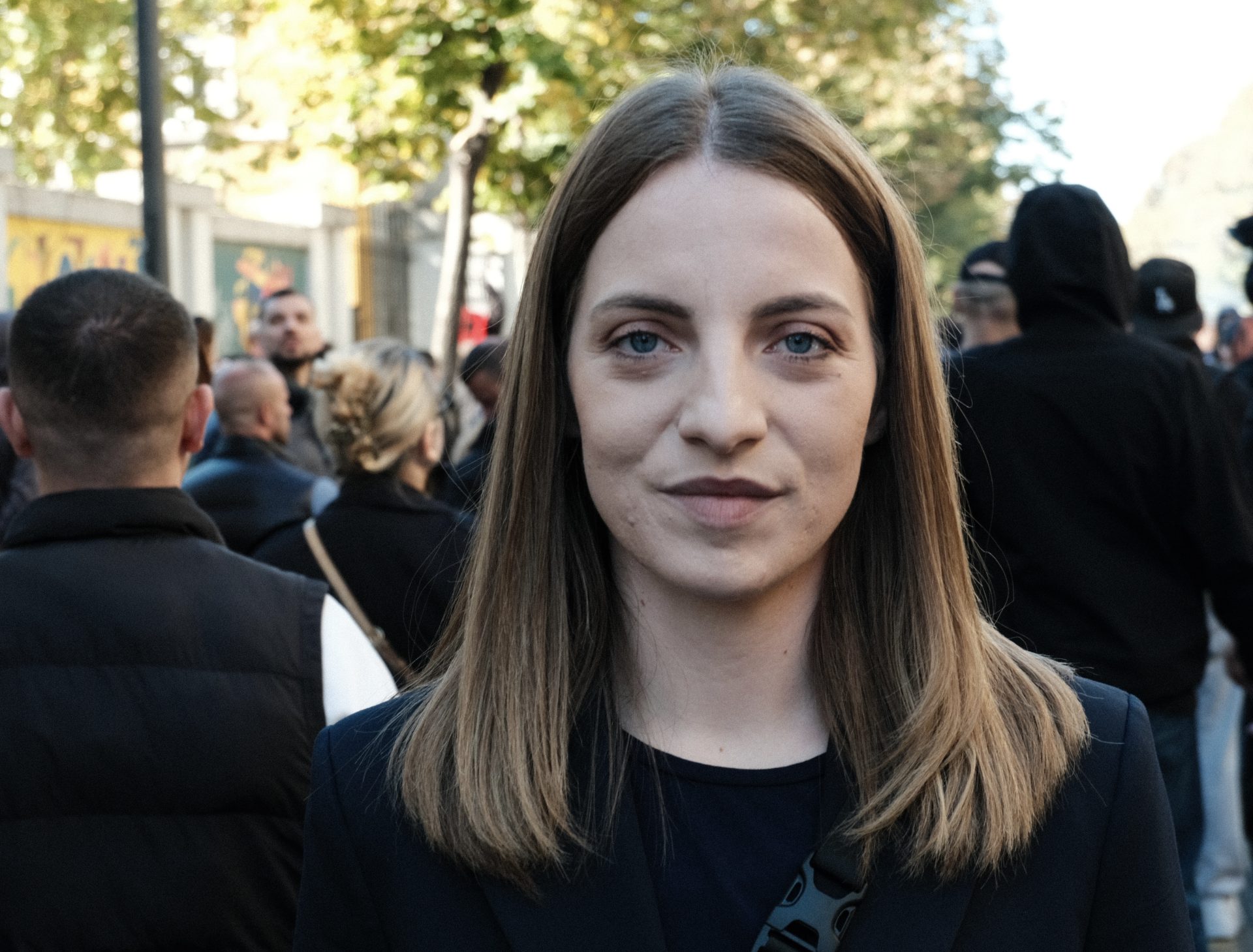
Outside the Ministry of Education, I met the 25-year old MP Marjana Koçeku, elected to parliament for Rama’s Socialist Party only last year, and who resigned when the Flamingo protests began. As we spoke, over the loud explosions of tear gas grenades, our conversation was twice interrupted by older women coming up to kiss her, thanking her for her support. “Being part of this group [the Socialist Party] I understood that just by being part and having my vote on their support, I am contributing to the destruction of my country,” she told me. “I think it’s very important to have a deep reformation of the system of the political elite that we have right now, because they are strongly rooted in a mentality of corruption, in a systematic violence of making politics and [its approach] to the citizens. So if this is a safe and healthy solution for our country, I fully support it.” Indeed, she added, “I believe that this protest will not end soon,” she told me. “I expect it to last for some time, and I definitely believe in good and positive results of this protest, and of this movement. The only and the most necessary reflection into political actions that should be coming now from the government part, is the resigning of the Prime Minister, from his government, and from politics at all, because he had enough time to witness what our nation is really looking for, and enough time to understand that he cannot be the right image of leading Albania toward the European Union, especially with all the scandals that have popped up.” I asked Koçeku if the Flamingo Protests had now become a revolution. “Revolutions are beautiful,” she smiled, “I’m looking forward to seeing one in my country.”
In the clashes on Durrës Street, I bumped into the Canadian-Albanian revolutionary activist Bora Mitrovica, who I had interviewed in the summer. You were right, I said to her, that the Flamingo protests would soon turn violent. “I know my people,” she replied, “I’m just surprised it took so long.” But whether the protests will really force Rama to resign seems doubtful. Seemingly wavering last weekend, the state’s use of coercive power has since become stronger and more confident, hampering the ability of the protesters to gather or hold their ground. The protesters’ appeals to claimed European norms on humane crowd control also suffer from comparison to the riots, and robust policing methods, now seen in France and Italy. With Rama directly linking the violence in Tirana with the riots in Western Europe, it is perhaps unfortunate timing for anti-government Albanian activists that their uprising has been overshadowed by events in the EU’s heartlands.
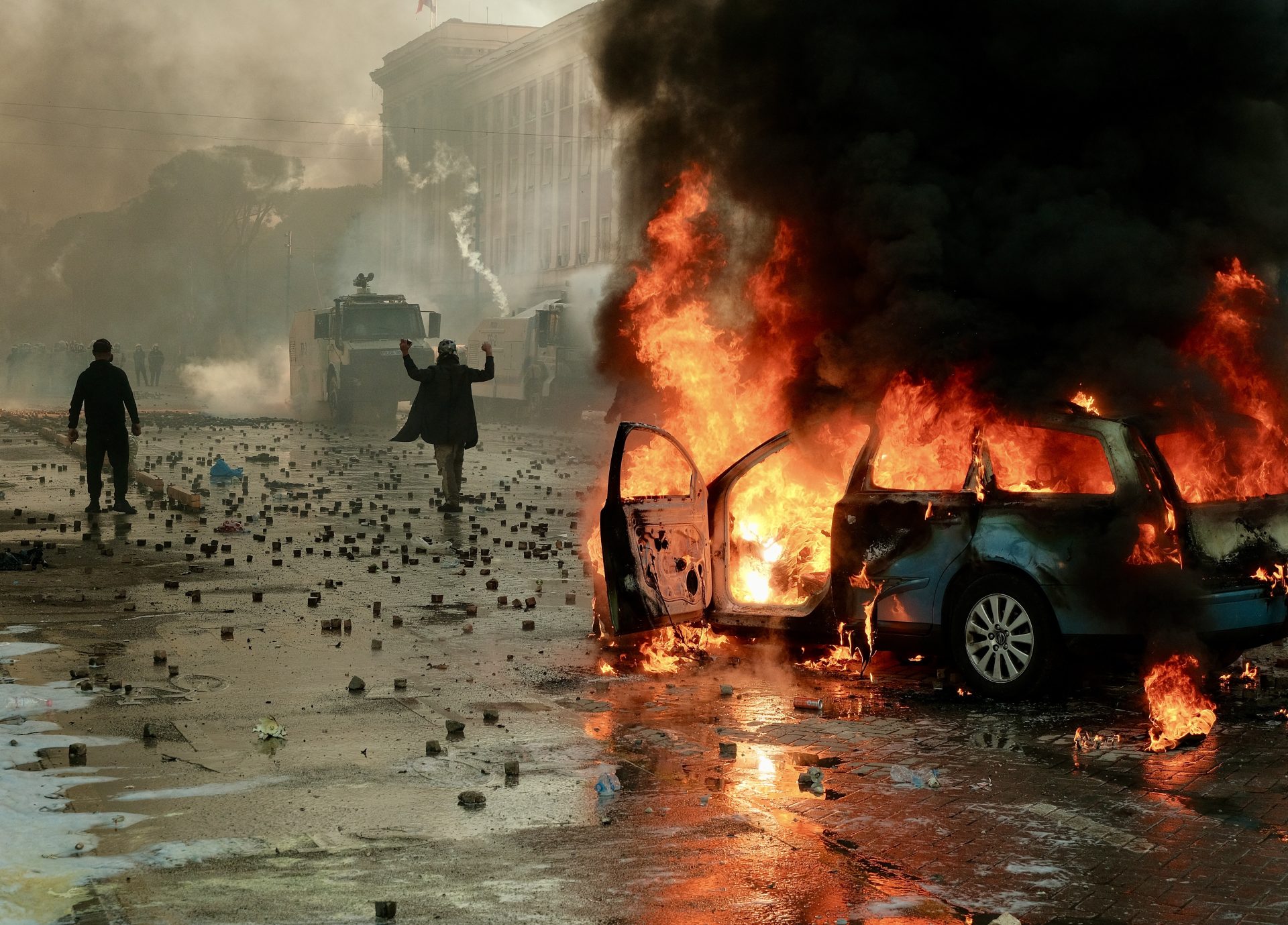
Whether or not the protesters evolve new and more effective tactics, as the government has, remains to be seen. The country’s religious leaders — Sunni Muslim, Orthodox, and Catholic, —have made joint appeals for calm and dialog, hinting at a political transition. But even if the government wished to negotiate with the protesters, it is unclear who they could negotiate with. Over lunch, an exasperated Western diplomat, who had attempted to reach out to the demonstrators, told me that they still don’t know who is leading the movement, or indeed if anyone actually is. The government’s hope, then, must now be that the attempted revolution turns back into a protest movement, with which it can choose to negotiate or else continue to ignore. Winter rains will soon be coming, perhaps diminishing the will of protesters to gather in large numbers, but also limiting the effectiveness of tear gas, upon which Rama’s authority increasingly rests. Another possibility is that the protests will evolve into an electoral movement beyond the control of either main party, as in Serbia, where the two-year student-protest movement looks this weekend to be on the cusp of power. The one thing that could tip the balance, almost everyone I spoke to told me, would be a death resulting from the riots, at which point, I was told over and over again, “anything could happen.”
But for now, two immovable objects, Edi Rama and the protesters, are locked in a battle of wills with no plausible means of de-escalation other than the total defeat of their foe. On Monday, on the boulevard, eerily quiet after the police’s overwhelming use of force the day earlier, I bumped into Bora again. “I don’t like it,” she said, gesturing at the small knot of placard-holders outside the Prime Minister’s office. “If this protest turns back to peaceful, we’ve lost.” She need not have worried: the clashes have since resumed. Overshadowed by turmoil elsewhere in Europe, Albania’s most serious political crisis in years still has a long way yet to go. Perhaps, rather than appealing to EU institutions for mediation, the greater impact will be a disenchantment with a European core not so very different in its essence to Albania after all.
