




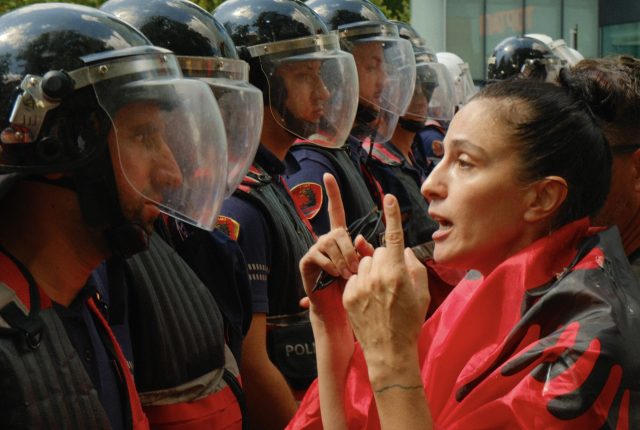
A protester remonstrates riot police in Tirana. (Aris Roussinos)





On 16 May 2026, a revolution began in Zvërnec, a sleepy village on the Albanian coast where Jared Kushner and Ivanka Trump planned to build a luxury resort. It spread across the country, as Albanians vented their frustration with a political class accused of corruption and democratic backsliding, headed by Edi Rama, the 13-year prime minister and darling of the European Union.
Aris Roussinos visited the fraught country at the height of what is now being called the Flamingo Revolution, speaking to activists, opposition leaders, and even the country’s embattled PM himself — who believes that his people have never had it so good.
* * * * *
“Why am I living in England?” Avni, an Albanian in his 40s working in London as a builder, asked me angrily, as we walked to the lines of riot police separating Albania’s Flamingo Revolution protesters from the country’s parliament. “Albania is a very good country, there is no war here. We shouldn’t be immigrants. We should come back home,” he added, telling me that his home village in northern Albania was now entirely depopulated, as everyone who could had already decamped to Britain or elsewhere in Western Europe.
“Because the government [in Albania] is very corrupted, people doesn’t get no rights, but if you know anybody from government, you’ll be a millionaire in two days. All the MPs from Albania, they become billionaires, they’ve got massive houses, massive cash, hidden everywhere. All their cousins, they got massive, massive cash. It’s a really, really corrupted government, and we’ve had enough of this. They push us all [to] Europe, but we need to come back.”
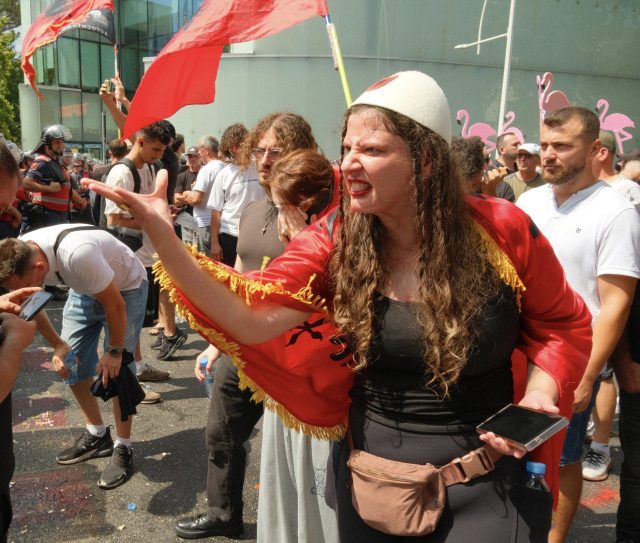
It was the 54th and most violent day so far of the street protests that have overshadowed Albania’s summer, to the chagrin of Edi Rama’s Socialist Party government, which has run the country for 13 consecutive years. “Everyone thinks that this is a democratic state,” Bora Mitrovica, an Albanian-Canadian activist, told me at the police barriers where I had found her, shouting “Down with communism!” and cursing the police with elaborate Balkan oaths. “It is not. Edi Rama is a dictator. This is a dictatorship.” Bora had just been pepper-sprayed by police, after attempting to push through the barriers towards Albania’s parliament. Protestors had hurled eggs and water bottles at police lines, and at the cars of politicians making their way to the voting chamber. When the police pushed them back with tear gas, water cannon and pepper spray, the protestors howled in fury, some breaking aloe leaves from the decorative street planting and squeezing the soothing juice into their eyes. “Dictatorship does not end with a chant, You need to fight. We need our Albanian men to stand up and not just say ‘fuck you’, because that’s not how you change the country,” Bora told me. “I advise all tourists to get the fuck out as soon as they can, because they’re not going to be able to handle what we can handle as Albanians.”
The protests had begun in the southern seaside village of Zvërnec back in May. Villagers had discovered access to their fishing boats and coastal olive groves suddenly closed off by security fencing, and construction vehicles apparently starting work on a luxury resort project backed by Trump’s daughter and son-in-law, Ivanka and Jared Kushner, and strongly supported by Rama’s government. In violent scenes, security guards and villagers clashed, before local protesters broke down the fencing and reclaimed possession of what they say is their land. Who the land in question actually belongs to remains a matter of dispute. Because of the many land reforms and disbursements marking the country’s shifts from Ottoman rule to independence and Italian occupation, and then from Enver Hoxha’s isolationist regime to the chaotic transition to democracy, claims in Albania often overlap. Frequently, more than one party can claim legal title to any given plot.
The ostensible owner of the Zvërnec coastline at the center of the Kushner project, a Miami-based businessman called Artur Shehu, has been accused by lawyers working for local villagers of forging Ottoman title deeds to seize control of their valuable property. In June, he was also announced to be under investigation by SPAK, an anti-corruption body set up by Rama’s government, for money laundering and international cocaine trafficking. Shehu, for his part, denies any wrongdoing, insisting he is a legitimate businessman who inherited the land from his medieval forebears. Complicating the story are hints, in SPAK proceedings, of government officials’ attendance at meetings with Shehu and other alleged cocaine traffickers. And SPAK files leaked to international journalists suggest that Belgian investigators noted that “these meetings appear to be related to real estate projects in Albania, potentially financed with illicit funds, with the support of political authorities”.
At the same time, SPAK stresses that “at this stage no evidence is presented that identifies the officials involved or proves their participation in illegal activities”. The gap between these two claims is now, in Albania, filled with feverish and dramatic political speculation, used by the opposition Democratic Party to claim high-level political corruption.
* * * * *
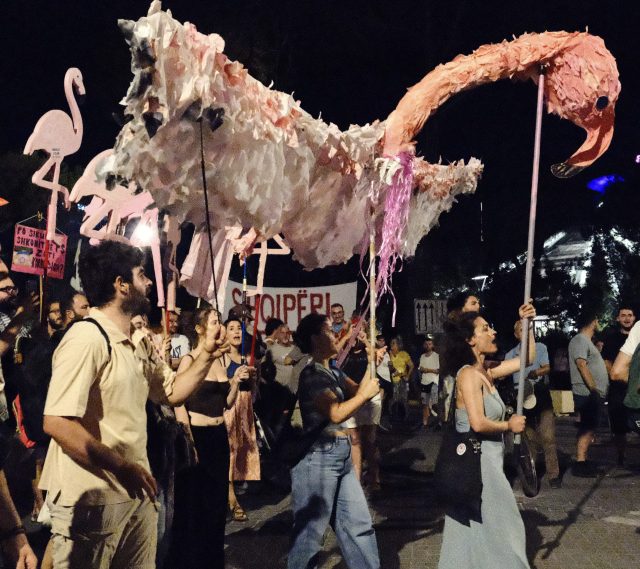
Because the salt lagoon at Zvërnec is a rare European breeding ground for flamingos, the initial protests in Tirana were environmental ones, with festive protesters carrying giant styrofoam flamingos as their emblem. But over the course of the following weeks, the protests escalated from halting construction on the project and reinstating Albania’s recently quashed environmental protection laws, to demanding what is in effect a full revolution against the entire political system. The protesters now insist that Rama must resign and face trial for corruption, along with the leader of the opposition, Sali Berisha, while Albania must install a 12-month technocratic government before new elections. Naturally, Rama is not inclined to agree, hence the current standoff.
Though the nightly protests along Tirana’s leafy boulevards are good-natured family affairs, those in the morning are rowdier, bringing along a more committed core of activists who declare themselves to be revolutionaries. While there are young masked men to be seen throwing missiles, and older working-class men wearing the traditional Albanian felt cap or waving the flag of Greater Albania, the majority are from the young, highly-educated and socially liberal Tirana bourgeoisie, as well as the diaspora — ordinarily a reliable vote bank for Rama’s reformist and pro-EU government. Conservative young women in hijabs stand alongside heavily-tattooed hipsters, chanting “Rama, hand in your resignation,” in Albanian at the police lines, to the tune of The White Stripes’ “Seven Nation Army”, or “Rama, Rama, Fuck You,” to the tune of “We Will Rock You”.
Over the days and nights of protests I attended, long and passionate speeches condemned the government as terrorists, as a dictatorship, and bemoaned the claimed sell-out of Albanian land to Israeli interests. The latter, rather conspiratorial, claim transpired to be a regular theme when talking to Albanians. Even stickers observed on lampposts in central Tirana depicted Rama as a stooge of George Soros or as a Hasidic Jew. Xhoana, a fashionably dressed marketing executive, told me: “Our government is selling our land to Jared Kushner and Ivanka Trump, and the oligarchs in our place. They don’t work for the people. We want a revolution because everything is a mess.”
“Albania right now doesn’t need a revolution,” said a government spokesperson, who insisted on anonymity, drawing on a cigarette at a pavement cafe. “People have been saying for 50 days we need a revolution, but they have no plan for what comes next. A revolution at this stage, when we are so close to going into the EU, is a dangerous thing.” Rama’s Socialist Party government has pledged EU entry for Albania by 2030, but negotiations have dragged on since 2009, delayed by rule of law concerns, the country’s relative poverty, and worries over organized crime — particularly the domination of international cocaine trafficking by Albanian clans. Russia’s invasion of Ukraine reignited the accession process, as EU officials felt compelled to exert the bloc’s agency in the new age of geopolitical competition. But the window for accession may be narrow and short-lived. For both the ruling Socialist Party and the EU, this summer’s mass protests are an unwanted complication.
“Europe, chiefly the European Commission, they wanted to see all progress,” Genc Pollo, a prominent Albanian conservative intellectual and former Deputy Prime Minister told me. “They didn’t want to see the democratic backslide, and in their annual reports, they omitted all the problems, for whatever reasons.” A skeptic of Albania’s progress under Rama’s government, which he termed a “narco-state,” ruled by a “klepto-regime”, Pollo told me that “Rama has allowed for the Albanian rings, which bring coke from Latin America to central and northern Europe, to launder their proceeds in construction. And then, I mean, when elections come, they, with their money and their muscle, they help him get the vote.” But, in his telling, European diplomats are deaf to the opposition’s concerns. “Edi Rama is a master in staging things, and organizing, in having summits in Tirana, and having the leaders in some restaurant presenting a pizza, with his face on the pizza box, and then you have the President of the European Commission, saying ‘Oh, this is wonderful, this is wonderful, oh, dear Edi’.”
On the face of it, though, the protests, supported by every single Albanian I spoke to who wasn’t a member of the government, seem strangely timed. Under Rama’s rule, Albania’s GDP has almost tripled in a decade, a growth rate Western Europeans can only envy. New tower blocks, exuberantly designed in the flush of new wealth, loom over Tirana’s handsome Mussolini-era civic architecture and the few surviving Ottoman mosques and coaching inns. Until recently seen as rather outré destinations, both Tirana and the country’s many fast-developing beach resorts are now filled with tourists, both northern Europeans seeking summer sun and Turks and Gulf Arabs escaping it. The bustling cafes, bars and restaurants are as stylish and comfortable as anything elsewhere in the Mediterranean, if no longer significantly cheaper. Albanian wages have not kept up with the rapid inflation of prices, particularly of food and property, introduced by the influx of money, legitimate or otherwise. In some ways, Edi Rama appears a victim of his own success.
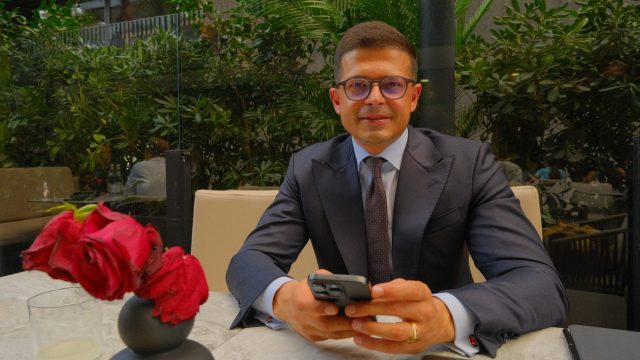
The protesters are “an urban group of people, predominantly highly educated”, says Pirro Vengu, a Socialist Party MP for Vlorë, including Zvërnec, over coffee at one of those stylish restaurants. “The paradox is that this is the youth that has come to age during this government. So, apparently we’ve done something right, right?” Young, smartly suited and charismatic, Vengo is a rising star in Albanian politics, who even government critics in Zvërnec ruefully admitted liking. “It’s also totally legitimate that Albanians are not comparing the country now to its tragic past of the Nineties. We’re not the poorest country in Europe anymore. We’re comparing ourselves to Western Europe, where all Albanians have traveled several times.”
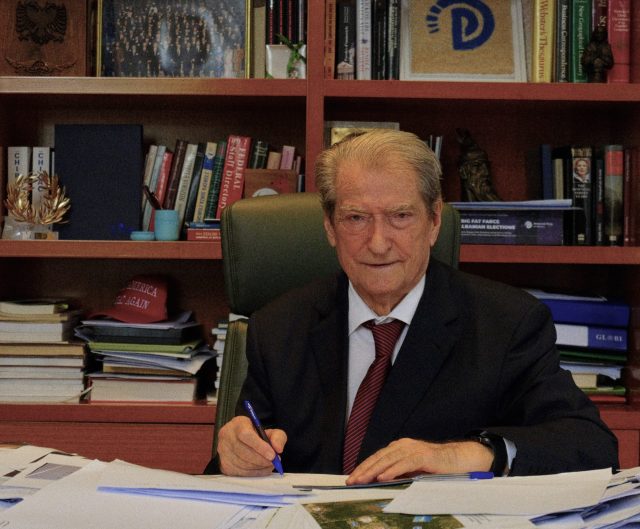
For all the country’s economic success, Albanian political discourse is riven by eyebrow-raising claims of impropriety, emanating most strongly from the opposition. In his office in Democratic Party headquarters, Sali Berisha, the 81-year old leader of the conservative opposition, came out from behind a desk piled high with papers to shake my hand. Behind him, on the cluttered bookshelves, a MAGA baseball cap and framed photograph of Mother Theresa vied for space. Albania’s first democratically elected leader, and the architect of the country’s Western orientation, Berisha is as central a figure in shaping the country’s modern course as his arch-rival, Edi Rama. Just a few weeks earlier, the Trump administration, citing national security grounds, had lifted the Biden-era entry sanctions placed against Berisha for corruption in office, which he denies. British sanctions remain in place — unjustly, Berisha told me, handing me a printout of an FCO document relating to his case, and accusing the previous British ambassador of being “corrupted” by Edi Rama. The influx of money from criminal proceeds, Berisha told me, had distorted the country’s economy, wrecking Albanian exports to Europe while being laundered in high-value construction projects. “If you look to this country,” Berisha asked me rhetorically, “What you will find? You’ll find an extraordinary power in the hands of Edi Rama and his government, which is the power of drugs. The power of drugs is many, many billions of euros. The power of drugs, of Albanian drug cartels, controls everything in this country.”
Recently returned to frontline politics after defeating internal rivals within the Democratic Party, Berisha eyes the protests as a route back to office, or at very least as weakening his bitter rival Rama’s grip on power. He concedes that “maybe 20%” of the slogans demanded his jailing, but assures me that these demands were made only by “Left-wing extremist groups”. For the most part, he said, the protesters were against the government, “and their cause is just. [It] is our cause. That’s why we fully support it. We fully respect it, we do not try to take the leadership of it.” As for his rival himself, “Edi Rama treats Albania like his personal fiefdom, in which he could do everything,” Berisha told me. “Like being a sultan, in a sultanate of centuries ago, where the air, the land, and the water, are considered property of the sultan.”
* * * * *
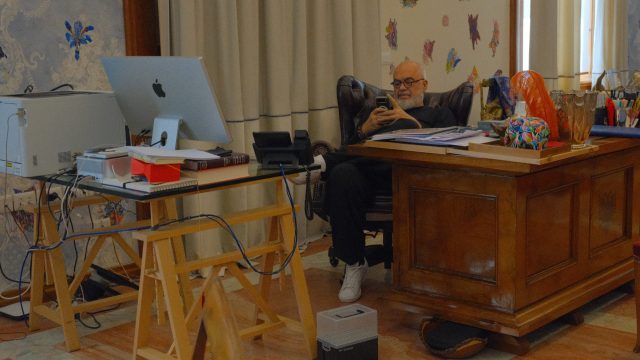
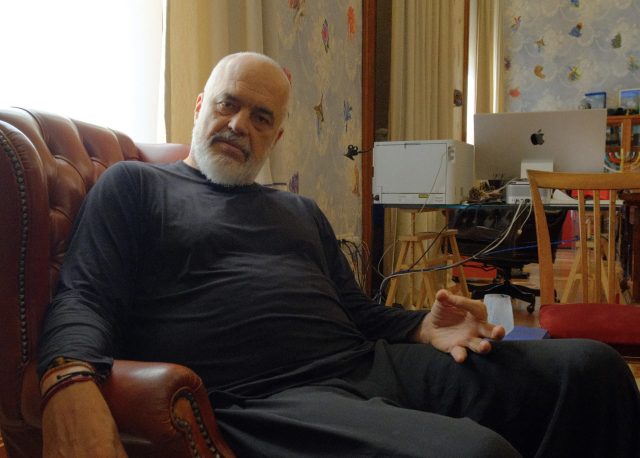
The Prime Minister’s Office is in a handsome Rationalist building opened in 1941, designed to house the Italian colonial governor. Attendants there ushered me through long corridors, lined with classical Greek and Ottoman ceramics and into Edi Rama’s office, where he pointedly ignored me for some time, busy scrolling on his mobile phone. Rama had been an artist and writer before entering politics as the reformist Mayor of Tirana, whose policy of beautifying the capital had turned it into an Instagrammable tourist destination, and himself into Albania’s second longest-serving ruler since independence in 1912, surpassed only by the communist dictatorship. A big and powerful-looking man, today dressed all in loose, black clothing, apart from spotless white trainers, the fiercely intelligent Rama is as charismatic as he is intimidating. But recent international interviews had been fraught, making the mood in the office tense. When Rama finally sat down beside me, leaning into his chair, I asked him his opinion of the protests.
“The protests today are not the protests of June, so the people who spoke today are different. They are engaged in political parties. They are engaged in opposition parties, small parties of opposition, Leftists from the extreme and Rightists from the extreme,” he claimed, “While the June protests were different, were bigger, a lot of people that voted for us were there.” In any case, “I am very, very proud that we have had such a big protest for days in a most peaceful manner, and that nobody was hurt, nobody was stopped to do what he or she wanted,” he added, “The bottom line is that this protest shows a country that is like a normal European country where you have protests.” Repeating his government’s claim that the protests were being stoked by foreign actors, he suggested that “the algorithm did a lot to bring them to bring them in the boulevard, you know? Listen, I’m telling you, one of the things that we have seen from the back of the mirror, the social media, is that a very high percentage of the content is produced outside the building. It’s not Albanian.” Indeed, Rama added, “If this would not have been about Jared Kushner and Trump and Ivanka and all type of fantasies, this would not have been so good for the algorithm,” but the Kushner link “brought all the anti-Trump people on steroids.” When I demurred, he added, “You are an exception in this if you are not looking for an angle to say how terrible Trump is and how he’s killed flamingos in Albania.”
* * * * *
But neither Trump nor flamingos seem the prime source of discontent down in Zvërnec. “Albania is not a democracy,” an older man told me in the village’s heavily-accented Greek. “They are thieves, all of them, Edi Rama and Sali Berisha are the same,” he said, rubbing his forefingers together for emphasis. “We have had no water here for two months. I have to use my little well, but then they take everything we own here for themselves.” A local woman agreed. “They have taken my elderly father’s olive groves. We have had these plots from generation to generation but they won’t give us the papers saying they belong to us, not even for the house we live in.”
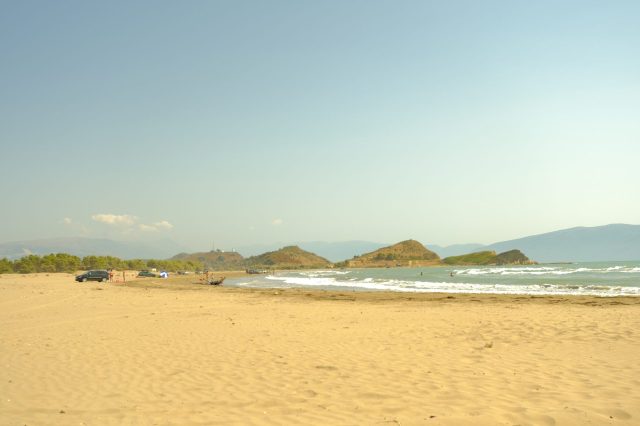
For the birthplace of Albania’s political crisis, Zvërnec is a sleepy place, a village of a few hundred people, mostly ethnic Greeks or Hellenized Vlach pastoralists. Close to the southern city of Vlorë, whose thudding beach bars stretch along the sandy shoreline to the village boundaries, Zvërnec reflects an older, unspoiled Mediterranean, increasingly a nostalgic memory even in Albania. Wading birds hoot and croak in the coastal marshes of the Vjosa delta, cicadas rasp in the olive groves, shaded from the ferocious summer sun: it is all reminiscent of the Greece of maybe 30 or 40 years ago. “We want investment, but not this investment,” one woman told me. “This is our land, and we have never got our family land back since 1991. We also don’t want Israelites here — this is Albanian land, and if they come here we will kill them.”
On Zvërnec’s wild sandy beach of Portonovo, empty save for a handful of local families, happily ignoring the notices forbidding them to swim, I met Kosta Xhaho, the local project coordinator for PPNEA, Albania’s largest environmental NGO. This is, he told me, one of the most important, turtle nesting areas, and Ground Zero for the protests that had long migrated to central Tirana. “We started to protest here. Then we started to fight with those bulldozers that started to construct a road and the trucks in the protected area. And then we started to fight with the security that they put on the fences, and now we are fighting with the government to change the law, so this area is to stay protected forever.”
PPNEA’s wish is for the beach and the rest of the coastline to remain public land, as was all the way back to King Zog’s Kingdom of Albania. But it is a highly marketable commodity, just as much for those who have farmed it for generations as for the Kushners. And it is not clear that the villagers themselves wish the site to remain undeveloped, rather than profiting from the tourism boom they believe Shehu has stolen from them. In nearby Vlorë, local opinion is distinctly more in favor of the Kushner project. “These people [in Zvërnec] are stupid,” a Vlorë taxi driver told me. “They don’t want to go forward, but it’s one of the biggest investments in Europe. It’ll be so good for our city. I just hope it’s like they say it is, and Israel doesn’t build a base there,” he added. Even so, he told me that he supports the Tirana protests “because they’re about high prices. Albania is a very poor country still, and very corrupt.” I asked him who he voted for. “Rama, of course,” he said, looking at me as if I’d asked a stupid question, “Every time Edi Rama.”
For Rama himself, re-elected just over a year ago for a fourth term, the protests have come as a jolt of shock. In the recently released “Besa” strategic document, whose name alludes to the unbreakable oath-making central to traditional Albanian culture, Rama’s government declared that “the flamingo boulevard” presented “a mirror that society held up before us”, and proof that “ever more Albanians, including older ones, no longer compare the Albania we have with the one we had in 2013, but only with the one they themselves believe Albania can and must be”. Much of the Besa document seems to draw from de Tocqueville’s observation that the most dangerous moment for any regime is when the rising expectations derived from reforms already undertaken make any residual injustices seem intolerable. “The citizen who has more than yesterday,” the strategy’s authors write, “is a more dissatisfied citizen. Precisely because they live better today than yesterday, they likewise believe that their country is capable of doing far more than it does today.” In a recent open letter, the former Socialist Party insider and Rama loyalist Elisa Spiropali, recently removed from her role as Europe Minister, declared that the protests represent a “political and social mobilization, especially among the younger generation, that cannot be ignored without consequences.” In what can only be read as a critique of Rama’s governance style, Spiropali asserted that Albania requires “not more personalization of power, but institutions stronger than individuals”, “more humility, less arrogance”, “more representation and less concentration of decision-making”, to build “a state where the law stands above power and where power is not identified with any one person”.
When I asked Edi Rama whether Spiropali’s open letter highlighted inner disputes within the Socialist Party, he shut down the question. “This is a very internal, domestic thing,” he said. “And we have to keep it for our own because I don’t think we have to export our internal things outside for the audience, because then it becomes like feeding with curiosity, feeding with curious things, an audience that is not at all inside the story, not informed or nothing.” But the opposition had no such qualms, I replied, adding that Berisha had made very specific allegations that political figures within Rama’s inner circle had attended the Aruba meeting with the alleged drug trafficker Artur Shehu, and that the government had uncomfortable links with organized crime bosses. “Where is it? Who, where? Where is the picture? Where is the document? Where are the tickets? Where, where?” he responded. “So how would you answer,” he added, pointing at me, “for example, an allegation that you were yesterday with some drug dealers in the hotel where you are sleeping. How do you answer that?”
He went on, “Yeah, the opposition figures may tell you many things, but it’s not for me to say to you, if we are linked or not, it’s for them to prove that we are linked or not, because I’m really disgusted from years now that in this country… that the burden of proof has passed to them who were accused.” Asked about the opposition’s characterization of Albania as a narco-state, Rama dismissed the idea entirely. “You can say whatever you want. But ‘narco-state’, a narco-state that started to close negotiating chapters with the EU? It doesn’t match in any shape or form. If Albania has problems with corruption, Albania has never fought corruption like these years. If Albania has problems with crime, Albania has never fought crime like these years. And when it comes to crime, I’m telling you, we pay a big price in the Balkans, to the fact that people from the Balkans are very active in organized crime. Outside. But the industry of the crime is not here. It’s there.”
Referring to my being a journalist, he added, “You know narco-states, I guess, how they feel like, you know corrupt poor countries, how they feel like, you know middle-income countries, how they feel like. I don’t think you need me or whomever else to tell you in which type of country you are, with all the goods and the downsides… It doesn’t feel unsafe, it doesn’t feel like a poor country, you don’t feel all these things.”
I asked Rama if, having secured his place as one of the most significant figures in Albania’s history, he worried that an escalation of the protests might harm his legacy. “No, how protests can threaten the legacy?” he said, “I like the pressure.” He had ridden out two previous waves of protests, he told me, maybe bigger than today’s, in 2013, just after entering power, and also in 2018. “When it came to the first one, I pulled back because they were right. They had a very strong point. I said, you are right, we’ll stop. And it ended, they got what they wanted. Second time, I didn’t pull back. But I started a conversation with them and we did good things. This time, I learned things, so we are not going to pull back from the [Zvërnec] project, for sure. But we’re gonna make a [consultation] process.” In the end, he added, “I strongly believe the project will close this chapter completely because it will be beautiful.”
Many Albanians I spoke to, including those otherwise supportive of Rama, likened his current situation to that of Serbia’s strongman Aleksandar Vučić — not, in Albania, a flattering comparison — who has also won the EU’s favor while facing down months-long street protests. While it is unlikely that the protests alone will unseat Rama, they clearly highlight a growing disaffection with the two-party system, and the current politics of patronage. Mostly young, liberal and highly-educated, the protestors are, to a large degree, Edi Rama’s children. For nearly a generation, Rama’s brand of developmentalist, benevolent paternalism has transformed the country into a genuinely dynamic boom economy, at a dizzying pace. But like the villagers in Zvërnec, Tirana’s middle classes feel poorer, not richer, for the visible growth and wealth sprouting around them. For Western observers, now accustomed to stagnant wages and the limitations of two-party systems, Albania’s political crisis shows, ironically, how European the country has become, even while stuck in the EU’s Balkan waiting-room.
With the protests continuing, contrary to early expectations, through August, the likelihood of their escalation in the cooler weather of autumn, when holidaymakers have returned home and students have returned to classes, appears to be growing. But juggling his attempts to secure the simultaneous approval of EU observers, of the mercurial and acquisitive Trump administration, of the party shaped in his own image and of his increasingly restive voters, Rama projected only calmness. Leaning back into his armchair at the end of our meeting, he told me, “Listen, I am 13 years here now. So I have three more years. I have nothing to prove to myself. Because in the beginning, you know, there are many things to prove to yourself. As you said, I have my place in the history of this country, then, in which light this will be decided by the people.”
But navigating the vagaries of the second Trump administration has increased the pressure on Edi Rama, whose attempts to court favor with the American president, whether by signing up Albania to Trump’s dubious Board of Peace scheme or by pushing through the Kushner family’s contentious real estate project, has revealed previously hidden fractures within his own voter base. Rama’s only reward, so far, has been Washington’s sudden rehabilitation of his bitterest political rival, Sali Berisha, in what can only be read as a means to exert American pressure. What happens over autumn will now decide everything, Sali Berisha told me. “Very much will depend on September. Will they re-energize, remobilize? Will opposition parties succeed to get united in a large front? To persist for a caretaker government for new elections, or not, I could not predict. It’s difficult, but I think it’s vital.” But the Democratic Party’s chances of riding popular dissatisfaction to power seems doubtful, given the broad, anti-systemic nature of the protests. In the street directly outside Berisha’s office, pausing to check my phone, I noticed a slogan prominently scrawled on a large metal bin. “Revolucion, Rama Burg, Berisha Burg,” it said, Rama to jail, Berisha to jail. It is, by far, the most popular slogan shouted on Tirana’s streets.
