




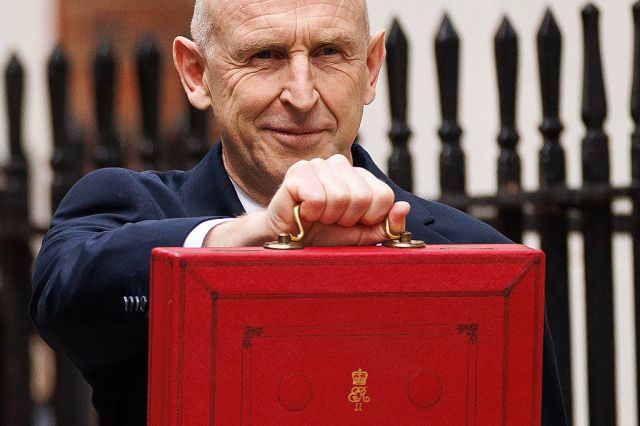
“Healey emphasizes continuity with his hapless predecessor.” (Dan Kitwood/Getty)





Many British politicians like to think of history in terms of seismic shifts; that the past is a succession of epistemic breaks, of ruptures in what economic historians now call “growth models”. In this telling, 1945 was the birth of postwar socialism, 1979 the beginning of neoliberal revival, 2008 the end of a long, doomed experiment in financial globalization. Andy Burnham is a man who thinks in such terms, with his “circuit breaker” on “40 years” of Northern hurt, with his “four horsemen” of neoliberal apocalypse.
John Healey is different. Where the Prime Minister is all about the rupture, his Chancellor emphasizes “continuity” with his hapless predecessor. Never mind that Rachel Reeves has been voted the least popular recent resident of No 11 — as a former Treasury lackey of Gordon Brown, Healey was trained not to rock the boat too aggressively, lest the judgment of “the markets” and Fleet Street’s business pages condemn Blair’s Labour as “New” in name only. Presumably, in those halcyon days, the budding junior minister Healey didn’t slog away in the belief that he was complicit in the maintenance of some great four-decade injustice. If the last “40 years” are to be blamed for blithely destroying social-democratic Britain, then it’s as much the responsibility of Blair, Brown, and ministers like Healey as it is Margaret Thatcher, who after all left office when the Soviet Union was still around.
And herein lies the central feature — the central contradiction, some might say — of Burnham’s first Budget: the dissonance between his lofty promises and the policy reality. This was no “circuit breaker”, no fundamental shift, no new growth model. This was merely a placeholder, a tinkering exercise, a nothingburger of small-cash transfers and bean-shuffling. In short: about as much as we could have expected from a consummate Brownite. Since 2024, after all, we have been stuck in a half-baked rerun attempt at Gordon’s grand bargain: keep the financialized, globalized, FDI-dependent paradigm largely intact, but redistribute the proceeds of growth via cash transfers, statutory entitlements, and tax-and-spending. That was the modernizers’ Faustian pact. Alas for poor Healey, post-Great Financial Crisis, there is now little growth to speak of, and the whole Blair-Brown paradigm is dead.
In lieu of a replacement for this zombie model, then, we got what Healey called “a Budget for the working people of Britain”, the biggest item on which will be yet another energy-bill subsidy for poorer households (to be judged by council tax bands). There will also be some extra, modest, off-the-books investment via the British Business Bank and the National Wealth Fund. And there were some mild adjustments to capital-gains allowances, and some small rises to gambling and bank taxes. It could have been a lot worse, the spivs and the City will have concluded. Foreign bankers and hedge funds too: those omnipotent gilt markets were pretty relaxed about the Chancellor’s “steady-as-she-goes” measures. Sky’s Ed Conway tallied up the tweaks: 98 in total — a new record. But the average gross value of each pecuniary item was tiny — the lowest on record. Departmental cuts, meanwhile, are being shunted towards the end of the Parliament, rewriting St Augustine’s prayer: “Lord, make me fiscally sustainable, but not yet”.
All of which is to say: how long can this discordant Downing Street double act go on for? Surely the new dialectic between Burnham’s dad-socialist idealism and its conservative, Healeyite antithesis is bound to be resolved in an electoral and real budgetary synthesis before 2029? The prime minister cannot spend three years bobbing along with grammable titbits of cost-of-living policy while promising a post-election new dawn. Something will have to give, and despite the repeated denials, all other signs point towards an early poll. Burnham has restored Labour’s lead and has high personal ratings. Those will be slowly squandered as the inevitable compromises of power begin to bite, and as global stagflationary forces accelerate. Healey’s programmed cuts to Whitehall spending for the supposed year of the next election are testament to this. It would be suicidal for the Government that is promising post-neoliberal national renewal to begin a round of austerity heading into the year of a general election.
Burnham is caught between the cautious pledges of Labour’s thin 2024 manifesto and the necessities of a bleak fiscal outlook. The temptation to seek a fresh mandate for a more ambitious agenda — for a National Social Care service, publicly owned utilities and reindustrialization-through defense investment — will grow by the day. What’s more, running an election campaign against a still second-placed Reform Party, which rightly or wrongly the majority of the electorate is genuinely repelled by, is far more attractive to Burnham than waiting for the revived Conservatives to run a more traditional, less scary, less risky campaign against Labour profligacy.
But it isn’t simply political considerations, nor mere timidity, that is preventing a major Budget intervention before the next election, whenever that turns out to be. For Healey really is constrained by economic realities. Transformative investment that might finally change Britain’s economic geography is, whether the Labour Party likes it or not, currently precluded under the current framework, not least by spiking gilt yields. Somewhere along the way, the bond market, along with the OBR, has become a kind of unelected second and third chamber, fastening successive administrations to a narrow orthodoxy.
Yet there is nothing natural, pre-ordained or apolitical about this arrangement. The markets are not permanent, capricious deities that must be placated. They are institutions, governed by rules and political decisions. A radical Budget could have set out a major investment program to renew public capital stock, focusing on energy, transport and industrial capacity. It could have leveraged public financial institutions to finance it, and mandated pension funds to leverage their mountains of capital toward domestic investments. It could have instructed the Bank of England to use its balance sheet to hold borrowing costs down and invest in public infrastructure bonds for growth and revenue generating capital projects, all while bypassing Britain’s labyrinthine planning laws.
More than Burnham’s abstract seismic shifts, the lesson of the postwar settlement is surely that it didn’t depend on ministerial speeches. It relied, rather, on capital controls, on directed lending, on nationalizations, on price controls, and close fiscal-monetary coordination. Ending these policies was integral to the “neoliberal” revolution that Burnham decries, and, in extremis, reimposing some version of them would be integral to any truly “post-neoliberal” order. Tellingly, two recent papers from Mainstream, the pro-Burnham parliamentary grouping, have nodded in this direction. The first, “The Productive State”, calls for extensions of public ownership; the second, “Reclaiming the UK’s Fiscal Space”, argues for an alternative macroeconomic strategy to facilitate a radical agenda.
None of this is costless. There would be losers, not least the substantial body of Britain’s asset-rich middle class. Any push to radically increase capital investment would have to be accompanied by demonstrations that ballooning current spending could be brought under control. The middle-class homeowner with a large, unearned rise in the value of their house, the landlord collecting rent from an increasingly scarce asset and the affluent saver accustomed to earning a safe return without productive investment in the domestic economy — all would face a different bargain with the state. But the purpose of policy would no longer be to preserve asset values, maximize private shareholder returns, then redistribute whatever income remained. It would instead be to end the Faustian pact, and begin a shift from a bureaucratic cash transfer and entitlement state, towards an investment-first, productive state. But Healey and his boss have chosen not to make the argument, accepting the orthodox framing and the market’s verdict before testing whether it could be challenged, managed or otherwise politically overridden.
When Burnham selected Healey as his Chancellor, there were reports that it was because he was a smaller beast than Ed Miliband or Shabana Mahmood, and could therefore be relied upon to roll over and impose No 10’s will. No 10 North has been conceived as the most significant breach in the Treasury’s monopoly on economic policy since Harold Wilson’s ill-fated Department for Economic Affairs. And yet for all the talk of a Prime Minister willing, finally, to get to grips with a proper political project, the offer of his first Budget is a thin gruel, totally at odds with the stated ambitions of his office. It seems that Healey is more powerful or persuasive than first thought — less willing to implement Burnham’s whims come-what-may, and more beholden to the Treasury mandarins. Never one to shy away from contradictory spitballing for political convenience, perhaps Our Andeh only ever intended a radical systemic overhaul at the level of rhetoric and vibes: unite the Labour Party and the progressive voter bloc by talking Left, but keep the show on the road by governing Right. Only time will tell.
Of course, it would be foolish to assume a real break with history could arrive in a single Budget. Labour’s “1945 moment” didn’t invent social democracy from thin air, but rather rested on decades of embryonic welfare state experimentation and the wartime command economy. Thatcherism had a prehistory too: before 1979, the IMF crisis and James Callaghan’s warning to his party that the Keynesian option “no longer exists” had already narrowed the field of acceptable economic policy. Perhaps Burnham’s rise, Healey’s cautious Budget, and the likely election to come will be remembered in the same way — not as the moment Britain emerged, fully formed, from “neoliberalism”, but rather as stepping stones away from a model that no longer works. Yet for now, at least, that much-touted new settlement remains mere aspiration — maybe until that election.
Jonny Ball is a Contributing Editor at UnHerd. He formerly wrote under the name Despotic Inroad.
 DespoticInroad