




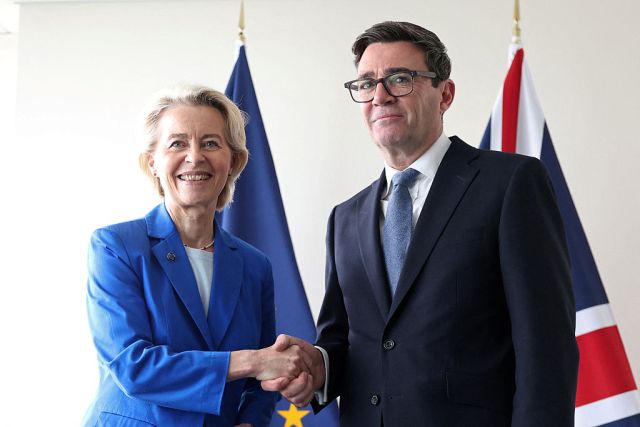
“Like Luther, Burnham can do no other.” (Toby Melville/WPA Pool/Getty)





A British politician’s attitude toward the EU is as immutable as his blood type. One is either EU-positive or EU-negative — and Andy Burnham is most certainly the former. Last week, during a BBC Radio 4 interview, the Prime Minister casually opened the door to a Brexit reversal. “I would like to see Britain rejoin in my lifetime,” he said. Meanwhile, The Guardian reported that Downing Street officials have already contacted pollsters and think-tanks to test public support for the UK rejoining the EU. Like Luther, Burnham “can do no other” when it comes to EU politics.
Is reigniting the Brexit wars really a clever idea? I personally favored Remain in 2016 but became disenchanted by the campaign’s excessive focus on dubious economic claims. I argued at the time that Remain should offer a positive vision of Europe, rather than doom-mongering. But if Burnham asked for my advice today, I would tell him: don’t look at the polls. Don’t worry about “Bregret” or Labour Party politics. Look instead at the state of the EU, which has changed dramatically since 2016.
Right now, the EU is not a club you’d want to join. In fact, the sensible Icelanders recently voted against pursuing EU membership. Despite barely surviving the Eurozone’s sovereign debt crisis, the EU never bothered to fix the underlying problems that triggered it, such as a fragmented banking system and the lack of a common capital market. Now another sovereign debt crisis could soon be on the horizon, with French interest rates going through the roof. And if the polls are right about France’s presidential election next year, the political center might shrink or even disappear as a political force, leaving France and the Eurozone under the influence of the far-Right. Does Britain really want to be in the same club as President Marine Le Pen or Chancellor Alice Weidel?
If Britain were to foolishly seek to rejoin, it would doubtless get a raw deal. For one thing, the EU will not be able, or willing, to offer the UK any rebates or opt-outs. In the past, such concessions have been achieved through diplomatic master strokes. Margaret Thatcher negotiated the rebate after driving everybody crazy about the issue. John Major landed the opt-outs, including from the euro, because he would otherwise have vetoed the Maastricht Treaty in 1991. But the age of miracles has passed. Since then, the EU’s finances have deteriorated. Germany is no longer prepared to bankroll the EU as generously as it once did: the fractious coalition in Berlin needs all the money it can get just to survive. Meanwhile, Le Pen has pledged to reduce France’s EU budget contributions. If she succeeds, other European nations will have to pay more; if she does not, she will almost certainly block anyone else from getting a rebate. I cannot conceive of any political constellation that would allow for Britain to rejoin on the cheap.
In fact, according to my calculations, Britain’s annual contributions to the EU budget would be around £30 billion in today’s money if it were to rejoin. That’s about half of the UK’s entire defense budget. How would Chancellor John Healey pay for this: by cutting defense or welfare spending, or else by raising VAT? Pray tell!
You might now accuse me of knowing the price of everything and the value of nothing. So let’s talk about value for money. For the most part, Britain’s EU contributions would not go toward investments, such as cross-border railways, hyperscalers, or nuclear fusion. Instead they would be redistributed to other member states. Where is the value in that?
There’s another, even bigger obstacle to Britain rejoining the EU: Artificial Intelligence. What almost nobody engaged in the Rejoin debate is thinking about is the sheer extent of the EU’s anti-tech crusade. Since Brexit, the Luddites in Brussels have passed a large number of laws seeking to control the spread of digital technologies and impose their will on the global tech industry. Of these, the 2024 AI Act would be particularly damaging to the UK’s prospects. The European attitude to AI is best exemplified by the German media, which only ever publishes news stories that emphasize the dangers of AI. It views AI as a means through which evil American entrepreneurs could destroy European culture.
Of all the policy mistakes the EU has made over the years, its tech legislation must be both the most stupid and the most significant. The EU believed in the story that it kept telling itself: if America was an innovation hub and China a manufacturing powerhouse, then Europe was the global regulator. For sure, it used to be. But that was only because world-leading European manufacturing companies, such as the German car makers, set standards for the rest of the industry. Today, by contrast, only four of the world’s 50 largest tech companies are European. The EU has lost the AI race and as a result it has no leverage in the global debate over how AI should be regulated. That debate is limited to Anthropic, OpenAI, the US government, and to some extent China.
Unlike the EU, the UK is a player in AI — albeit a small one. Brexit was not an economic success story overall: in fact, I’d call it a macroeconomic non-event. But AI was a silver lining. Last year, AI investment in the UK took off. This year, the UK poured more capital investment into AI than the whole EU; in a few years’ time, it will probably have invested even more.
Yet if the UK were to rejoin the EU, it would have to sign up to all of Europe’s tech regulations, including the onerous AI Act. If that happened, all current and future investments into UK-based AI firms would be at risk. There is no way the EU would allow the UK to maintain its liberal regulatory regime and become Europe’s only technology hub. And I struggle to imagine a UK government voluntarily strangling what could eventually become the country’s most successful industry.
Given the way the EU is run right now, the UK cannot conceivably return. But Burnham has reduced the question of rejoining to shallow identity politics. The EU is an abstract placeholder for progressive multilateralism. Many of the loudest advocates of EU membership think of business in terms of clichés: they insist, for instance, that business always benefits from the single market — but for many industries including AI, that is just not true. I don’t imagine that many Rejoiners are considering how EU membership would affect the fledgling London-Oxford-Cambridge tech triangle. To do so would upset their lazy narratives.
In the end, I felt the same way about Leave and Remain as Henry Kissinger felt about Iraq and Iran. He wanted them both to lose. Now, I feel just as pessimistic about Rejoin.
