




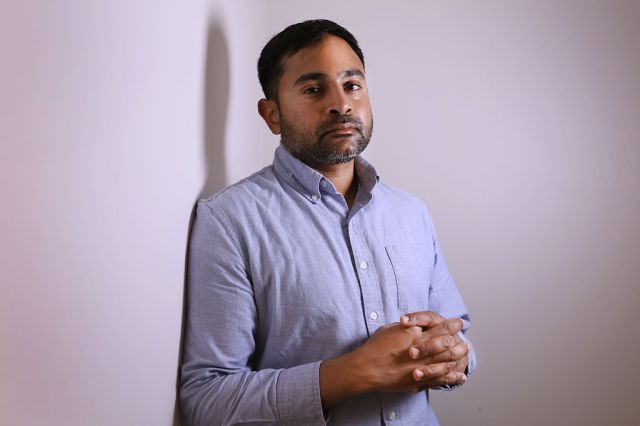
Socialist thinker Bhaskar Sunkara corrects the movement’s excesses. Credit: Getty





Zohran Mamdani raised eyebrows at a gathering of global mayors this week with remarks that sharply broke with recent trends in progressive urban governance. The Left, Gotham’s socialist mayor warned, shouldn’t concede watchwords such as “quality of life” and “efficiency” to the Right: “If you are staring at an example of social disorder or social inefficiency, and the Left refuses to explain either why it has happened or how they will fix it, then the Right gets to point at someone in the immediate area and say, ‘That’s who did it.’”
Tackling disorder and making streets welcoming for families should be a no-brainer — the very foundation of good government at the local level. Yet over the past decade, many blue jurisdictions abandoned these basics in the name of racial justice and “equity.” This had the predictable result of associating such places, in the public mind, with open drug use, needle-strewn sidewalks, tent cities, and rampant antisocial behavior.
Conservatives made political hay of these failures, and who could blame them? Now, however, Mamdani — one of the most popular Democratic politicians in America — is reclaiming social order for the Left and implicitly questioning the ultra-libertarian social ethos that earlier captured the movement. If he succeeds, it could mark a sea change in progressive thinking. But where is Mamdani getting these ideas?
The answer is, in part, a person: Bhaskar Sunkara. The founder of Jacobin magazine, the president of The Nation, and a contributor to these pages, Sunkara counts Mamdani as a friend and ally. Sunkara has also been quietly but steadily injecting a healthy dose of social realism — some might even say conservatism — into a progressive movement that has been besotted with ideas like defunding the police, legalizing all drugs, and abolishing the family.
“It’s about making sure that these citizens, regularly using hard drugs, living in tents, who are even gambling on their phones, are able to reach their potential and contribute to society,” Sunkara tells me recently, as we sit down for an interview at Jacobin’s downtown-Brooklyn offices.
Sunkara, who rails against vices from porn to sports betting to even alcohol, strenuously avoids coming across as a Right-wing culture warrior. One senses in his tone that he doesn’t want his more culturally conservative positions to come across too strongly or, as he puts it, in “authoritarian” fashion: “As a society, [we] should have a normative vision of a good life, but also leave room for minority preferences.”
But even that is an astonishing statement for a figure who used to be the vice chairman of the Democratic Socialists of America and who remains arguably the single biggest intellectual force behind it. As the DSA makes dramatic gains among young voters nationwide, it’s notable that one of its most important theorists believes that we “should have a normative vision of a good life.”
On the core economic issues, he’s in broad alignment with many of his DSA comrades: Medicare for All and, on a grander scale, a “constitutional socialism” that would work within America’s existing framework to infuse socialism into the republic and its market economy. Crucially, Sunkara’s vision of socialism wouldn’t get rid of the market, but rely on market mechanisms to price and allocate goods efficiently. (He lays out this vision in his new book, The Blueprint: How Socialism Can Work in the Real World, co-authored with fellow Leftist intellectuals Ben Burgis and Mike Beggs.)
When it comes to culture, though, Sunkara in some ways easily meets the definition of “conservative” as it’s understood by most in 21st-century America. This, however, shouldn’t be mistaken for his being a “man of the Right.” There is a long tradition of Leftists — George Orwell, Dorothy Day, and Christopher Lasch among them — who opposed the excesses of capitalism not only when it came to market activity, but also in the social and private realms. Moreover, “actually existing socialism” from China to Cuba has often been socially conservative in many respects — and in the “authoritarian” fashion from which, to be clear, Sunkara shrinks.
But ask your average DSAer today on an American college campus about how, or even whether, to address crises like porn addiction or cannabis-use disorder, and you will be mistaken for a Republican and simply brushed aside. I would know. I attend the uber-activistic Columbia University, and this has happened to me too many times to count. Sunkara acknowledges this, as well, but he doesn’t place the blame on socialism or Leftism. Instead, per Sunkara, this way of thinking is “more common just among young people in general,” whereas you’ll find less of it among the Bernie bros and old-school socialists.
In acknowledging this reality, Sunkara puts it charitably: “I think the common response on the Left is, like, ‘Let’s just focus on Medicare for All’” and put the cultural debates to the side. There is also, he suggests, a class dimension to Left tolerance for social vice and disorder. “I think you often find this thing — upper-middle-class people will have lifestyles for their own children and themselves that are quite conventional, low tech, etc., but kind of not want it for other kids.”
He doesn’t see why socialism should necessarily equate to American-style socially liberal policy prescriptions. Though he tells me he would have “probably” supported gay marriage back when that debate was happening, he explains that “even in socialist countries, on the gay and lesbian question, it was considered kind of a bourgeois decadence in places like Cuba, until Cuba opened up, I guess, really, in the ’90s on this issue.”
The degree to which such speech is wholly verboten on the Left — including among the somewhat-less-woke new crop of DSA politicians — can’t be overstated. And yet Sunkara doesn’t blink in saying so, speaking to me in a calm and elevated cadence, matter-of-factly. He may well be one of the minds behind Zohran Mamdani, but one could simply not imagine the same sentence issuing from the mouth of the New York mayor.
I ask Sunkara about Taylor Lorenz, the Leftist tech blogger, who mocks “‘Leftists’ arguing that porn addiction and social media addiction is real.” Sunkara would be one such Leftist. Indeed, one of a very few. “You get the dopamine hits. It just seems fairly obvious,” Sunkara replies. “I’m one of the few people [who] doesn’t have a beef with Taylor in part because I just have muted her.”
“Prohibition [of alcohol] was, in fact, a success,” he adds later, unprompted by me. “Prohibition actually led to a decrease in crime, a decrease in domestic violence, a decrease in certain fights and other sorts of public disturbances. Yes, there was an increase in organized crime. That increase, I think, pales in comparison to other advantages.” Though “it’s too late now” to have Prohibition policies reinstated, he laments, Sunkara has previously spoken in support of Utah liquor laws, which limit the sale of high alcohol-by-volume drinks to state stores, impose drink limits at bars, deploy state-mandated devices for measuring the volume of alcohol in a single drink, and proscribe happy hour.
What, then, does Sunkara have in mind when he urges resistance against the “authoritarian” impulse in fortifying restraints against vice?
He wouldn’t jail people for marijuana use but would get rid of omnipresent dispensaries (there’s one right outside the Jacobin office). While “porn is very difficult to regulate,” he concedes, he maintains that age-verification is a good “barrier to entry,” particularly for those most vulnerable to its dark and addictive side: “You’re just creating a little bit more friction for like a 13-year-old or a 12-year-old. But by the time someone’s 16 or 17, they can navigate around it and access porn if they want, which I don’t think is a huge problem.” Sunkara believes it’s possible for a man who regularly consumes porn to have positive relationships with women, but that it’s just “common sense” that younger exposure will lead to “pathological outcomes.” We “really need to hold the line” on things like sports betting and, in general, “see how we could regulate and roll back elsewhere.”
Put another way: Sunkara may not be rushing to absolutely prevent everyone from consuming booze, ingesting marijuana, watching porn, and gambling. Yet he sees all of these things as inherently bad — stuff we would be much better off without — and instead seeks maximum moderation within our current societal constraints. That, needless to say, is a far cry from the “porn-good” and “marijuana-good” libertarian orthodoxy on much of the Left.
Unlike many DSA comrades, Sunkara is also unapologetically patriotic. “America was the most racist country in the history of the world, and I think the Left actually does a great discredit to its own history when it pretends like it still is,” he said, to much subsequent internet virality, on what would turn out to be one of Ross Douthat’s last podcast episodes for The New York Times. Sunkara elaborates this point in our interview: “We live in communities, and we have to draw where the level of fellowship [is]. I’m a New Yorker. I’m an American. I also am broadly a man of the Northeast, so I feel fellowship with Ontario, a greater fellowship than I do with Alberta.” This, he cautions me, does not take away from his universalism, but is the reality of how our political organization works.
It’s an outlook in stark opposition to the DSA’s Darializa Avila Chevalier, the pro-Palestine hard-liner who delivered a June upset to the five-term, establishment incumbent Rep. Adriano Espaillat in New York’s 13th District. Chevalier’s X history includes tweets such as: “I forgot to get napkins so I just wiped my hand on the American flag behind me.” On the case of Chevalier, Sunkara says, “I think Darializa came out of a campus radical background,” and that we should wait and “see what she does in office,” because “you could find equal examples of people coming out of the religious Right and having certain rhetoric before they’re in public office.”
His comfort with patriotism also allows him to reach audiences that would otherwise never hear a socialist message. “I would speak to anyone as long as they also have an audience that’s worth my time,” he says. “So Fox News, you know, three out of four times that Fox News reaches out to me, I’ll say yes.” The only exceptions are when outlets are “openly fascist, openly nativist in the sense that they don’t respect my right to be a part of the American polity, even though I was born here.”
Would he go on Tucker Carlson? “I could never beat Tucker Carlson in a debate,” he says, “and I don’t necessarily want to agree with him because I do think there [are] undertones to his work that are not only nativist, but I also think that his criticism of Israel is something we should be very wary of.” He adds: “I don’t think a Leftist should necessarily go on Tucker because also then you’re blurring the line between your critique of Israel as a Leftist and his critique of Israel, or your critique of Trump and his critique of Trump.”
Some of Sunkara’s social prescriptions may seem excessive, and not only to socialists. But he’s trending in the right direction at a time when America is racked by deleterious forms of antisociality that line corporate pockets, whether Big Weed’s or Big Porn’s. To be sure, it’s hard to imagine the DSA embracing Sunkara’s practical, socially moderate, pro-American model of democratic socialism. Then again, a year ago, it would have been hard to imagine Zohran Mamdani, a onetime champion of defunding the NYPD, urging the Left to stop coddling disorder.
