




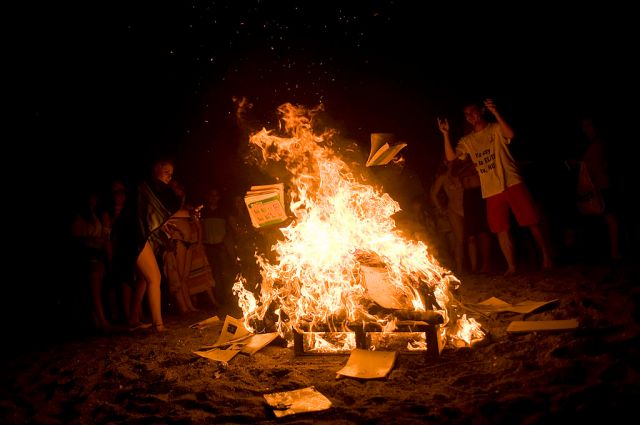
Are cultural sanctions any better than book-burning? (Jorge Guerrero/AFP via Getty Images)





The summer just gone saw the 40th anniversary of Paul Simon’s seminal album Graceland. Memories of the Eighties came flooding in — I remember the shiny CD, the joy and intrigue of the music — but I was also transported further back, all the way to 1968. I was only 14 then, just beginning to relate to the outside world. There was a lot going on: Vietnam, MLK, RFK, students in France and Mexico, the Soviets in Czechoslovakia. But for a British boy, apartheid in South Africa was the big issue: their Olympics ban, England’s cricket ban, and the rise in clamor from South African students. There had been economic boycotts against the Right-wing Apartheid government since 1959, followed by step-by-step cultural boycotts in 1963 and 1965, culminating in a UN-backed blanket cultural boycott in 1968.
But in 1985, Paul Simon broke that boycott. He went to South Africa to record African music with local musicians, and got in a lot of trouble for it: he was blacklisted. I felt the criticism was dumb. Certainly, I agreed that Simon shouldn’t go and play his greatest hits to an all-white audience in some ritzy arena. But the “Graceland” project wasn’t that. It was about downtrodden and disadvantaged people getting global exposure — and income. Simon paid his local guys triple the US union scale. Bass player Bakithi Kumalo — he of the mesmerizing, looping, sliding basslines — used his pay to buy cancer medicine for his mother. Ladysmith Black Mambazo became worldwide superstars. Authentic African genres were suddenly everywhere. The effect on global consciousness was huge. I’m not saying that Graceland brought down Apartheid — but it was a tiny, legitimate pebble in the avalanche that eventually did.
Boycotts, I realized, are politically seductive. But though they seem powerful, they might be having the opposite effect. So this became my first test. By banning this, are we hitting what needs to be hit? Or are we inadvertently damaging what needs to be heard? Forty years on, I’m something of a cultural figure myself, and not long ago I deployed that test: I publicly opposed a 400-author open letter demanding a boycott of all Israeli cultural exports. It wasn’t quite a Graceland moment. But I stood my ground.
My opposition was tactical, not strategic. My disgust with the Netanyahu administration knows no bounds. But how might the dream of a just outcome in the Middle East be achieved? Would a boycott of Israeli creatives help? I ran the test: would we be inadvertently damaging what needs to be heard?
And yes, of course we would. Israel’s cultural sector — authors, poets, artists, actors, dancers, musicians, thinkers and academics — is, by and large, the center of gravity of the Israeli internal opposition. These folk feel the same way I do. They’re desperate for our solidarity. They’re a critical conduit to organic reform. Why shut them out?
There’s a second test, which might make my point clearer: the “shoe on the other foot” test. Imagine a dystopian scenario in which one of those 400 authors’ home countries was suddenly landed with a fascist government. Should I never speak to that writer again? Never read them again? Should I lead a campaign to have their work canceled all around the world?
Of course not. They would be the first people I would want to talk to. Along with their peers, they would be the resistance. They would be stunned if the rest of the world were to turn its back on them, leaving them hopeless and betrayed. Why would they seek to inflict the same on their counterparts in Israel? They would know for sure that their own domestic population was not monolithic. They would know that a furious debate would be raging, because they would be taking part. Why, then, would they imagine the Israeli population to be any different?
In any case, why should I be allowed to dictate which voices should be silenced? In any case, I want to hear all the voices. All the ideas, all the opinions, everything. I might find myself agreeing with some of them, and some might change my mind — and no doubt others would make me incandescent with rage. But that’s the point. We should all be equipped with a comprehensive mental list of all the points in favor, and all the points against, and we should use our critical thinking skills to figure out the best way forward.
Unfortunately critical thinking — and imagination, and empathy — is becoming a lost art. Reality is receding. Theocracy-adjacent nations — where most of the trouble is fomented — first train people toward credulity, then reward them for it. Information and opinion are siloed. To quote Paul Simon, from a different album: “A man hears what he wants to hear, and disregards the rest.” We need to stop doing that.
Enter publishing. For centuries, books have wielded a unique power. The stories and arguments are contained within forever; they are waiting patiently to be understood, at the reader’s own pace, in peace and quiet and contemplation. Books have educated more people than schools or teachers. They are cheap, durable, portable, and you can get any title you choose tomorrow.
Except the ones that weren’t published. You can’t get those. They aren’t going to educate you. And that’s because publishers are commercial operations, with a practical limit on the number of projects they can advance. How do they choose? In the same way all businesses have, over the past decade: try to make a profit and try to avoid a social media scandal. This is the world we live in. I have nothing bad to say about publishers. They’re the best-intentioned, best-hearted people I know. But some conglomerate’s main board, a continent away, will have told them what their bottom line needs to be.
The result is that any slightly risky possibilities are planed away, left and right, leaving only the smooth, safe mainstream center. So while it might be fair to say we’re hearing most of the voices, we’re not hearing all the voices. Those we’re missing are the ones most likely to raise a social media storm. Simple as that. This is the world we live in.
But I want to hear those voices. I want to read their stories, so I can get to know them better. I want to hear their arguments, one after the other. And then, you know what? I can decide for myself what I think.
That’s why we need a new kind of publisher, small, brave, not answerable to corporate money, willing to publish and be damned, willing to search through submissions with only one question in mind: is this a good and valuable book? If not, it should get rejected. If so, it should get published, come what may, no matter who or where it came from. It’s possible, of course, that the resulting explosions of intense energy on both sides of the divide simultaneously would crash social media forever. Maybe that could be a business plan. I live in hope.