




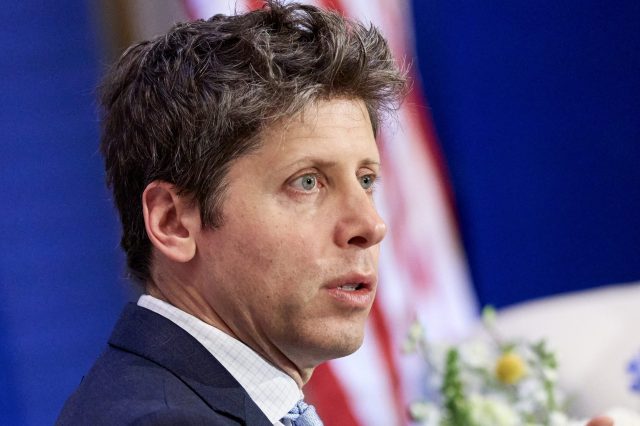
Chinese competition could ultimately triumph over Sam Altman's OpenAI. (Matt Ramey/Getty)





There are two mistakes you can make with predictions: claiming that something will happen when it won’t, or that it won’t happen when it will. The economist Paul Samuelson joked in 1966 that the stock markets predicted nine of the last five recessions. What, then, should we make about forecasts that the AI boom will burst, and that the world as we know it will end?
Rather than predictions, let’s focus on what we know. The coming of AI is the biggest structural shift happening to the global economy right now. If the massive AI investments currently under way in the US succeed, the payoff for the world will be enormous. If they fail, we will go into recession. There is a scenario where they fail in the short-term but succeed in the long-run. Remember the dotcom bubble in the late Nineties? The bubble burst. Dotcom didn’t.
Big financial crises generally do not happen when the stock market falls, but when people and governments take on too much debt. The global financial crisis started with a subprime mortgage bubble. Today’s equivalent could be the rise in debt to fund the AI boom.
One of the few Wall Street insiders to predict the 2008 crash was Steve Eisman, who featured prominently in Michael Lewis’ book The Big Short, and who was portrayed by Steve Carell in the subsequent film. Eisman said in a recent podcast that he predicted Armageddon once in his life — but isn’t quite ready to do it again.
That reluctance is probably wise. For if AI almost certainly is the most transformative technology since the invention of the steam engine, we don’t yet know when and how this transformation will happen, and whether it’ll justify the massive debts currently being accrued by the largest industry players.
The so-called hyperscalers — large tech companies that operate data centers and cloud-computing infrastructure — are estimated to incur capital expenditures in the region of $600-800 billion in the US alone this year. Eisman notes that 70% of hyperscaler AI revenue comes from only two companies, OpenAI and Anthropic. This pair accounts for around a third of the hyperscalers’ entire cloud computing revenue, and though Anthropic is on a roll right now, OpenAI is currently undershooting revenue forecasts. More worryingly, Sam Altman’s firm has suffered an exodus of senior staff, a sign, perhaps, that something is going seriously wrong. Certainly, if any of the big AI companies were to go bankrupt, this could unleash a chain reaction of defaults.
Global financial crises are always caused by chain reactions; the Great Depression and the global financial crisis were both chain reactions within the banking sector. What most of these crises also have in common is a sudden explosion in debt. The logic, however, does not go the other way: just because debt is rising, and stock prices go up, you cannot conclude that it will inevitably lead to a crisis. There are perfectly legitimate reasons for people to borrow money, and debt-funded investments that fuel future productivity gains are a good thing.
But if you believe this narrative, and I do myself, you have to watch out for things going the wrong way. After all, though the dotcom bubble had a solid underlying rationale — that the internet would give rise to very profitable businesses — the investors of that era were in too much of a hurry. Many of the companies that eventually succeeded had not yet been founded.
Whatever these challenges, the subprime crisis of the early 2000s was fundamentally different. It was, to be blunt, a scam from the outset. Banks gave people no-questions-asked teaser mortgages that the borrowers could not conceivably service once interest rates reset. Then banks repackaged the mortgages into financial products and sold them to naive investors, all with the collusion of the rating agencies. Once mortgage delinquency rose, most of those “triple-A” products became worthless.
Those varied histories explain what happened next. When the dotcom bubble burst, recovery soon followed. When subprime exploded, however, it triggered a chain reaction throughout the world. This was infamously true in the eurozone: after US mortgage products turned into junk, banks found themselves sitting on billions worth of worthless products. Many got into financial difficulties. Governments bailed them out, but in smaller countries with large financial sectors, finance ministries overextended themselves. This is how the Greek sovereign crisis started, and how it spread to Spain, Portugal, and Ireland.
Today, there is still a potential for global chain reactions — but the mechanisms would be different. Over the years, China and Germany have accumulated massive trade surpluses against the US. As a result, both countries have large investment stocks in American companies. If the AI bubble blew up, and if that resulted in a US government bailout of big tech, the combination could trigger falls in both global stock markets and the dollar’s exchange rate. This would be a double whammy for the Europeans: a strong euro would kill the continent’s export industry, while all those American investments would suddenly be worth far less.
Yet if this suggests any crisis would quickly cross the Atlantic, none of this tells us if a crash is actually coming. How, then, to answer this question?
One vital thing to reiterate is that the rationale underpinning the AI boom is fundamentally correct. AI matters not because ChatGPT can do our children’s homework — but because it can transform countless different industries. The fate of legal assistants suggests this is happening already, with AI promising to transform everything from finance to accountancy, perhaps even journalism. The automation inherent in these changes could encourage manufacturing productivity to skyrocket, making goods cheaper and leaving workers with more free time.
Another reason for optimism is how quickly AI models are improving. Anthropic’s Mythos model was deemed too dangerous for ordinary users and had to be neutered before it was released to the wider public. OpenAI released its latest model GPT 6.0 only a few days ago; I have not been able to test it yet, but the broad progression in quality has been astounding.
To be clear, I am not predicting a Panglossian utopia. Friction in the transition will be enormous. Yet I think that if an AI crash does happen, it wouldn’t be caused by AI as an idea, or even as an industry, but, rather like the dotcom crash of the Nineties, because of excessive optimism and unfortunate timing. With firms taking on so much debt, the risk is that they’d be forced to repay before their investments started paying off. Another risk, for Wall Street anyway, is that China’s open-source software ends up overtaking the top US companies.
So even if the big picture story of an AI-led productivity boom is correct, the investment story is more complicated. We can have both — AI as a life-transforming technology, and an AI bubble that triggers a toxic chain reaction in financial markets. The single biggest node here would be the American government. The rise in US debt to the symbolic benchmark of $40 trillion should give us all pause for thought. If the US economy were to continue to grow at 2-3% as it has done in the past, all would be fine. Contrary to forecasts, Donald Trump did not crash the economy. Yet he is piling on a ton of debt, and if the AI bubble bursts, and the US economy falls into recession, those levels would suddenly look dodgy.
And if Eisman is getting nervous, so too are some of the world’s top investors. The Norwegian sovereign wealth fund, for instance, which is still the world’s largest, says it wants to diversify its government-bond portfolio away from the US. That should be a warning sign for the rest of us, especially given the way government and private debt can fuse during a financial chain reaction.
This is how it might start. First, a large AI company gets into trouble. So do several large investors. The US government then comes under pressure to bail out the financial sector, but has already accrued too much debt itself. At this point, the Federal Reserve steps in to buy US government debt and cut interest rates. Inflation duly rises further, the dollar crashes — and the crisis spreads to the rest of the world.
But remember: what goes for the stocks markets that predicted nine of the last five recessions also goes for columnists and financial experts. Our ability to predict financial crises is not great. But what we can do, at least, is prepare for one. And the time has come, I think, to do just that.
