




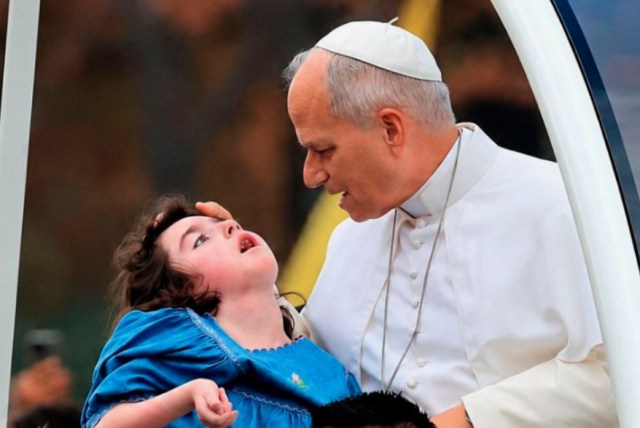
Pope Leo blesses a girl with severe disabilities during his visit to Paris. Credit: Getty





In the wake of President Trump’s re-election in 2024, an unnamed banker told the Financial Times, “I feel liberated. We can say ‘retard’ … without the fear of getting canceled.… It’s a new dawn.” Sure enough, around that time — or even a little earlier, by my reckoning — the R-word began cropping up in everyday conversation. Not just among finance and tech bros, but even some progressives. And, admittedly, it is a satisfying descriptor for conduct that fails the demands of intelligence (say, hiring a crony to fix the Lincoln Memorial Pool and falsely pinning the resulting damage on an Olympic athlete; or renaming New Mexico “New America”).
Then came this week’s visit by Pope Leo XIV to France, which has been marked by the Bishop of Rome’s constant, special solicitude for those whom medicine once branded “retarded.” Will it spur Christians, and perhaps others, to return the R-word to the realm of taboo? And would such a social shift have any wider positive effect, besides marginally curbing the coarseness of daily language?
Let us pray. And not just for the sake of being decent. But because in the age of AI and “agentic” machines, a culture that mocks and denigrates human frailty — that reduces worth to intelligence and agency — may soon target many people, including those who today consider themselves gifted and use the R-word with abandon.
Much has been made of the surprising resurgence of French Catholicism, amply on display in the 800,000 souls who attended the Roman pontiff’s Mass at the Place de la Concorde and the long lines of penitents waiting to pour out their troubled consciences to priests in open-air confessionals. Yet if there is a unifying theme to Leo’s French trip, which continues through Monday, it is the inviolable dignity of the vulnerable, including the elderly, the infirm, and people suffering from mental and intellectual disabilities.
On his way through the streets of Paris, Leo stopped the pope-mobile to bless a severely disabled girl, creating what is likely to be one of the defining images of his reign. At his Paris Mass, the altar servers included six young men with Down syndrome. And speaking at Lourdes, where an apparition of the Virgin Mary has long drawn those seeking healing beyond what medical science can achieve, Leo launched a jeremiad (in the true sense of the word) against abortion and assisted suicide. The former, selective abortion, has all but eliminated people with Down syndrome from some jurisdictions. The latter, assisted suicide and euthanasia, increasingly ensnares people with intellectual disabilities like autism.
“No human law should ever make you lose the certainty of your dignity,” the pope told the patients and their carers at Lourdes. “You are not a burden. You are the beating heart of our humanity and a precious treasure for the Church.” He added: “It is precisely in the name of this inalienable dignity of the human person that we must reject the temptation to cause death under the guise of false compassion. It is impossible to regard causing death as something normal. What is legal is not necessarily moral.”
Defending vulnerable life is, of course, nothing new for Catholicism. The Didache — one of the earliest compilations of Church teaching, generally dated to the late first century — includes the injunction: “do not abort a fetus or kill a child that is born.” In modern times, that consistent, maddeningly unbending ethic of life has occasioned some of the Church’s most morally heroic moments, even and especially amid its failures.
In the Nazi period, for example, when too many of the German bishops kept mum about the Holocaust and otherwise failed to resist Hitler, one prelate stood tall for the cause of life. I’m speaking of the bishop of Münster, Clemens August Graf von Galen, who, on Aug. 3, 1941, delivered a homily condemning Aktion T4, the Third Reich’s program of involuntary euthanasia targeting the physically and neurologically disabled and mentally ill.
A massacre of the innocents was afoot, von Galen charged, “because in the judgment of some official body, on the decision of some committee, they have become ‘unworthy to live,’ because they are classed as ‘unproductive members of the national community.’ Poor human beings, ill human beings, they are unproductive, if you will. But does that mean that they have lost the right to live? Have you, have I, the right to live only so long as we are productive?”
That productivity aspect is the heart of the problem today. In the postwar period, overt eugenics and overtly coercive euthanasia were out of the question, having been tainted by association with the Nazis. But the Church now detects the same impulses lurking under the guise of “choice” and “compassion” and the obscene phrase “death with dignity,” used to describe doctors dealing death. Scratch through such cant, the recent pontiffs have argued, and you find the same ideas: that worth lies in productive intelligence, the capacity for autonomous choice or “agentic” activity (to use today’s parlance). The distance isn’t far from that premise to the conclusion that some lives just aren’t worth keeping around.
In his 2015 encyclical, Laudato Si’, Pope Francis warned against a “dominant technocratic paradigm” that only finds value in “a subject who, using logical and rational procedures, progressively approaches and gains control over an external object.” People with intellectual disabilities frequently fall short of this paradigm, but so do many others. So do babies in gestation and young children. So do the elderly. And so do people undergoing chemotherapy. All of us spend great stretches of our lives in various states of vulnerability and incapacity and unproductivity.
Which brings us to Leo XIV. The new pontiff has so far devoted the lion’s share of his teaching to the moral challenges posed by AI. He and the Church aren’t opposed to automation. On the contrary, emancipating man from “arduous, repetitive, or dangerous” labor, as his encyclical on AI put it, has long been an aspiration of classical and Christian civilization. Insofar as AI achieves this emancipation, it is to be welcomed — but not when it intrudes upon distinctly human activities or if it recasts our conception of human worth.
That last danger is already present in practices like selective abortion, euthanasia, and assisted suicide, and is likely to be greatly magnified in the age of AI. Indeed, during his visit to France, Leo explicitly linked the two. Speaking on Friday at a gathering of UNESCO, he commented, “The paradox has become increasingly evident: while ‘intelligence’ is attributed to computational systems, we struggle to recognize the inalienable dignity of human persons, whose lives are judged according to the criterion of efficiency and, when deemed no longer productive, are rejected and discarded.”
A large language model can never replicate human intelligence, which, as Leo has noted, includes wisdom and other depths that are impenetrable to the machine. Yet in terms of raw computation and recall, my Claude app is already far more capable than I. Compared to it, I am a “retard.” Is it that hard to imagine a not-too-distant future in which an LLM in the employ of my insurer decides I should no longer receive medical care in light of my mental shortcomings?
Renouncing the R-word won’t forestall such a future, of course. That will take collective political action. And there are plenty of people who are perfectly polite in ordinary discourse, even as they pursue monstrous ends in politics or business. But each time we do use that word, we not only trample the dignity of some of the most defenseless people among us, but strengthen the technocratic paradigm that, left unchecked, could soon discard many or even most of us.
Sohrab Ahmari is the US editor of UnHerd. His next book, on The Triumph of Normal, is forthcoming from HarperCollins.
 SohrabAhmari