




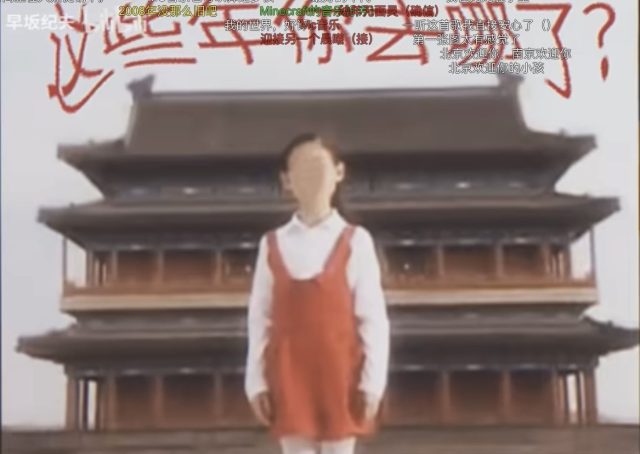
“Never to find those happy days again”. (bilibili)





You were born in China around the 2000s. Night is falling after another endless day at work. The commute home has been a gray, anodyne blur. Some mechanism of involuntary association returns you to simpler times: voices, laughter, the warmth of remembered sunlight. “Something’s off,” you feel more than think. “Life wasn’t supposed to turn out this way.”
Later, in bed, like twentysomethings the world over, you defer sleep with your phone: scrolling through selfies on WeChat, video essays on bilibili, and microcelebrity meltdowns on Weibo. When you open the photosharing app, RedNote, one post catches your eye.
“You’re awake,” the title reads. “It’s ‘08 in a Beijing alley, and the Olympics are set to begin.”
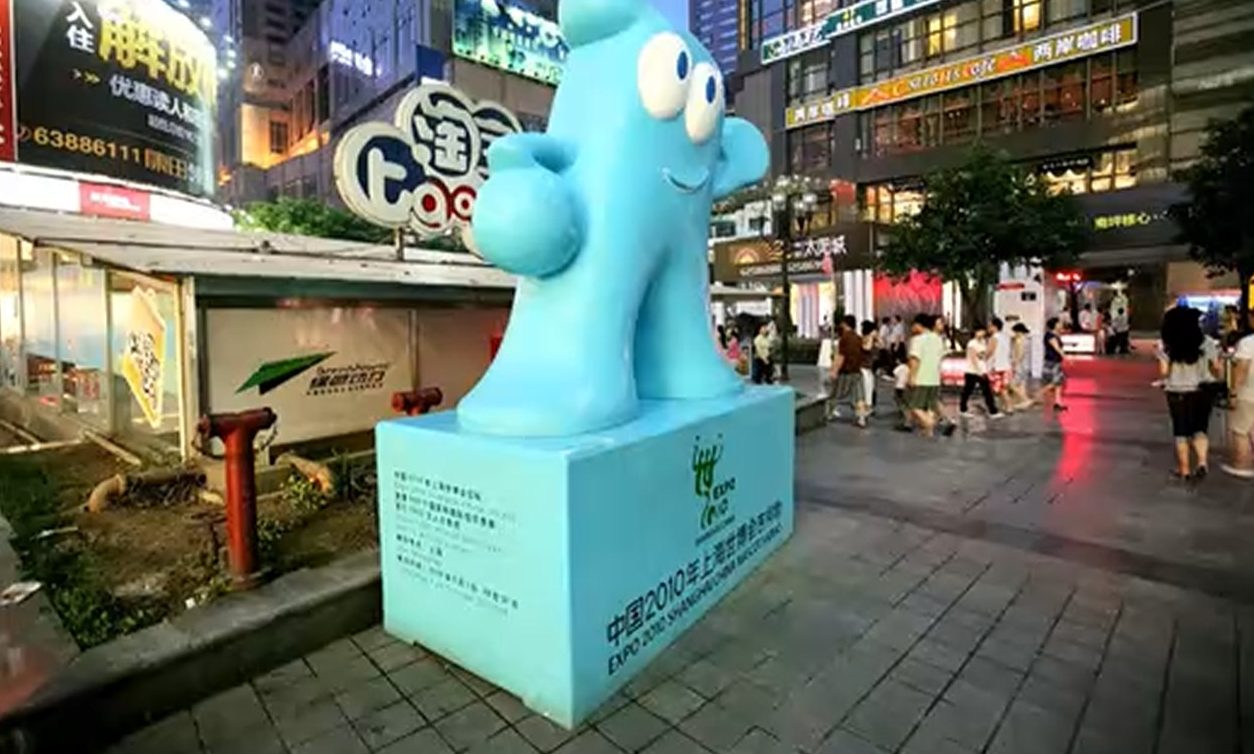
The images flicker through dimly remembered scenes from childhood: cluttered newspaper stands, roadside skewer vendors, kindergarten kids in bright tank tops. Prominently featured are the Fuwa, the five adorable multicolored mascots of the 2008 Olympics. The posts have gnomic, melancholy titles (“Why cry? Wasn’t this the life you always wanted?” or “Never to find those happy days again”) that serve as little daggers to the Gen Z heart.
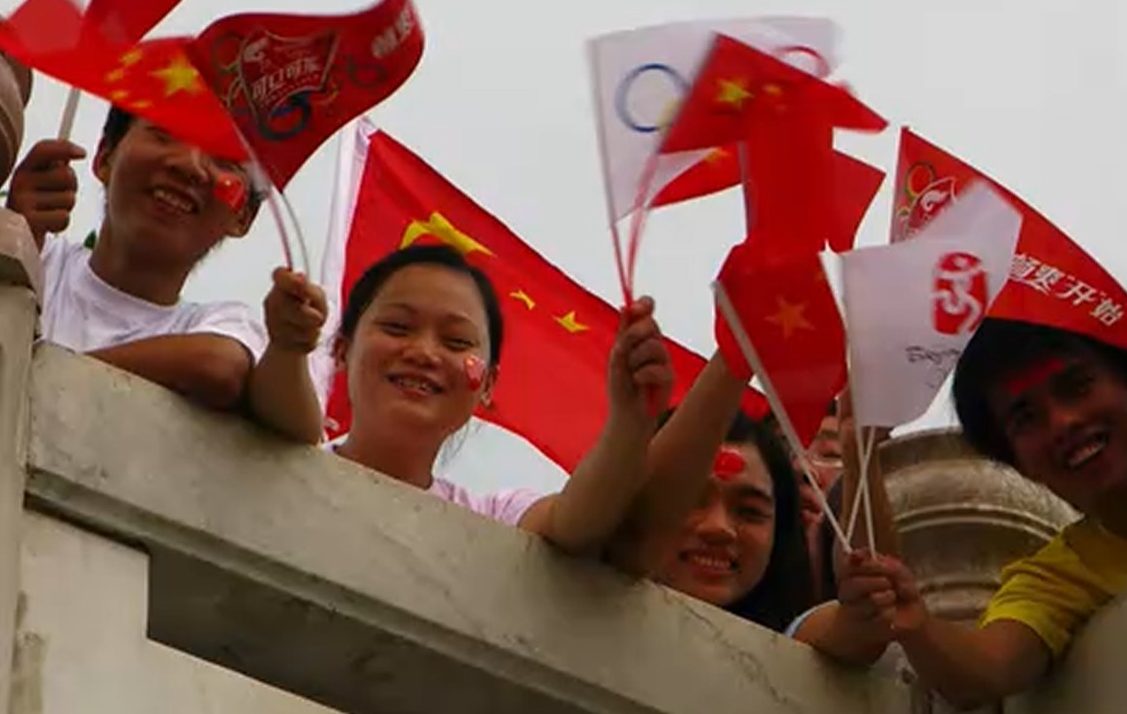
But what really gets you — what really sets off the Sehnsucht in your bosom for the lost dreamworld of childhood — is the music. “Beijing Welcomes You”, the old Olympic anthem, is a soaring, catchy ballad that can crack the cool facade of even the most stoic of Chinese Zoomers. Its lyrics (“Open, always, is the gate of my home…”) capture a China that was confident, cosmopolitan, and welcoming; a China that now seems as forgotten as the threadbare plushies of our childhood.

What gives the song such emotional significance is the sheer breadth of its saturation. In the Summer of 2008, you heard it broadcast on the bus ride to school; on a walk with your parents in the park; as you snuck into the cornershop to buy red bean popsicles.
It’s clear from all the comments that the rediscovery of “Beijing Welcomes You” is, for China’s Gen Z, only part of a wider reckoning with the recent past. “In those days we all believed in progress and world peace…” writes one poster on bilibi (China’s YouTube analog). “This song has such pure intentions; there’s no political agenda to it at all. Culture above all else…” adds another. A reply to this notes that the star-studded cast features A-listers from both shores of the Taiwan Strait, as well as the Chinese diaspora: “Back then, everyone set aside their ideologies and national differences to showcase to the world nothing other than Chinese civilization and the Olympic spirit… Truly, those were the good times.” Without getting lost in the vexed politico-linguistic question of Chinese autonyms, it’s notable here that the commenter uses the term “中华文化” (Zhōnghuá wénhuà) for Chinese civilization, which has the expansive sense of an overarching culture spanning all Chinese-speaking people, as opposed to the more parochial “中国文化” (Zhōngguó wénhuà), which refers to Chinese culture within the People’s Republic. Such are the linguistic pains taken by the user to emphasize the ecumenism of Chinese unity manifested during the 2008 Olympics.
British readers might feel a pang of recognition at the potency of Olympic patriotism; images from the London 2012 opening ceremony are still apt to prompt wistful accounts from progressives about the forward-looking, multicultural, welcoming country they thought they grew up in. But whereas Britain’s Olympic games live on in cultural memory as the last gasp of liberal Britain, Beijing 2008 was supposed to be the inauguration of a newer, more open China — a China that never was.
The aesthetic that Chinese Zoomers have fashioned in response to these foreclosed hopes is a variation on “dreamcore”, a style that first took shape on US-based platforms like Tumblr and DeviantArt in the mid-2010s. American dreamcore is marked by its obsession with eerie liminal spaces like hotel lobbies, parking lots, or the yellow, fluorescent-lit basements of old furniture stores that inspired Backrooms, this summer’s horror blockbuster. Chinese dreamcore retains some of the formal elements — eerily empty streets, 2000s internet graphics — while sinicizing its content; this is, in other words, nostalgia with Chinese characteristics. It could even be seen as further confirmation of the late Mark Fisher’s pet concept, hauntology, the idea that we’re living now in the “slow cancellation of the future”, surrounded by the dreams we once abandoned.
That the Chinese youth are just as pessimistic, anxious, even fatalistic, about the present state of affairs as young people in the West may come as a surprise. From Friedrich Merz to Mark Carney, politicians on both the Left and Right often invoke China as the presumptive winner in our global return to bipolar Great Power geopolitics — the country with the technology, infrastructure, jobs, growth rates, and above all, the sense of collective purpose buoyed by national unity. But behind the phalanxes of dancing robots and ribbons of high-speed rail is the stark economic reality facing the generation now coming of age, who, like their counterparts in the West, are coming to terms with the closure of the guaranteed upward mobility that their parents enjoyed.
In the late Seventies, China’s then-leader Deng Xiaoping implemented a wildly ambitious suite of market reforms. As Deng overhauled the creaky Soviet-style economy that he had inherited from Mao, a corresponding ideological makeover of the Chinese Communist Party was inevitable. Gone was the fiery Marxist-Leninist exporter of international revolution, replaced by the staid, technocratic guardian of state capitalism we’re familiar with today. Jettisoning the Mao-era baggage, however, meant losing the story that gave the Communist government its legitimacy — the grand Us vs Them narrative of the working class as co-authored by Marx and Engels, a story second only to the New Testament in its ability to form social cohesion and inspire mass action.
What narrative could fill the ideological vacuum left by Marxism? Political scientist Feng Chen argues that the CCP’s pivot to “eudaemonic legitimacy” accomplished precisely that. Here, eudaimonia, Greek for happiness or flourishing, refers not to any lofty Aristotelian actualizing of human potentialities, but to satisfying people’s demands for iPhones, McDonald’s, electric cars, hotpots, Korean beauty products, and so on. The result was a tacit social contract that “led the masses to link their assessment of the regime to their personal material advancement”. In the post-Mao period, political legitimacy depends on the uninterrupted economic growth that allows the government to deliver the (literal) goods.
One shortcoming of deploying eudaemonic legitimacy as a long-term political strategy is that it’s crassly reductive. Human beings are more than rational self-maximizers; man does not live by designer handbags alone. We have an exasperating tendency to put forth moral, not just material, demands — and when these moral demands are unmet, political stability falters. For Chen, eudaemonic legitimacy depends not only on delivering economic growth to the people, but also on ensuring that those people adhere to a notion of morality that is itself narrowly economic.
In the Mao era, moral character meant subscribing to a mix of proletarian solidarity, anti-imperialism, and ascetic self-discipline. A capitalist China required, at minimum, an abandonment of these collectivist socialist ideals — and, ideally, something to replace them. From the late Nineties, Chinese media saw a number of happiness campaigns — deliberately engineered self-help movements involving everything from TV talk therapy to positivity gurus to a torrent of translated American self-help paperbacks. The plan, as the anthropologist Jie Yang documents, was to inculcate new values in Chinese society — values such as “self-care, self-realization, and self-enterprise”, enabling the Chinese people to positively affirm themselves as autonomous agents, happily engaged in private enterprise.
So as the government delivered on economic growth, the governed reconceived of the good life along exactly such lines. What could go wrong?
The more basic problem with the quid pro quo of political acquiescence for material gain is what to do when growth tapers off. In the popular Chinese consciousness, the tapering took place sometime between 2018 and the beginning of the pandemic, and the record-breaking 17.9% youth unemployment rate recorded in July evinces no change to this downward trend. Attitudes, though, can be slower to change than economic realities, and a distinct generational gap has opened between the Deng cohort, who maintain a sunny and increasingly obsolescent optimism that comes only with decades of double-digit GDP growth, and their children, who are now faced with a job market decimated by outsourcing, automation, and cutthroat competition. In response to this future of secular stagnation, Gen Z has rejected en masse the chipper self-help morality of China’s boom years.
In the absence of civil society — and in the face of continued state-sponsored optimism campaigns — China’s youth has vented its dissatisfaction in the only direction available: inwards. The ethnographer Dino Ge Zhang has coined the term “Sinopessimism” to characterize the private world conjured up by the slang of Chinese Zoomers. They describe their time in higher education and the workforce with the term 内卷 (“involution)”, or “the experience of being locked in competition that one ultimately knows is meaningless”. The natural reaction to an involuted society is 躺平 (“lying flat”): in other words rejecting expectations of upward mobility and career advancement in favor of alternative lifestyles.
However, Gen Z’s most distinctive neologism must be 历史的垃圾时间, or “garbage time of history”. The term, coined by Hu Wenhui, a newspaper editor in Guangzhou, borrows its meaning from “garbage time” in sports, referring to the final portion of a match so lopsided that its outcome is already a foregone conclusion. Hu, in a 2023 WeChat post shared millions of times, extends this to cultural critique: those living in the “garbage time of history” are stuck in an agonizing interim period when nothing seems to work, when decaying, outmoded social structures refuse to collapse, and when individuals feel powerless to respond. Though Hu limits his examples to the Brezhnev-era Soviet Union and the fall of the Tang dynasty (while making thinly-veiled allusions to contemporary China throughout), it’s written in the same spirit of global pessimism that moves Western Zoomers to drop the term “late capitalism”, or the Gramsci quote that diagnoses the present as the “time of monsters”.
Nothing expresses the ennui of the Sinopessimism generation better than Chinese dreamcore. Time will tell if it remains a trendy hashtag or develops into a full-fledged artistic movement. But for now, if nothing else, Chinese dreamcore stands as a melancholy corrective to the widely-held assumption that the passing of the globalized era (which counts, as one of its fading triumphs, the Beijing Olympics) also heralds a new epoch of winners and losers: namely the oft-repeated narrative of China’s inevitable rise, and the West’s gradual decline. It seems misguided, to say the least, for Western progressives to spread narratives of Chinamaxxing at a time when the Chinese youth are themselves avoiding their economic present by escaping to the safety of the past. Ultimately, this new epoch of isolationism may consist only of losers and other losers.
If there’s any doubt about the crisis in China’s youth outlook, take a look at the panicky, hectoring responses it has elicited from the establishment. Discussion of “lying flat” is censored online; meanwhile a battalion of mainstream academics have come forth with thinkpieces rebutting the concept, decrying it as a “fraudulent academic concept,” a “logical fallacy,” or, my particular favorite, the “absurd fantasy” of “idiotic literary youths.” And, in direct response to Chinese dreamcore, a recent article published in the Social Sciences Review of Gansu Province warns of the “latent ideological risks stemming from the glorification of ‘negative emotions’”. More than just a case of bad vibes, officials are treating the pervasive pessimism as a serious ideological challenge — the one really obvious lesson from the 20th century being, after all, that keeping around a bunch of nihilistic, directionless, and economically downward young people tends to be really, really bad for political stability.
Still, one comment under a Chinese dreamcore post stood out to me as a corrective to the idea that China’s recent past really was so much brighter. It was from a bewildered Gen-Xer. “The 2000s were a time when I was scared to leave the house at night, back when trash piled in the streets, and my hometown didn’t even have streetlights. I don’t know where exactly the romance is.” So even the golden years of childhood prove no escape. If Western pundits idealize a non-existent future for China, its youth romanticize a non-existent Chinese past. All attempts at escape turn up only dead ends. How, then, can we comfort ourselves amidst this time of monsters? Perhaps there is a slender hope: that one day, with enough distance, our present may also be misremembered as beautiful.