




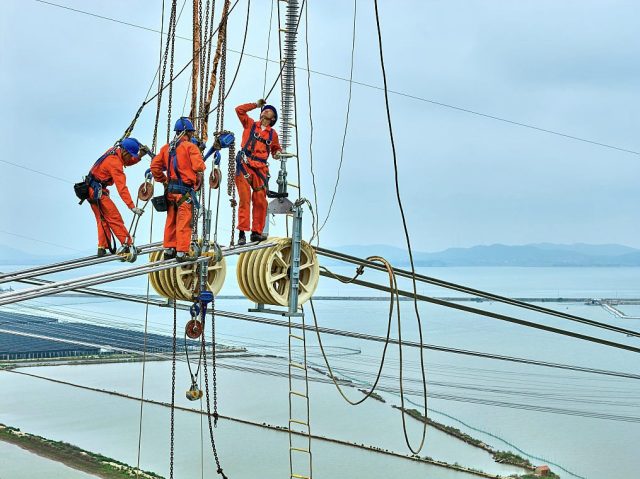
China has been on an infrastructure binge. (Shi Jiamin/VCG via Getty Image)





In the Eighties, Marxism Today, the theoretical journal of the Communist Party of Great Britain, enjoyed remarkable influence. Edited by the journalist and academic Martin Jacques, it was the first magazine to properly examine the dramatic changes occurring in Thatcherite Britain. Boasting contributors who acted as the Left’s leading intellectual lights of the era, including Eric Hobsbawm and Stuart Hall, the journal explained how the old industries that had sustained British socialism were dying: the Left could no longer rely on mass trade unionism and politicized, blue collar militants as its solid class bloc.
But for some Marxism Today writers, there were also signs of hope. Just as the Left bid farewell to the old proletariat, a new, educated creative class would become the new agents of history. Arthur Scargill may have been picketing organized labor towards a heroic defeat, a final denouement of the postwar era’s powerful trade unionism, but the rising service industries, and a proliferating array of innovative consumer trends could also be interpreted as the rebirth of a latent spirit of progressive individualism, personal autonomy, and harmony in diversity.
When these new social forces failed to produce any kind of rupture with a dominant Thatcherite revolution — and when the response of the Left turned out to be Blairism and Cool Britannia — Jacques was despondent. The Soviet Union had fallen, and the cultural consumer fads of the new Eighties turned out to be ephemeral and superficial. And so, in defeat, his attention shifted to China, his interest piqued by a 1993 visit to the country. Where the Western Left had failed in the face of Thatcherite radicalism, the Chinese Communist Party was building the future. Some years later, Jacques wrote a bestseller, When China Rules the World, extolling the virtues of this grand “civilization-state” on the march. The Middle Kingdom was sui generis; it would develop in its own way without recourse to Western liberal ideas of nation-building. Its capitalism would be resoundingly statist. Its political model would be illiberal and collectivist. And it would come to dominate the world in a new Chinese century. He was, without knowing it, the first contemporary Left Chinamaxxer: indulging a foreign political fandom to mirror the Very Online Gen Z trend of adopting Chinese cultural mores, the frontier of algorithmic Chinese soft power combining with expanding ideological hegemony.
Today, following the defeats and indignities of the Corbyn era, with the Left at a historic weak point domestically, Left Chinamaxxing has gone mainstream. And, indeed, the Left’s modern-day predicament has eerie echoes of the problems faced by its forebears in Marxism Today. For the old British working class, the offerings of the populist, insurgent Right look more attractive than anything served up by today’s socialist radicals, who remain electorally and demographically confined within a relatively exclusive milieu of urban graduates and young professionals. And if local prospects for power and influence look weak, new objects of enthusiasm must be sought in distant climes. China fills the void. Where Britain lacks vigor, China is dynamic. Where the Western Left is defined by impotence, Chinese Red Princelings command supreme authority. Left-liberal economists such as Adam Tooze marvel at the results of the CCP’s activist industrial policy and green manufacturing revolution. The Corbynite shock troops and progressive cool kids at Novara Media are spellbound by the results of state-owned EV factories in Chongqing. I myself have indulged in the trend and called for “Anglo-Dengism” as a tonic for Britain’s myriad contemporary ills. Whatever the example, the fundamentals are clear: Chinamaxxers today have less time for the more humanist strands of the Left tradition, for workers’ power, independent trade unions, or radical participatory democracy. What they instead have is a fetish for economic expansion and impressive feats of state capacity.
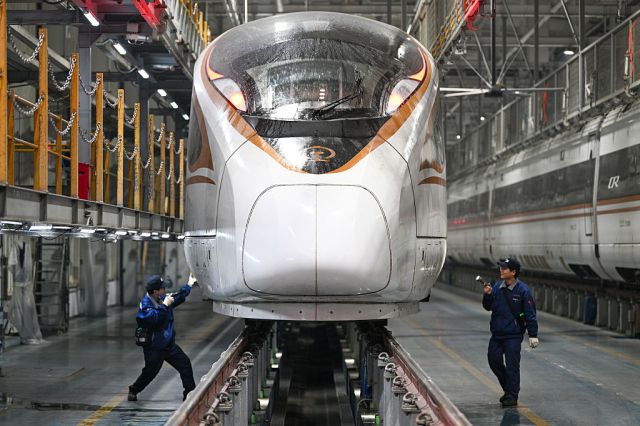
In a domestic context, where real income growth has been non-existent for nearly two decades, and in which state failure is the norm from HS2 to a one-in-one-out prison service, the subtle conversion to this developmentalist, production-oriented socialism is a predictable, understandable response to secular decline. It evidences a widespread, burning desire for the basic functions of the state to be adequately upheld. In the tradition of Jacques, the Chinamaxxers contend that China has resolved the contradictions of failed 20th-century socialism, applying ruthless pragmatism with Leninist zeal, Deng Xiaoping’s famous cat analogy — “It doesn’t matter if a cat is black or white, if it catches mice it’s a good cat” — built in glass and steel. This may seem an inversion of the Western Left’s often-puritanical desire for moral and ideological homogeneity; the Chinese have broken with every taboo, broken every prerequisite of socialist orthodoxy to embrace a practical, utilitarian realism. But perhaps this signals a buried desire among some of the Left’s number to do what the critical theorist Mark Fisher enjoined over a decade ago: to “exit the vampire castle”, put a stop to the endless cycle of language policing and witch-finding that has become the hallmark of Leftwing “praxis”, and to actually build something instead.
There has long been a proclivity in sections of the Left intelligentsia to find solace in the exotic social-political experiments abroad. In The Reckless Mind, the political scientist Mark Lilla identifies the figure of the “philotyrannical intellectual” to describe the 20th century’s “useful idiots” who sullied themselves to cosy up to Stalinist Russia: Sidney and Beatrice Webb, George Bernard Shaw, and HG Wells among others. Despite the privations of the Great Depression, the British people steadfastly twice voted the Conservative-dominated National Government to power in the Thirties. For many on the Left, the actually-existing British working classes have long been a source of continual disappointment.
But the new Chinese mythos is unlikely to be punctured in the same way as Thirties Russophilia. Pro-Stalin sentiment was shattered as the scale of the Great Terror and the nightmare of collectivization became apparent, while postwar capitalism proved more amenable to the provision of social welfare than its prewar variants. There will be no similar reckoning for Beijing. The Cultural Revolution and the Great Leap Forward ended long ago. And there are no contemporary equivalents of the Beveridge Report coming to rescue our sclerotic model from itself.
Besides, if Stalin’s despotism was incomparably more brutal than contemporary China, the latter’s naked authoritarianism is eclipsed in the minds of many by the dazzling growth rates, the TikTok-promoted public infrastructure, all a mirror-image of Western decline and crumbling prestige. What’s more, it’s all delivered by a Politburo of staid, practical Marxist engineers, themselves about as distinct from the average Western Leftist in habitus, manner and thought-pattern as is possible to imagine. The weed-smoking children of the provincial bourgeoisie may have chanted “Mao! Mao! Mao Tse-Tung!” back in the Sixties. But China is now a model not for ultra-Left utopianism, but for its technocratic, pragmatic refinement of a state-managed market system.
When the Left held the reins of authority within the Labour Party during the Corbyn-era proper — between 2015 and 2019 — explicit political alignment with “socialism with Chinese characteristics” might have been tempered by widespread concerns over the plight of the Uyghurs. That particular issue seems to have abated as an international concern. The Left’s enthusiasm for the Chinese model might also have been dampened by the status of the rising giant as the workshop of the capitalist world, a giant FDI magnet producing iPhone headsets for an insatiable Western consumer market. But China has changed and so has our unsteady geopolitical era. The CCP’s “Made In China 2025” plan, initiated in 2015, fired the starting gun on a decade of overhaul for the manufacturing sector. Since then, the country has shifted from producing Western-designed goods in low-waged, low-productivity factories to promoting domestic innovation and industrial automation in high-growth, high-tech sectors. What’s more, the mask of American global power has been removed: with Trump in the White House, Washington’s empire, it’s finally clear, sustains itself not for the spread of democracy, human rights or individual liberty, but for the protection of its own extractive rights. Given all this, the old, neat categorization of a benign Western hegemon versus a malign “revisionist power” in Beijing becomes far harder to rationalize.
But the case against Chinamaxxing doesn’t depend on any of this. China’s successes are very real, but they are not directly replicable across all of time and space. Jacques was right that China would develop sui generis, but the conditions that made that development possible were sui generis, too: a vast supply of surplus rural labor; a young, growing population; an open American consumer market; and a steady process of globalization driving inward investment. There may be lessons for how the CCP has managed that particular historical moment, but not for how to manage a medium-sized, open market economy that is dependent on services, with a centuries-long tradition of liberal individualism, an anarchic political culture, entrenched property rights, and habeas corpus.
Besides, to valorize the efficiency of a one-party state as if delivery and dictatorship go hand-in-hand ignores a more frustrating truth: Britain did used to build; the state did used to function, and, indeed, many of our democratic allies still do. Japanese infrastructure is a marvel, and is built and maintained despite a debt-to-GDP-ratio that dwarfs our own. State-owned South Korean firms build nuclear power plants in half the time that we do, and at a fraction of the cost. And closer to home, the French and Spanish countryside is criss-crossed with high-speed lines. Britain isn’t suffering for lack of Marxist-Leninist one-party foresight, but rather is struck with a peculiarly British disease. The prescription will never be a replication of Chongqing, but we can take solace in the fact that we have solutions that are more mundane: long-term capital budgeting; government departments that approach problem-solving by prioritizing investment over more cash transfers; planning reform that presumes a well-regulated right to build over a discretionary right to block.
There is a unique precision with which Western Chinamaxxing tracks domestic disappointment: the Left admires Chinese state capacity in exact proportion to the British state’s inability to build a railway line; it admires grand ambitions in proportion to the narrowing of its own political horizons; it admires a party that governs a fifth of humanity in proportion to its own distance from governing. The object could just as easily have been located somewhere else — and often has been, whether in Moscow, Havana or Caracas. And alas, the diagnosis sustaining the trend is largely right. Britain is stuck. Despite its failings, Marxism Today employed an admirable method in analyzing the conjuncture: it looked unflinchingly at the country and the people who lived in it and attempted to build a politics congruent with the historical moment. That was the method, the discipline. Despite being a Communist Party journal, it faced the problems of the Left head-on, and treated the Thatcherite enemy with the respect it deserved rather than fantasizing about either a new 1945 or a Soviet Britain with Five-Year Plans. Today, rather than a civilization-state, the Left needs to do what Marxism Today once did: be honest about itself and its own capacities and inadequacies, focus on the fundamentals, and pay unflinching attention to Britain. If the Left is to have a future, then the future is Britainmaxxing.
Jonny Ball is a Contributing Editor at UnHerd. He formerly wrote under the name Despotic Inroad.
 DespoticInroad