




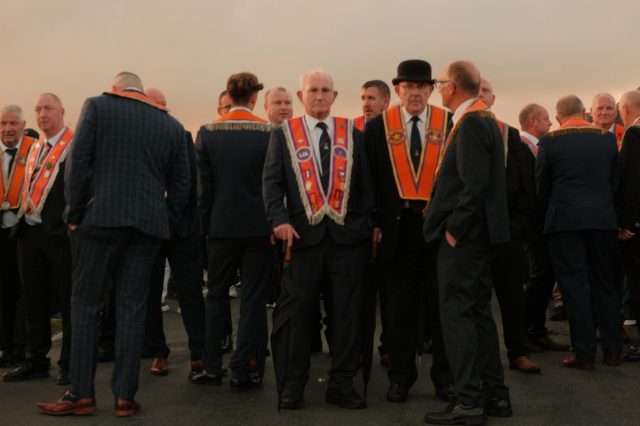
The Orangemen assemble at Drumcree (Credit: Aris Roussinos)





In a famous 1922 speech, Winston Churchill lamented “the dreary steeples of Fermanagh and Tyrone”, a literary device for the intercommunal conflict in Ulster which, even as great empires collapsed and new nations were born across Europe, continued with a grim and relentless dedication not far short of romantic obsession. As he remarked, “The integrity of their quarrel is one of the few institutions that has been unaltered in the cataclysm which has swept the world.”
Churchill would not have been surprised to find the steeple of County Armagh’s Drumcree Parish Church as dreary as ever on a wet Sunday afternoon in 2026. In the parish hall, a few dozen Orangemen sat waiting on folding chairs for approval from the Police Service of Northern Ireland (PSNI) to march down a country lane a mile or so towards the Garvaghy Road, a Catholic and strongly Nationalist and Republican suburb of largely Protestant Portadown.
The parade, banned by Northern Ireland’s Parades Commission since 1998, as a result of the drastic uptick in lethal violence its previous iterations caused across the province, had been allowed to take place this year, after the PSNI declared there was little risk of disorder occurring. The PSNI, clearly, was wrong. Thousands of Nationalists and Republicans, from across the whole of Ireland, had gathered since Saturday to join the Garvaghy Road residents who were blocking the route. An attempted start to the march, at its allotted 8am time, had been swiftly abandoned. The Orangemen now sat gloweringly waiting for the nod to go ahead. When I introduced myself as a journalist, one leapt from his chair at the other end of the room to briskly, if politely, frogmarch me from the building.
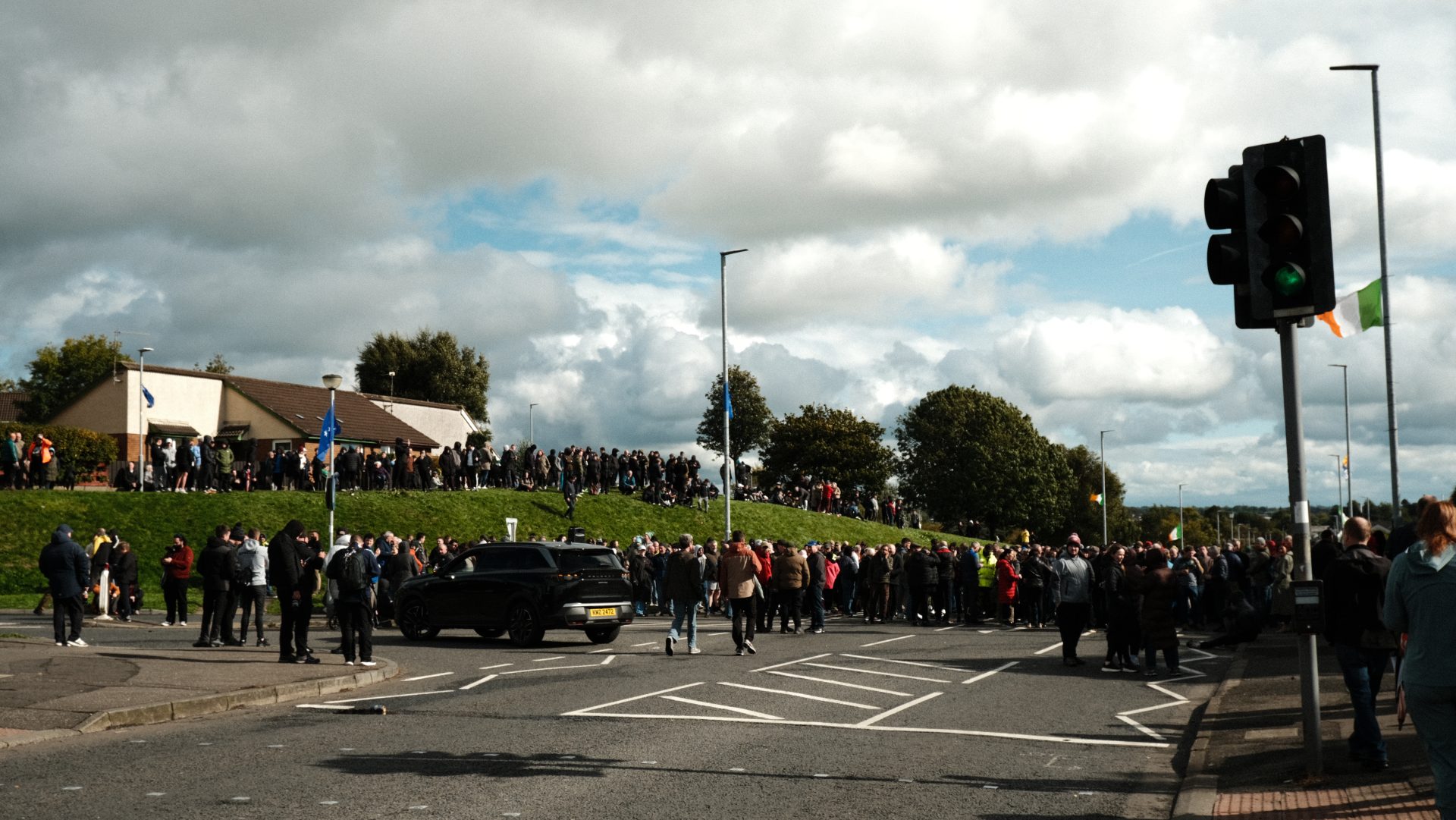
Outside the church, Nigel Dawson, the Grand Master of the Portadown Loyal Orange Lodge, was more accommodating. “All that’s happening is that we’ve been to church and we’re walking home, and they,” he added, pointing down the hill at the Garvaghy Road, “will have to move, and if they won’t, the police will have to move them.” But on the Garvaghy Road, where loudspeakers blasted Oasis and Kneecap tracks at the line where protestors confronted the PSNI, this did not look like an imminent event. The mood throughout was cheerful: rather than a riot, the intent was to dare the PSNI to use force first, which it did not. Elderly volunteers weaved through the crowd collecting litter.
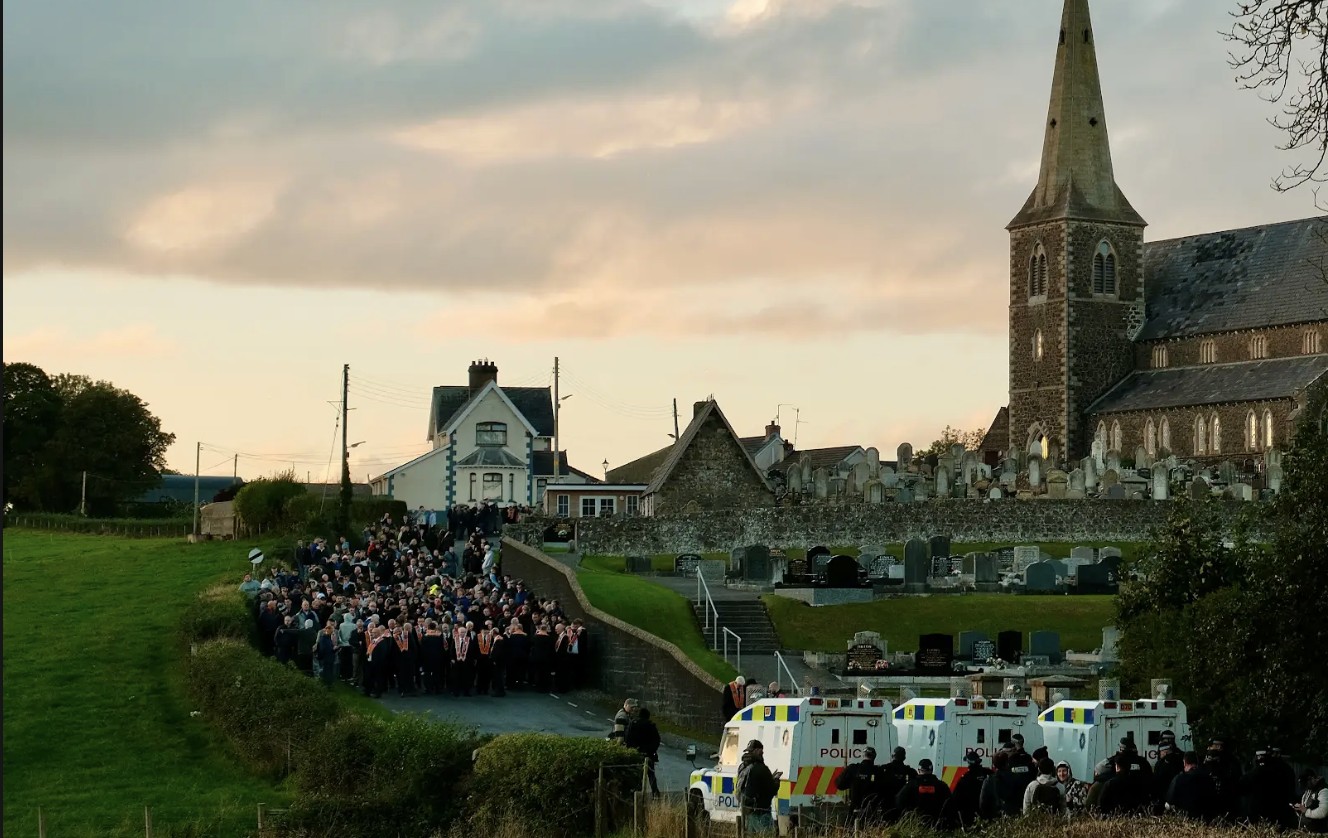
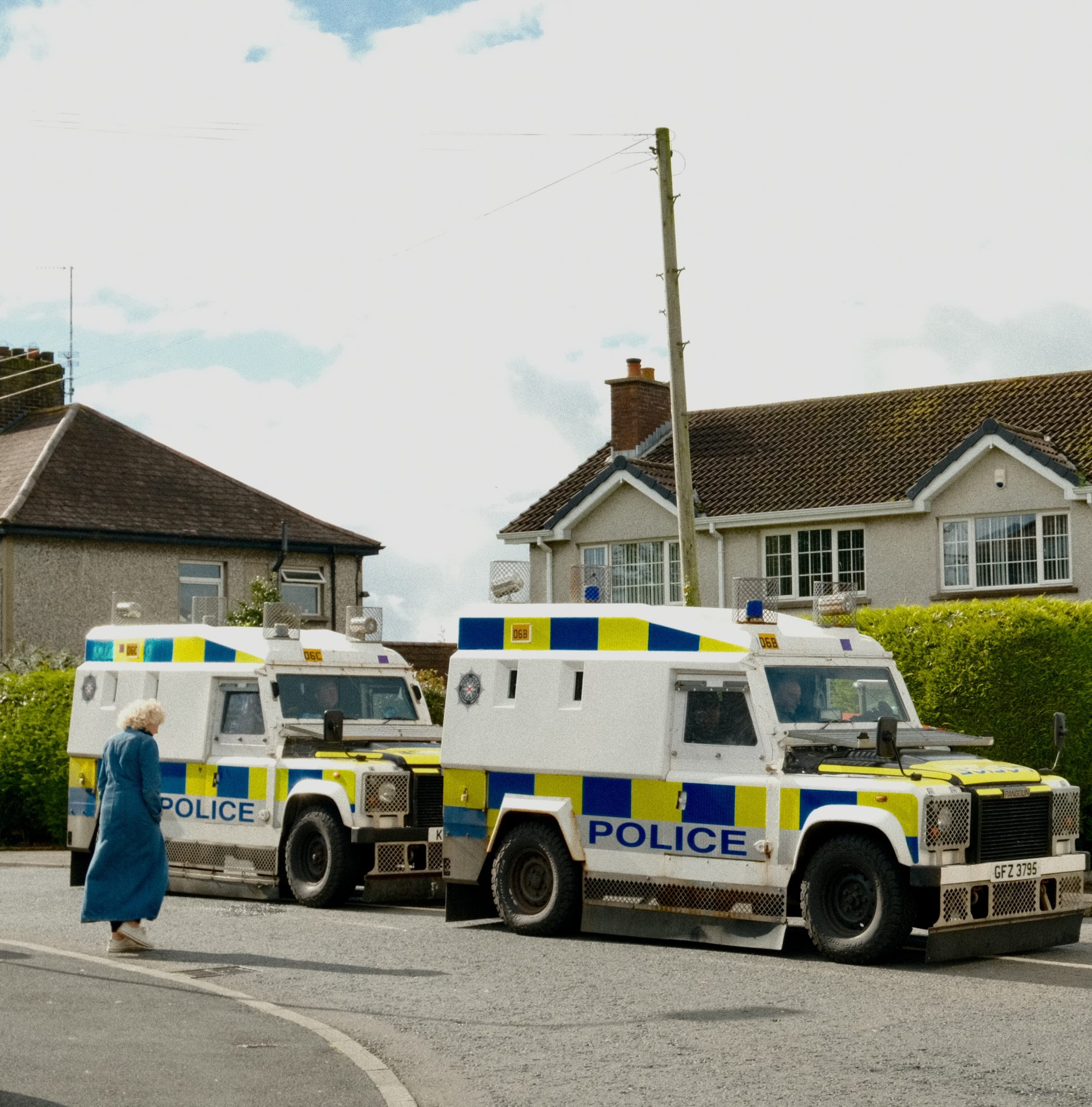
When messages sporadically boomed out of the armored Landrovers warning the protestors that this was an illegal demonstration, and that they would soon be dispersed, the crowd responded with jeers, mocking laughter, or chants of “SS RUC”. Police negotiators were rebuffed: there would simply be no negotiations. “They can’t arrest us all,” Mary, an elderly local woman told me, “There’s nowhere to put us. Sure they’re already letting out all the rapists.” Mary asked me if “Halloween Face”, by which she meant the DUP politician Carla Lockhart, was still up at Drumcree. When I said she had left, she said “She’ll have turned up for the cameras and then gone on home for her dinner, that’s all they’re good for.”
Certainly, Unionist politicians were, with the brief exception of Lockhart and her DUP colleague Jonathan Buckley, notable for their absence from Drumcree. Politically divided at the best of times, Unionist politicians and commentators were debating on social media whether they had won a great moral victory or achieved a total disaster. For all the detailed local history lessons I was given by representatives of both sides, the simple binary of Northern Irish life is that the march taking place would be seen by both sides as a victory for Unionism and Loyalism over Nationalism; the march being prevented would be seen as victory of Nationalism over Unionism. If the mood was somber and numbers sparse at Drumcree, on the Garvaghy Road, the mood of impending victory had already brought forth a hundred fathers. Politicians from across the whole spectrum of Irish Nationalism and Republicanism were keen to show themselves and be seen, associating themselves and their parties with what had rapidly turned into another historic event, for a movement that lives off the compounding symbolism of historic events.
The broader Nationalist community, politically dominated by Sinn Féin, contains a bewildering collection of micro-factions of differing shades of political opinion. All had now entirely united at a protest directed and organized by the residents of Garvaghy Road. It was an extraordinary display of cross-class and cross-border political mobilization brought about to quash what seemed to be a sudden, legally-sanctioned reversal of Loyalism’s symbolic fortunes. So total was the sudden display of unity that a number of protestors declared their anger to me that the Irish Taoiseach Micheál Martin was not there alongside them, “instead of standing idly by, like his predecessor Jack Lynch did”, one added. Perhaps this displays a certain Northern detachment from Southern political currents — confronting armored police Landrovers at an illegal demonstration would not be a very Micheál Martin thing to do — but it certainly showed the mood of the moment.
Leading the blockade was local man Breandán Mac Cionnaith, formerly of the IRA and currently of the Garvaghy Road Residents’ Coalition. A softly-spoken man, Mac Cionnaith was once described by Tony Blair as the most intransigent person with whom he was ever forced to negotiate. He is due to meet with the new Secretary of State for Northern Ireland, Chris Bryant, tomorrow. “The police will not move too many people here,” Mac Cionnaith told me. “And there’s a big difference between today and 28 years ago, when the police wouldn’t even have tolerated this, a majority Unionist, Loyalist police force… in 1985, 1996, 1997, there was no mercy shown here. It took 2,000 troops, and police, to invade this area and put us under martial law in order for an Orange march to go down that road. It’ll never be allowed to happen again.” Instead, he suggested, the standoff threatened the ability of the Orange Order to hold its marches elsewhere in Northern Ireland, as “it’s actually putting those less contentious marches at risk, because, you know, there’s a lot of support from our communities, Nationalist communities right across the North…. So should we not send a message, well, if you’re going to mess about with the Garvaghy Road, you’re messing about with all your marches everywhere else.”
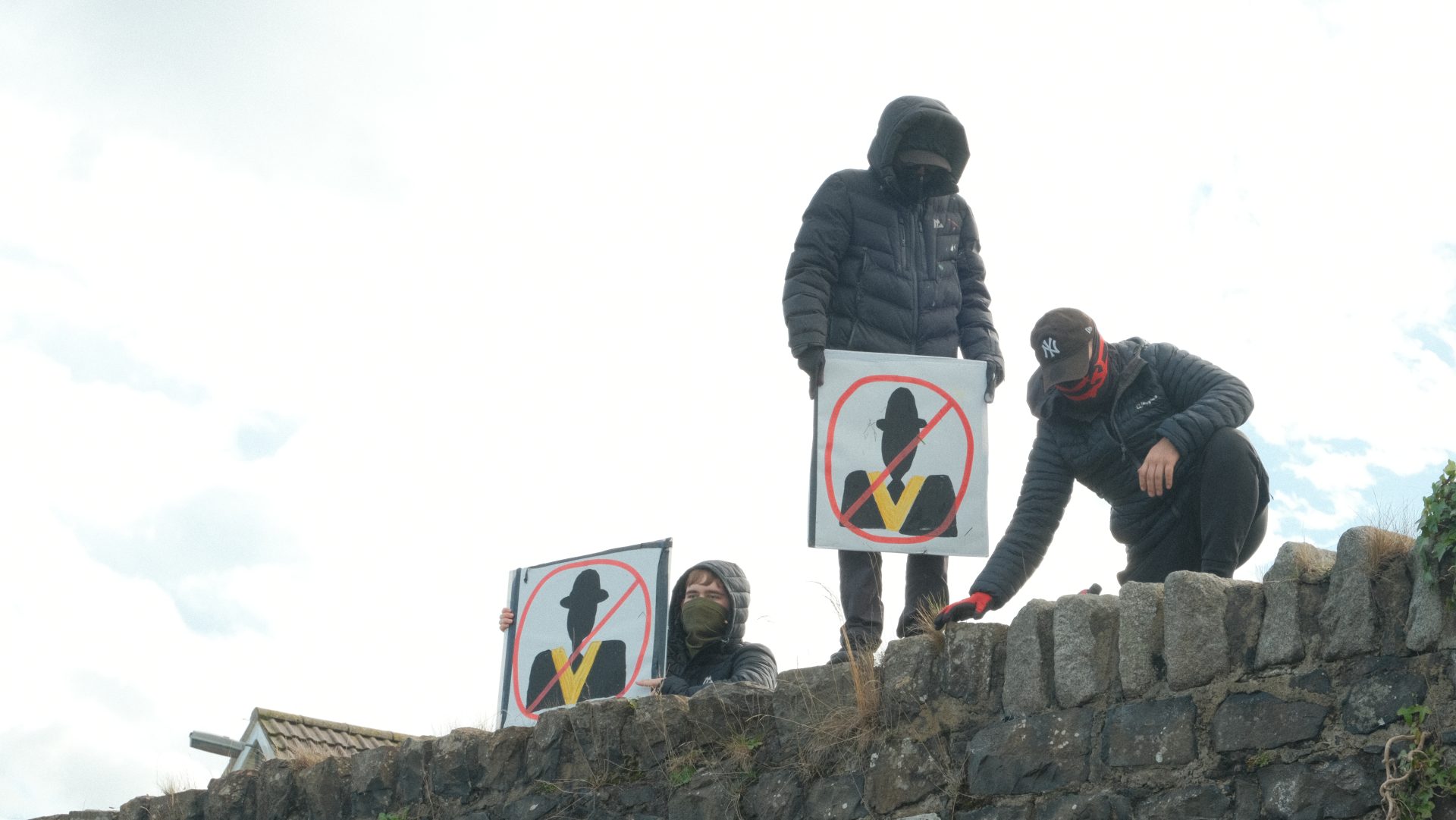
When rumors reached the crowd that the Orangemen were preparing to move, Sinn Féin MLAs linked arms at the front of the protest, as if daring to be arrested. Sinn Féin’s support has wavered in recent years, increasingly challenged by a resurgent SDLP in Northern Ireland, and hemorrhaging voters in the Republic, most particularly over the topic of immigration. Given the marked increase in immigration to Northern Ireland, even on the Garvaghy Road where a third of residents now have no identification with either Irish or British nationality, it had been theorized, particularly on the Irish anti-immigration Right, that the old loyalties would have little sway with the new residents: they would neither support nor be offended by Orangemen marching down their road for surely incomprehensible local reasons.
Interestingly, this did not appear to be the case. There were a number of African residents blockading the road alongside their ethnic Irish neighbors, and one East Timorese family traipsed along the road cheerily distributing bottles of water and packets of Tayto crisps to protesters. I asked the teenage son, who was the only one to speak English with any confidence, what he thought about the march. “We don’t need it here, this is a Nationalist community,” he told me, nodding vigorously when I asked him if he was himself an Irish Nationalist. Perhaps this dynamic is a result of the association with Loyalism with summer race riots over the past few years, or perhaps the power of Ulster’s traditional ethnic conflict is simply such that incomers happily assimilate into it.
In any case, the “new Northern Ireland”, that hopeful mantra of the country’s politicians and commentators, looked rather more like the familiar old Northern Ireland, revolving around its long-suppressed folkways, than it has in many years. On both sides, the participants dutifully fulfilled the roles allotted to them by Ireland’s history. “Fuck the sash”, “Orange scum”, and “Brits Out” graffiti marked the somber stone walls of the march route — sentiments visually at odds with the new development of handsome detached houses dividing the Orangemen from their unwilling mooted audience. Aside from a large handmade banner proclaiming “From Gaza to Garvaghy Road: Resist Occupation and Fascism”, there was little sign of the Palestine flag so central to recent Irish Republican mobilization: instead it was the Starry Plough of Irish Republican Socialism that fluttered from every lamppost alongside the Irish tricolor.
I asked Gerry Carroll, a popular West Belfast MLA for the socialist all-island People Before Profit party, if he was concerned at the prospect of arrest. “I’m not really bothered about that, to be perfectly honest, you know?” he replied. As for the collection of politicians to be seen, it was, he added, a broad front on display today. “It’s a broad swathe of Republican opinion here, obviously we’re a socialist organization, we are here. Other Left people, independents, people kind of came together. There’s obviously disagreements on many issues, but I think people are united in the fact that if this goes ahead, then there’s this open season for hardline, right-wing Loyalism, and that would be pretty devastating for Garvaghy Road, but also people right across the North…there’s a bigger battle here today.”
At the Drumcree Community Trust community center, a hub for local Nationalists, protesters from across Ireland charged their phones, chatted, dozed on playmats repurposed as mattresses, and drank vast quantities of hot tea. Volunteers produced tray after tray of sandwiches in apparently endless succession. “I have a 25 year old son myself,” Róisín, who had driven up from rural Leitrim across the border, told me. “I called him yesterday morning, and I told him, I’m sorry I wasn’t going to be able to go to Dublin to visit him. He said, ‘Why?’ I said, I’m going to the Garvaghy Road. He said, ‘Where is the Garvaghy Road?’ He’d never heard of the Garvaghy Road. Now, I’m not saying it’s not a beautiful place and a great community, but thank God. My 25 year old, my son, had never heard of it because there hasn’t been trouble in 28 years. And the Orange Order decided they wanted to walk over people in this community and bring back the Troubles again. And to me, it breaks my heart that there’s youngsters out there, the same age as my son, that never saw trouble in this country, and now they’ve been brought back into it again.”
That the march was proposed at all, Paul Doherty, formerly Deputy Mayor of Belfast for the constitutional nationalist SDLP, and now a popular local independent councilor and community activist in West Belfast, told me, was really a story about divisions within Unionism and Loyalism, particularly in the wake of the DUP’s macabre recent legal travails. “We’ve an election next year as well, and I believe the DUP are electioneering, and they’re ramping up tensions in the North of Ireland, here, for political gain. And I think that is quite shocking, and I think they’re dragging people in, who are unelected, people like [Loyalist activist] Jamie Bryson, who are ramping up tensions. I mean, when tensions are ramped up here, when rhetoric is ramped up, we know what the consequences are.” But it had been, he mused, a failure of governance more generally. “I think people need to sit down and reflect upon what has happened here today and the poor decision-making that has come from the top and the impact that it’s had, and the impact that potentially can have on stability here, and for peace in the North.”
Back at Drumcree, the mood was increasingly frustrated as the Orangemen, who had formed up on the road to Portadown, were prevented from moving by riot police, who had now completely withdrawn from the Garvaghy Road, and re-established themselves in a long armored convoy outside the church. “They’re asking me what my plan is and I intend to stay here,” Dawson told me, as his fellow Orangemen stood in ranks behind him. “And I said, listen, that’s the wrong question. You need to answer my question that I’ve asked now five times today. What time are you coming to bring us home? And we haven’t got a response to that yet.” Instead, the police were now informing them that the march could not go ahead for the marchers’ own safety. “We have given a clear commitment,” he told me, “even though we’re not happy with the policing, but we’ve also gave a clear commitment, that we will abide by the direction of the police. That’s who we are and we’re not going to step outside that.”
I asked Dawson, given all the trouble it was causing, to explain to readers outside Northern Ireland why it was so important to march down the Garvaghy Road in the first place, and not choose another route. “So you’ve got to know who we are, first of all,” he replied. “The Orange Institution. So we’re a massive organization, but Portadown District, who I represent, it was the first district ever formed in their history. We were in place before the Grand Orange Lodge of Ireland was ever constituted, and we came to church in Drumcree in 1807, and have done so on Sundays, once a year, ever since. So this is our tradition, and we are a traditional organization. It’s part of our history, part of our culture, part of our heritage, part of who we are. And that’s why it’s important to us. So that’s why we can’t walk a different route. Because our forefathers walked this in 1807.”
Wearing a Rangers gilet, the Loyalist activist and legal advisor to the Portadown Lodge, Jamie Bryson — a prominent and influential figure in Northern Irish politics — told a crowd of Loyalists who had gathered in support that the PSNI were now asking the Lodge to stand down, “to give them a way out for their appalling policing all day”. But, he added, to cheers and claps, “We will not give them a way out. The PSNI have caused this, they have failed in their legal obligations,” and had a legal duty still to to allow the march to take place. “The only option open to them if they can’t is go to the Secretary of State, cap in hand, and ask him to revoke the determination of the Parades Commission, which he said he had full confidence in. So, it’s a big problem between the PSNI and the Secretary of State, but as far as I’m concerned the Unionist and Loyalist community shouldn’t be solving that for them.”
I asked Bryson, given the PSNI’s seeming incapacity to allow the parade to take place, what this meant for the writ of the state in Northern Ireland. “The law has been completely undermined,” he told me. “We have the First Minister engaged in an illegal protest, on the Garvaghy Road, we have a mob now, the Republican mob, and the PSNI have shown themselves incapable of dealing with this mob. So that’s the present situation.” Asked if he thought, realistically, he would march down the Garvaghy Road that day, he replied “I think that the law has to be upheld. And I think that if it’s not, that the consequences for the political stability of Northern Ireland is going to be absolutely profound.”
While I was up the hill at Drumcree, Sinn Féin party leader Mary Lou McDonald and First Minister Michelle O’Neill were down on the Garvaghy Road urging protesters to stay out “until at least midnight”, when the permission for the march would expire. I asked Bryson if the day’s events would have ramifications for Northern Ireland’s devolved Stormont executive, where Sinn Féin politicians blockading the road share power with DUP politicians accusing their colleagues in government of “participating in an unlawful protest” and “giving two fingers to the police, the courts, and the rule of law”. His answer was instantaneous. “The DUP should collapse the executive in the morning, in my view,” he told me. “I’m not a member of the DUP. I don’t speak for the DUP, but I mean, it’s an intolerable suggestion that the DUP would remain in Stormont.”
Certainly, for Chris Bryant, the risk is growing that his role will suddenly become more hands-on than any sensible Westminster politician would wish. Adding to the many unwanted headaches direct rule will bring to the Burnham government is Reform’s sudden and unexpected interest in Northern Irish politics, shown by Danny Kruger’s speech at the DUP conference last week in which he praised their “Ulster granite” and proposed vague but significant new restrictions on the Common Travel Area. In a Sunday night tweet, Kruger observed that “The First Minister of Northern Ireland, Sinn Fein‘s Michelle O’Neill, has joined an illegal protest blocking a march that is allowed by law. The lawful management of parades was a key article of the peace process and for Sinn Fein to be joining illegal street action is a terrible step backwards.”
While it is common enough for Northern Irish politicians to complain of Westminster’s neglect, they may yet find it preferable to a sudden burst of interest from their British counterparts, in a situation where devolved governance is no longer tenable. One possible next party of British government is, after all, increasingly flirting with Ulster Loyalism, rather than the respectable and ineffective middle-class Unionism with which the Conservative Party is most comfortable. In such a scenario, the logic for Sinn Féin to push for a border poll, already a longstanding demand, becomes almost inescapable.
For the mostly middle-class Orange Order, and the broader swath of working-class Loyalist opinion sympathetic to it, it will not go unnoticed that attempts to follow the letter of the law, and utilize the legally mandated dispute managing mechanisms of the Northern Irish state, entirely failed. The newly traditional summer race riots, on the other hand, both win London and the world’s horrified attention, and swiftly achieve their intended results. In a country where the state’s coercive power is strikingly weak, a march that never took place, of 35 men down a few hundred meters of contested road, may have political consequences far beyond a rainy Sunday in a small Ulster town.
