




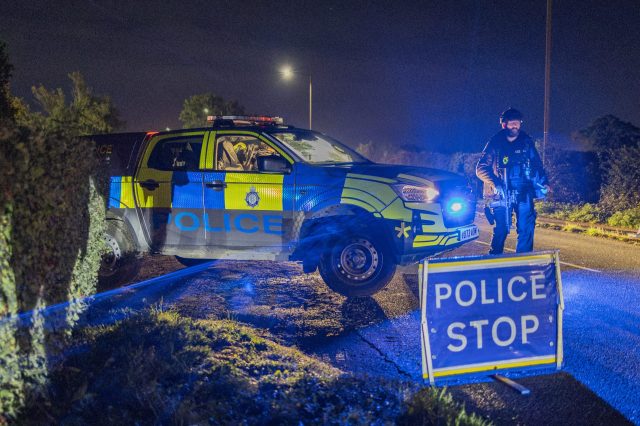
“The foiled weekend attack on RAF Fairford was incubated in the policy gap between the national and post-national versions of Britain.” (Marcin Nowak/Anadolu /Getty)





To widespread scorn, cartoon posho Jacob Rees-Mogg has been making videos, enjoining young Brits to get ready to fight and even die for the nation. But do we even know what “fight” means these days? Or “nation”, for that matter? Perhaps not: the Imperial War Museum recently announced a major re-brand, because young people reportedly can’t relate to the two World Wars.
The trouble is, it’s been so long since a full-on war that no one alive remembers what it was like. Our template for what “war” means is woefully out of date. And, worse, what’s driving us toward conflict now is the very architecture of institutions and beliefs that proved so successful, for so long, at keeping the peace.
It’s perhaps understandable that young people visiting the IWM today should be left cold by its exhibits: we live in the successor polity to the Britain that is its subject. It marks 20th-century wars that were fought between nation states, including Britain. But the Britain we now live in is only sometimes, and in some respects, a nation on this model.
Nation states were the characteristic political form of the modern age, combining multiple tribes agglomerated by a border, legal regime, national language, and imagined community. Great Britain was one of the first to coalesce in this way, but by the 19th century much of Europe comprised such entities, some expanding into global empires. And all of this was, as the great political economist Harold Innis argued, inseparable from the role of print in consolidating, expanding, and mediating these nation-states to themselves.
Our 19th-century nation states applied much the same template to geopolitics as classical liberal economics did to the free market. Every state was seen as an individual, pursuing its national interest. Statecraft consisted of jockeying to ensure a balance of power, in which no one nation-state became too mighty. For a long time, with the odd blip, this worked well. The 99-year era from the end of the Napoleonic Wars in 1815 to the outbreak of the First World War in 1914 is known as the Long Peace. But it couldn’t last.
The media theorist Marshall McLuhan drew on Innis’s work to argue that electrified communications disrupted the 19th-century equilibrium by speeding up communication across vast distances, intensifying national-interest politics until war broke out. These days, we tend to frame those wars as Good vs Evil narratives about democracy and Nazis. But at the time, as A.J.P. Taylor recounts it, the concern was much more about balance of power. For British statesmen in the Thirties, the problem with Hitler was less a moral evaluation of his regime, than the geopolitical risks of allowing Germany to expand.
Even then, no one fully reckoned on the role industrial technology would play in scaling up the violence. The result was the frenzy of manufactured slaughter and industrial production and destruction commemorated by the IWM. In the aftermath, many blamed nationalism. From the understandable longing to avoid a re-run was born the America-led rules-based international order, and with it the now-dominant story about democracy and Hitler.
In this new world, culture and communications dissolved borders, flashing round the world via radio and TV antennae. Nationalism was re-envisioned as a thin, symbolic thing of sports teams and boring ceremonies. Its more atavistic 19th-century predecessor was consigned to oblivion, as the mortal sin of “racism”. The new internationalism set out to soften national interest through international trade, and porous borders. National identities, meanwhile, might be moderated through the intermingling and integration of peoples.
Everyone’s model was America, the new hegemon and, aided by the transnational impact of American media, energetically promoted after the war as a “nation of immigrants”. Arguing for American immigration law to be relaxed, Senator Ted Kennedy rejoiced at the way this broadcast empire globalized and homogenized would-be immigrants: “In an age of global television and the universality of American culture,” he said, “assimilation, in a real sense, begins before they come here.” Downstream of this ebullient, successful, inspiring example, every developed nation retrofitted itself on a similar template.
In Britain, this consensus has diversified the national population. But notwithstanding all the school civics stuff about British Values, there are indications that the resulting post-war Britain feels at best ambivalently affiliated to the nation-state entity that preceded it. This is delicately implied by the IWM in its decision to rebrand: one that, its Corporate Plan stated, “reflects the growing number of people with no connection to someone who lived through the First or Second World Wars, or who was involved in the post-1945 conflicts”.
Though it’s not spelled out by the IWM, this isn’t just about generational change but also the demographic kind. Any contemporary 10-year-old of historic English descent is certain to have had forebears caught up in the two wars, even if the individuals themselves are long dead. But while this is surely true of some more recent migrants to Britain, it’s less necessarily so. Given that 38% of schoolchildren in Britain are now from ethnic minority backgrounds, perhaps we shouldn’t be surprised if school groups visiting the IWM today don’t always feel a personal connection to that particular past.
A plurality of ancestries and historic affiliations isn’t axiomatically bad. But much as electricity intensified national-interest politics, so the internet is both intensifying and undoing post-war internationalism. Specifically, it’s both accelerating global mobility, and also algorithmically sorting people into tribes. The result is the “global village” McLuhan predicted — but not in the way the utopians hoped.
The internet makes travel easier, facilitating legal and illegal migration alike. It also makes integration in a new country optional. Whereas a migrant to Britain or the USA in 1965 would have had to learn English, now between video calling, Google Translate, and social media, everyone takes their “community” with them. Concurrently, remittance services (and, less legally, money-laundering) have allowed finance to uncouple from nation-state economies and be re-routed via transnational familial, tribal, or ideological networks.
Meanwhile, everyone, whatever their heritage, gets sorted by social media into epistemic bubbles, then fed agonistic rage-bait about outgroups. What’s emerging is a multi-layered and digitally networked tribalism among migrant communities — and, increasingly, also former nation-state populations. That is: not “global village” in the optimistic hippie sense of borderless planetary love-in, but closer to what McLuhan actually expected: “a place of a very arduous interfaces and very abrasive situations.”
A lot of bread-and-butter culture war turns on street-level examples of such “arduous interfaces” and “abrasive situations”. That is: low-level aggro between re-tribalized subgroups, occupying contiguous or overlapping physical territories in the digital-age, post-national entity that used to be “Great Britain”. This is uneasy enough. But it gets more unnerving once mapped to questions of hard power and geopolitics, friend and enemy, whose most extreme expression is hot war.
Here the tensions inherent in our transitional phase are uncomfortably plain. Human rights lawyers may treat “national interest” as a wicked impediment to the universal good, but nation-state Britain isn’t altogether obsolete. The tribally constituted, post-national entity is rather superimposed on the older model and its bewildered, angry former imagined community. Meanwhile the erstwhile nation state still retains some functions — including, albeit in a threadbare way, foreign policy and military power.
A whole genre of low-grade post-national warfare has been incubated in the policy gap between these two versions of Britain. Incidents of domestic terrorism linked to geopolitics have grown frequent of late, of which the latest was genuinely frightening: over the weekend, an RAF base in Gloucestershire was evacuated, after a farmer spotted men in balaclavas leaving suspicious vans near the boundary. Five men have been arrested on suspicion of attempted bombing, and police are now investigating links to Iran.
But should we be surprised? An ideologically post-national governing class has so far clung to the older model, as to drive the formal military capabilities of nation-state Britain to the brink of hard-power confrontation on several fronts. This would be bad enough if we still had much hard power, or a cohesive nation. It’s made infinitely worse by the insouciance shown by the same class, at the same time, over who can come in and out of Britain, and how freely. This is consistent with the post-national worldview provided everyone is living in peace and harmony. But every indicator suggests everybody is not, in fact, doing that.
Instead, every element of the post-war order that once fostered peace is now doing the opposite. The internationalist regime of human rights has incentivized “grey zone” or “liminal warfare” conflict across operations such as cyber-attacks, sabotage, and weaponized migrant flows. The internet is accelerating and re-tribalizing demographic diversification, incubating sometimes radicalized subcultures within host nations. And the asylum regime, itself a post-war act of atonement by states which failed to do enough to prevent the Holocaust, has been weaponized for economic migration, organized crime, and infiltration by hostile actors.
What does war look like, when everyone lives everywhere, and loyalties are not geographic but networked? When soldiers don’t even need to be in the same country as the explosive drones they pilot? When you can get a child proxy to do terrorism for you via a website? The 19th-century model offers no very useful guides. Nor does Jacob Rees-Mogg’s demand for stiffer upper lips, among Britain’s now very diverse and sometimes ambivalently patriotic youth. The 20th-century postwar model is what got us into this mess. I wish I could tell you how we get out of it again.
Very obviously, no one currently in power has a clue what to do about the new normal. There are some obvious first steps to take, such as not granting citizenship to known senior Hamas operatives. We might also stem the tribalization of Britain by withdrawing from the asylum system, expelling known criminals and terrorists, cracking down on networked ethnic mafias, and being considerably more robust about ending the migrant dinghy industry operated by these mafias. But none of this would be anywhere near enough. The internet will still beam all wars everywhere, all the time, and whip everyone into agonistic tribes.
And meanwhile, the principal obstacle even to trying such measures is our own elites and institutions. Still grimly living in the internationalist 20th century, these will fight tooth and nail to obstruct any substantive policy response to the 21st. And this, not democracy and Hitler, is the real lesson of how the Long Peace ended. Institutions, ideologies, and elites that delivered good results for a long time are not hastily abandoned, even when it’s plain that, under new conditions, they are careering toward disaster. Alas: change on that kind of scale more often comes through having learned the hard way.
