




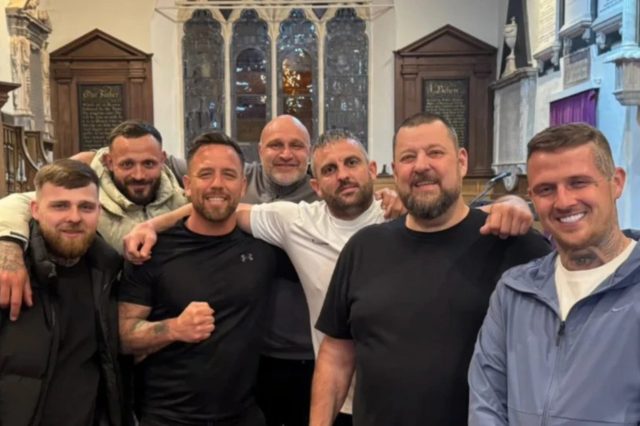
Daniel Thomas likely sees himself as restoring historic nation-state norms. In practice, he functions as a vector for ethnic majority re-tribalization. (Carl Court/Getty)





In 666 AD, St Wilfrid, an Anglo-Saxon bishop, was returning from France to the British Isles when his ship ran aground on the coast of Sussex, where he and his shipmates were attacked by pagan South Saxons. Wilfrid and his men defeated the attackers and their shaman through a mix of prayer and violence, then later came back and converted the tribe to Christianity.
At the time, the British Isles were occupied by multiple, sometimes warring tribes, and it wasn’t unusual for someone to try and kill you just for being on their territory. By contrast, today, the governing assumption for modern Western regimes is that no such rivalry is ever legitimate.
We got to this point via several centuries of tribalism-lite, in the form of nation-state patriotism, which climaxed in two disastrous world wars. After that, a consensus formed, with some justification, that even this much in-group preference was too dangerous. Instead, leaders dreamed that we might one day make separate nations obsolete, end all tribalism, and treat every human on the planet as, at least potentially, a member of the same tribe as ourselves.
But one of the most ironic consequences of this approach has been to set Britain on a retrograde path, not to the patriotic recent past, but to something akin to the Britain of St Wilfrid. More plainly: after half a millennium of growing ever more egalitarian and individualistic, Western nations are becoming more tribal — including some among ethnic majorities. And though opponents confuse this with nationalism, tribalism is harder, fiercer, and potentially much more violent.
By global standards, British culture has long been highly individualistic. Though this hasn’t historically always ruled out excluding someone on some ground or other, most ordinary Brits would shake their heads at (for example) preferring someone less qualified for a job purely on the basis of ethnic solidarity. But this may be changing. Tommy Robinson’s English Defence League was the first warning: more recently, phenomena such as Raise the Flags, and the Patriot Platform protest in Portsmouth last week, suggest English in-group ethnic preference is on the rise.
If the administrative class is spooked, it should be: this may point to a future in which they, not nation-states, are obsolete. For such a world would be governed not by managers, procedures, or “rule of law” — that is, by the current administrative class — but by warlords.
According to the movement’s leader, Daniel Thomas, the catalyst for “Patriot Platform” has been the years-long refusal by those committed to internationalist governance to control Britain’s sea borders — and the increased threat posed by an influx of unvetted men to British women and children. But if this has been the most recent spark, the fading of nation-states long precedes the small boats crisis. It was a governing theme of the Brexit debate, and has, in fact, been a policy objective (at least for some) ever since the Second World War if not longer.
In this utopian vision, we’d all join John Lennon in imagining there’s no countries. In the place of these racist, bellicose entities, we’d have an architecture of international governance that would bring about world peace by removing any need for nationalism and letting us all live as one, free from petty tribalism.
But if today this vision is bitterly contested, the irony is that both sides in this clash mistake the terms of the contest. For the internationalists, the villain to be defeated is still nationalism, identified (not unfairly) with a racially inflected model of nation-state rivalry that, historically, did cause two global wars. Those on the other side, meanwhile, long to return to nation-state patriotism. This, too, is understandable: for centuries this was the normative, unremarkable foundation of policy, governance, and national identity as such.
But what’s actually happening is far stranger than a battle between globalists and nationalists. The globalists already won the battle, comprehensively, and nation states really are obsolete. But their victory comes with an un-anticipated sting in the tail. For in the aftermath, what we’re seeing is not the utopia envisaged by John Lennon, but rather a return to something more like the hyper-local tribalism of Dark Ages England.
Perhaps the single most catalytic new factor, across the board, is the digital revolution. Smartphones make migration — both legal and illegal — easier and more appealing, while translation apps and long-distance calling make integration less necessary. The writer Fred Sculthorp has described the effect of the resulting transformation in areas such as Dagenham, where formerly homogeneous working-class polities have become dizzyingly pluralistic and at times alienated patchworks.
Then, too, as minorities cluster, the resulting enclaves may extend in-group preference beyond specialist groceries or religious centers, to alternative economies or disciplinary systems — sometimes in contravention of local law. There is, for example, some evidence that the so-called “grooming gangs” are one manifestation of an ethnic mafia, analogous to the Sicilian one, whose bedrock is Pakistani-heritage clan-based networks. Another notable such mafia is Albanian, while cash-in-hand car washes that fall foul of modern slavery laws tend to be Romanian-controlled, and people-smuggling into the UK is controlled by Kurdish networks.
This isn’t to imply that there is something uniquely innocent and blameless about Brits by comparison. This country has its share of home-grown organized crime “firms”: think of the Krays. It’s more to contrast both the legal and criminal versions of such ethnic in-group preference with the normative view across ordinary Brits and the government alike; namely, that ethnic nepotism is at best low-status, if not outright immoral.
The sociologist Eric Kaufmann has critiqued the official version of this as “asymmetric multiculturalism”. But a less grievance-y term might be “de-tribalization”. This isn’t just a British cultural trait, but a key element of being “Western” as such: a greater than usual willingness to take any individual on their own terms, rather than simply as a representative of their group or tribe.
This works well enough, as long as most of your citizens are similarly detribalized. If they are, you can perhaps aspire to what the Marxist philosopher David Graeber called a “utopia of rules”: a system of neutral procedures that frees all of us from messy partiality and decision-making (even if it also causes stagnation). In rather less critical terms, this neutral realm of procedure is what New Labour’s famous “British Values” image refers to as “the rule of law”.
But what if you share your utopia of rules with large minorities who still adhere to in-group preference? Then, instead of working neutrally for everyone, your rules risk degrading to a thin veneer over a morass of competing tribal interests. The former Singaporean leader Lee Kuan Yew stated this problem starkly, when he rejected British-style democracy as unsuited to Singapore. “In multiracial societies,” Yew said, “you don’t vote in accordance with your economic interests and social interests, you vote in accordance with race and religion.”
Until recently, with a few widely-condemned exceptions, the British ethnic majority has largely clung to de-tribalized legal and cultural norms despite a rapid uptick in the country’s ethnic pluralism. But this is clearly no longer the case. Again, the internet plays a part: whatever your heritage, all the incentives of clickbait tend not towards broad common culture, but away from it, into sometimes-adversarial in-group identities. These are then consolidated on the most reductive possible lines, and intensified by selective sharing of rage-bait stories.
The result has been a rapid propagation of tribalistic identities, including among previously individualistic normie Brits. Patriot Platform and Raise the Flags likely see themselves as restoring historic nation-state norms. But in practice they’re roaring back past patriotism, becoming a vehicle for in-group mobilization, among working-class men who feel their government now treats them as just one tribe among many, in a place that used to be “theirs”.
This emerging landscape has been acknowledged for some time, by British policing in practice. Last election’s “Gaza Independent” agitators and political actors, such as the wheeler-dealer Akhmed Yakoob, hint at the shape of things to come. Similarly, the decision last year to block a Ukip march through Muslim-majority Tower Hamlets was criticized as “two-tier”, but was clearly a pragmatic effort to keep one tribe from infringing the territory of another, hostile one. The same logic likely informed officials’ decision last year to block a notoriously tribalistic group of Israeli football fans from attending a match in a Muslim-dominated area of Birmingham known for strong views on Gaza.
The efforts by Birmingham Council to impose heavy penalties for “flagging” have likewise been denounced as un-patriotic. But in a place such as Birmingham, where less than half the population is white British and districts tend to self-segregate, suppressing this practice reads less as anti-government, than as a last-ditch attempt to slow the Ulsterization of a major city.
Daniel Thomas, meanwhile, seems out to accelerate the Ulster dynamic: Patriot Platform is reportedly inspired by tactics Thomas witnessed in Belfast. Things fall apart; the center cannot hold. If this gyre continues to widen, we’ll be looking forward to a new kind of localism: not the plethora of mayors Andy Burnham seems to want, but something (at best) more like the fiefdoms of the Middle Ages, with territory controlled by whoever can command enough loyalty from fellow-tribesmen to hold it. And this is a starkly different personality profile from what we tend to think of as an ideal modern leader. A world of warring tribes is probably less destructive in absolute terms than rivalrous nuclear-armed nation-states, but it doesn’t run according to the same calculus as a de-tribalized, peaceful one.
Notably, fitness to be a tribal leader is very different to fitness for de-tribalized governance. Guardian columnists can express puzzlement at the idea that men might have domestic violence convictions, and also answer (in Tommo’s formulation) a call to “Protect our country! And more importantly our women and children!”. But, from a tribalistic perspective, there’s no conflict between protecting in-group women from rival men, and (perhaps) abusing those women. Much has also been made of Thomas’ conviction for attempted kidnapping, which is obviously bad from a de-tribalized perspective. But a tribal leader’s task is to mobilize in-group men to protect the tribe, and, in that context, a capacity for strategic violence is not automatically a demerit.
Whatever you think of his project, footage of Thomas makes clear that he is a natural leader, on a template that would once have found an easy home in the military. The discipline shown by his group so far suggests he inspires loyalty. If the practices he is now modeling spread among white Englishmen, it’s not unthinkable that the country of the future really could look more like that of the past. Not, that is, precisely the “civil war” some predict, but a place fractured even more dramatically than envisaged by the nationalist leaders of Scotland, Wales, and Ireland. Perhaps, we might speculate, along lines more closely resembling the Heptarchy, or still more minutely into fiefdoms controlled by leaders on the Daniel Thomas or Akhmed Yakoob template.
In fairness to Thomas, he’s insisted his end objective is to “restore order” and to bring his followers to the voting booth. But his critics aren’t wrong to sense that, against this, the sheer intimidating number of black-clad men he can mobilize evokes a more pre-modern kind of power. Officials and civic nationalists are right to be frightened. A country where re-tribalized working-class men are turning out in large numbers, at the bidding of a telegenic leader with no loyalty to the regime, is one in which the universal, neutral “rule of law” is on borrowed time.
And the infuriating thing is that none of this has to happen. Our political class can choose to stop playing John Lennon Pretend at any moment, and take pragmatic Lee Kuan Yew-type action to restore order. My sense is that “Danny Tommo” would probably consider this acceptable. As a woman, and a mother, I would too. It’s my desperate hope that our country manages to shed its ideologues, and change course in such a direction, before we find ourselves back in St Wilfrid’s world.
