




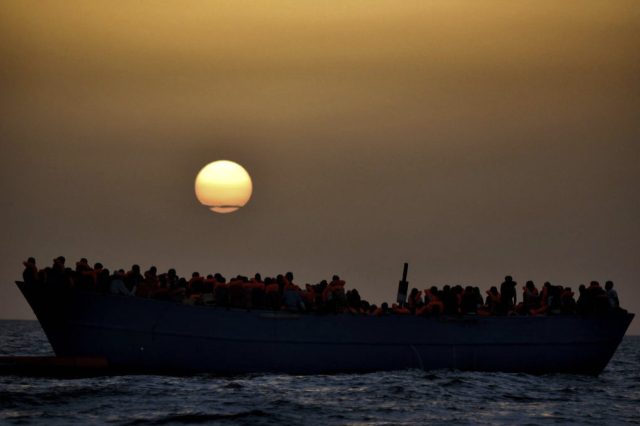
The Mediterranean is hard to police. (ARIS MESSINIS/AFP via Getty Images)





As 60,000 illegal immigrants poured into the Spanish enclave of Ceuta late last week, there was little sign of concern from Moroccan authorities. One of the many thousands of young men left wandering aimlessly around the city on Friday told The New York Times that Moroccan police simply “opened the border and let everyone go by.” Another said police pointed him in the right direction — swimming past the corpses of those who failed the attempt — saying: “Go that way, go that way.”
Another would-be migrant claimed Moroccan police encouraged him, crying “come to Spain!”
It sounds like a tourist board slogan, and it turned out to be misleading. By Friday afternoon, these men, along with most of the illegal arrivals, were already trudging home, baffled by Ceuta’s lack of suitable accommodation, food or drink. Europe’s famed hospitality had let them down.
The stories of illegal migrants who made the journey there and back again contrast markedly with official Moroccan reports. Moroccan rights groups claim police used water cannons and fired warning shots to prevent crossings (clearly with little success). Morocco’s ambassador to Spain said events unfolded against Morocco’s wishes and that “we have always prioritized legal, orderly and safe migration for all” — a Freudian slip for the ages.
The days since have seen a rash of speculation over Morocco’s motivations for encouraging — or at least facilitating — the crisis. Commentators and experts point out Spanish ties to Western Sahara separatists and the reopening of lucrative economic ties with Morocco’s regional rivals Algeria, as well as Moroccan resentment over the perceived colonial nature of Spanish rule in Ceuta. Other analysts argue that a nexus of Moroccan, Israeli and American interests has combined in order to undermine the Spanish government led by socialist Pedro Sánchez, whom Donald Trump appears to see as the embodiment of Europe’s ills.
Did Morocco facilitate the crisis? Were the young men’s claims of police encouragement true? This would help explain the scale of the migrant surge, but it cuts against Sánchez’s public response. Rather than rebuking Morocco for its egregious lapse in border enforcement, the Spanish leader thanked Rabat for its “cooperation” in defusing the situation.
Sánchez saved his ire, instead, for the 22 EU leaders who signed an open letter criticizing his pro-migration policies, in particular Spain’s recent mass regularization of illegal immigrants. Sánchez condemned the “selfish, polarizing and unlawful reaction” of his EU peers, saying countries that backed Spain’s temporary suspension from the Schengen Zone were “driven by prejudice, fake news, ignorance, or political interest.”
In short, Sánchez appeared happier with Morocco — the state accused by many of facilitating the crisis — than with fellow Europeans seeking to enforce stronger migration controls.
Granted, Sánchez is typically a defender of migration. But his refusal to cast blame on Morocco illuminates a shift in relations between the EU and north Africa, driven by migration dynamics. This shift puts European leaders of all stripes in the same boat.
The EU has made the externalization of migration controls a crucial factor in relations with countries around its external borders. A cornerstone of the bloc’s rightward shift on migration — often labeled “Fortress Europe” — is a focus on bilateral agreements with third countries, particularly in north Africa, which act as gateway states for those seeking to attempt the perilous voyage across the Mediterranean.
These agreements tie EU financial aid to efforts from countries such as Morocco, Tunisia, Libya and Egypt to contain illegal migration flows. European nations equip and train local maritime police while disbursing hefty financial aid to sweeten the deal. The EU’s controversial 2023 deal with Tunisia on migration proposed over €1 billion in aid, while Morocco, another key gateway state, has received hundreds of millions of euros, most of it earmarked for “integrated border management and the fight against smuggling and trafficking in human beings.”
EU leaders thought that by externalizing migration controls — and washing their hands of the dirty work involved — they had found the perfect solution. Stopping illegal migrants from ever reaching EU soil would, it was reasoned, save the bloc from ever having to confront the thorniest problem relating to illegal migration: the knot of human rights legislation that protects migrants once they arrive. For that reason, leaders hoped that partnership agreements would neutralize public concerns over illegal immigration.
But the Ceuta crisis suggests that “Fortress Europe” is a castle built on sand, one that is perennially vulnerable to the caprice of Europe’s partners. Incentivizing non-EU states to manage migration flows creates a mutual dependency: the gatekeeper states depend on EU financial aid, while the EU depends on their efforts to keep migrants off European soil. The seismic implication of Ceuta is that, amid growing Western panic over migration levels, that mutual dependency is no longer balanced — and the West’s partners are learning the art of blackmail.
Are Sànchez’s words, then, those of an out-of-touch, anti-European traitor, as many onlookers caricature him? Or are they, instead, the supplication of a man with a figurative gun to his head? It should, again, be emphasized that there is no hard evidence to prove that Moroccan authorities were complicit in the Ceuta crisis. But the EU’s externalized migration controls have handed its leaders significant power to disrupt Spain and the bloc as a whole, whether they choose to use it or not.
In that sense, the Ceuta incident shouldn’t have come as a surprise. The EU doesn’t have to look far for a precedent when it comes to hostile weaponization of illegal migration flows. For years, Poland has accused Belarus of sponsoring illegal migration, luring migrants from across the Middle East and Africa on tourist visas with the promise of an easy jaunt into the Schengen area. Successive Polish governments have undertaken heavy militarization of the country’s eastern border, and the route has become deadly.
Polish Prime Minister Donald Tusk justified this uncompromising response by saying: “We are not dealing with just any asylum seekers, we are dealing with a coordinated, very efficient operation to break the Polish border and attempts to destabilize the country.”
The Polish response has been harshly condemned by human rights groups, which, given the severity of Warsaw’s measures, is unsurprising. Measures at the border with Belarus include a 5.5-meter-high steel fence with electronic monitoring systems to detect attempted crossings. Poland has also loosened rules around the use of firearms — introduced after a soldier was murdered at the border — that NGOs say give officers a “license to kill”. And since 2025, Poland has suspended the right of all arrivals from Belarus to claim asylum. The latter move was lambasted by the UN High Commissioner for Refugees, as well as Poland’s commissioner for human rights, an internal ombudsman, as a violation of European law.
From the perspective of stopping illegal migration at the Belarusian border, though, Warsaw’s harsh measures have been a resounding success. While 40,000 attempted crossings were reported in 2021, and 15,500 in the first half of 2025, the official figure for the first half of 2026 was just 235. Belarus’s focus for illegal migration flows has now shifted to the Baltic states, forcing Latvia to seal its southeastern border at the end of July.
Given openly hostile relations between Belarus and the EU, Minsk’s actions are understood as a form of hybrid warfare and punished as such through sanctions. The EU has no similarly clear-cut way of understanding the new power wielded by its partner states in north Africa. European leaders must, in this context, ask themselves two questions: how can they be sure that gatekeeper states are on their side, and, if there are concerns over these partners’ good intentions, what options does that leave?
One potential path is appeasement. Sánchez’s thanks for Morocco’s cooperation — in defusing a crisis which it stands accused of having created — can be understood in this light. The more money Europe pumps into external migration partnerships, the more dependent it becomes on those partner states, and the greater their strength — and Europe’s concurrent temptation towards appeasement — becomes.
A second option, in which Europe accepts that externalization agreements pose risks, would be to take back responsibility by significantly strengthening EU states’ own illegal migration controls and enforcement capabilities. This won’t happen, though, until leaders tackle the legal protections that migrants gain once they reach EU soil. There is a tight connection between changes in international human rights law and resultant migration: hence the apparent link between the Ceuta crisis and a Spanish Supreme Court ruling blocking deportations without due process for sea arrivals. It is the opposite effect to the plummeting rate of arrivals to Poland from Belarus since all asylum applications from that country were banned.
Thirdly, Europe could consider applying the playbook which it already uses against Belarus and Russia to any state which it suspects of weaponizing migration with hostile intent — even gatekeeper countries. Hostile exploitation of migration by Russia and Belarus is met with punishment in the form of sanctions and the severing of diplomatic relations. These tools, or at least the threat of them, could be applied more broadly. Facilitating mass illegal migration is not, after all, the act of a friendly nation.
The EU is the largest trading partner for all the key migrant gatekeeper nations in north Africa. It has the economic clout to deter potential hostile exploitation of migration by those states, and while not every lapse in migration controls is an act of hybrid warfare, a carrot-and-stick approach — the “stick” being the credible threat of sanctions — may restore balance to the increasingly lopsided nature of these relationships.
It is disturbing to think that exploitative illegal migration flows may be motivated by geopolitical power games. But Europe should be more disturbed by its powerlessness in the Ceuta affair; a powerlessness created by counterproductive elements of human rights legislation, formalized in externalization agreements with third countries, and exemplified by Sánchez’s thanks to a state which dramatically failed to uphold its end of the bargain in protecting Europe from illegal immigration.
The EU must also face up to the fact that in the event of instability elsewhere in the region — renewed conflict in major migrant transit nation Libya, for example, or a breakdown in the EU’s fraught relationship with Tunisia — potentially hostile regimes may similarly wield migration as a weapon. This risk is only heightened by the ongoing surge of refugees north from war-torn African states; an estimated two million Sudanese refugees have fled to key EU partners Egypt and Libya alone since the nation’s civil war began in April 2023.
One thing has become alarmingly clear: the ability of non-European states, who may not have our best interests at heart, to dictate migration flows, in so doing undermining societies and sowing panic. Europe gifted them this ability. Whatever conclusions it draws from the Ceuta crisis, it must now learn to stand up for itself.