





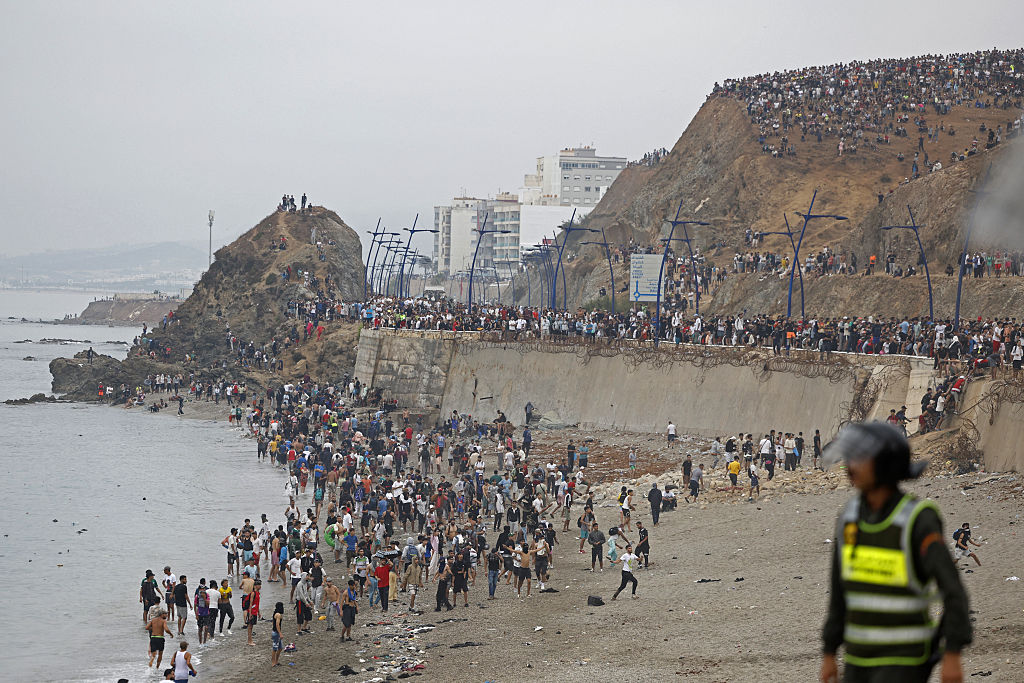
Young migrants arrive in Ceuta. (Marcos Moreno/Europa Press/Getty)





Sixty-thousand people — roughly the population of Loughborough. That is how many migrants just forced their way into the Spanish town of Ceuta, a coastal enclave on the Moroccan side of the Strait of Gibraltar. Dozens died climbing over barbed wire fences, even as Spain’s armed forces hastily started mobilizing. In a sense, none of this is new: Ceuta and its sister enclave Melilla have long been a source of tension between Madrid and Rabat, with Morocco claiming the territories as its own. Yet though Morocco has also used its control over migration flows into Ceuta to extract concessions from Spain and the EU before, the scale this time is remarkable.
Some analysts suspect that Morocco’s sudden lapse in enforcement may be in response to deepening ties between Spain and Algeria — the latter alleged to have sponsored Sahrawi separatists in Moroccan-controlled Western Sahara. In 2021, Morocco similarly waved through some 8,000 migrants to punish Madrid for hosting a Sahrawi leader. But a related — more insidious — reason for the latest breach is that Rabat is leveraging an increasingly close relationship with the Trump administration and Benjamin Netanyahu’s Israel.
MAGA has branded Spain Public Enemy No. 1 over its government’s strident posture towards the US and Israel during the Iran war. The socialist government of Prime Minister Pedro Sánchez has refused to allow Washington access to its Rota and Morón military bases, its consistent failure to meet Nato defense-spending targets also fueling MAGA ire. In March, the center-right American Enterprise Institute’s Michael Rubin wrote a policy brief calling on the White House to formally recognize Ceuta and Melilla as occupied Moroccan territory. True to the spirit of Third-World decolonialism, Rubin wrote that Spain was “a colonial power running colonies across the Strait of Gibraltar”.
Within days, neoconservative congressman Mario Díaz-Balart had entoned Fidel Castro, stating that the enclaves were “not in the geographic territory of Spain” and should be “established, negotiated, and discussed between friends and allies”. Similarly, Reuters reported in April that a Pentagon email outlined options against Spain, including Nato suspension; the treaty states explicitly in Article 6 that territories in continental Africa are exempt from collective defense obligations.
For its part, Rabat has since transformed into a vital partner of Washington and Tel Aviv under the Trump-brokered Abraham Accords, which normalized relations between Israel and several Arab states, including Morocco, in 2020. Ironically, Rabat proceeded to leverage the development in the service of its own expansionist aims, with the first Trump administration recognizing Rabat’s sovereignty over Western Sahara.
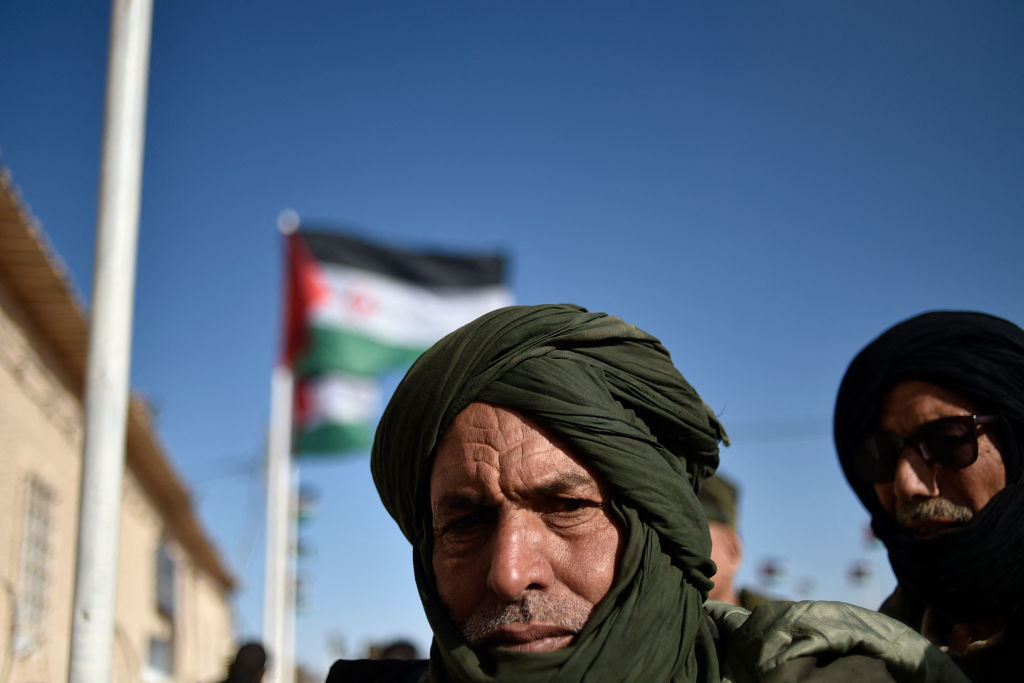
The dispute over Western Sahara traces back to Spain’s 1975 withdrawal from what was then called Spanish Sahara. Under the Madrid Accords, Spain handed administration of the territory to Morocco and Mauritania; Mauritania withdrew from its share in 1979 after heavy losses to Sahrawi guerrillas. A 16-year war followed, pitting Moroccan forces against the so-called Polisario Front. Rabat eventually built an extensive sand wall — fortified with landmines and troops — partitioning the territory. In November 2020, Moroccan troops entered the UN-patrolled buffer zone to disperse Sahrawi protesters, prompting the Polisario to declare an end to the three-decade truce and a return to armed struggle. The two sides have since traded sporadic strikes along the sand wall.
Rabat has since made inroads on virtually every diplomatic front. Following normalization through the Abraham Accords, Morocco signed a security agreement with Israel in 2021, proving vital for the conflict in Western Sahara; in January, the two nations signed an additional joint military work plan. Then, in February, secret talks chaired by the US brought Moroccan, Algerian, Mauritanian, and Polisario delegations together for the first time since 2019.
In true Trumpian fashion, Morocco announced on Monday that it was naming the Dakhla-Tiznit highway, which runs through Western Sahara, after the US President. Ecstatic, Trump exclaimed on Truth Social: “Thank you to Highly Respected Mohammed VI, the King of Morocco — Such a Great Honor! I look forward to traveling the entire length of this Great Highway someday, hopefully soon!”.
All of this comes as a royal headache for Sánchez ahead of a general election in 2027. His record of raising wages and opposing US and Israeli war crimes has boosted his standing both at home and abroad. Yet a slew of corruption scandals, and a lax immigration policy, have seen his party, PSOE, as well as allies in Sumar and Podemos, consistently trail the Right-wingers of Vox and the People’s Party (PP) in polls.
In recent years, the bulk of low-skilled immigration to Spain has overwhelmingly come from Spanish-speaking Latin America. As a result, negative attitudes towards immigration are rather less pronounced in Spain than other European countries. At the same time, though, Spaniards overwhelmingly oppose illegal migration — especially from Arab and Subsaharan African countries.
In January, Sánchez’s government issued a blanket amnesty for virtually all illegal immigrants living in Spain. The move, while laudable for granting labor rights to millions of workers, provoked an outcry, with roughly 60% of Spaniards expressing disapproval. Barring overwhelming enforcement on new arrivals, the issue with any such move is that it inevitably incentivizes further illegal immigration.
Sánchez now faces a quandary: clamp down in Ceuta and risk alienating affluent progressives in his coalition, or do little and suffer at the hands of the Spanish Right and the broader public. The former, naturally, is the sounder course. There is, moreover, room for the Prime Minister to maneuver geopolitically while outflanking the progressive Sumar and Podemos’ fantasies of an open-border utopia. After all, Sánchez can credibly accuse Morocco of acting at the behest of the US and Israel against a Nato member. At the same time, he could make a case in favor of overwhelming enforcement against illegal immigration precisely because of the March amnesty.

There is some reason to think that Spain’s famously sly Prime Minister could opt for just such a path, particularly as support for Sumar has collapsed from roughly 13% to 6%, and with Podemos in the doldrums too. The Socialist leader has defied the odds at consecutive elections, favoring high-stakes gambits against his Right-wing adversaries. Nonetheless, the PSOE and its allies have consistently failed to win more voters than the PP and Vox, instead relying on minor, regional parties to govern.
As both Denmark’s and Slovakia’s Social Democrats have shown, the key to Leftist success rests largely on a tough but humane immigration policy. In the wake of the surge in Ceuta, a member of PSOE’s youth wing made a surprisingly sensible plea. “The truth is, I hope this crisis pushes the PSOE to look at the immigration policies of its Northern European sister parties and realize it’s time to move away from what I see as an open-borders approach influenced by the more radical left,” they wrote. “That means protecting those who genuinely need asylum, maintaining secure borders, and avoiding mass regularizations.”
It seems Sánchez has opted for this course at least in part. Yesterday, he described the surge in Ceuta as “an attack on Spain’s territorial integrity” and stressed a stiff response: Al Jazeera subsequently reported that more than 37,500 of the 60,000 or so who entered Ceuta had been returned to Morocco. It remains to be seen if the Spanish Left ultimately benefits from the crisis. As for Morocco and the Trump administration, it seems that MAGA’s talk of “Third-Worldism” is more inclusive than many of its supporters might think.
