




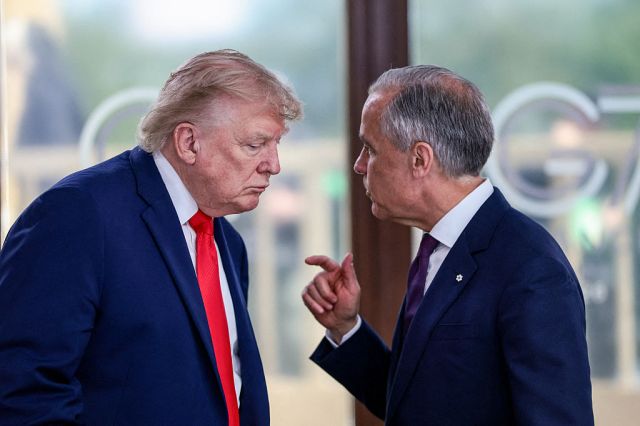
Donald Trump and Canada's Prime Minister Mark Carney are clashing on trade. Credit: Getty





The greatest threat today to American manufacturing and global exports comes from China. The People’s Republic has far surpassed the United States in industrial output and competes with Washington in a Cold War II spanning many fronts, including trade, technology, military development, and proxy wars in Ukraine and elsewhere. And that’s not to mention a new superpower space race.
Why, then, is the Trump administration appeasing China on trade, while picking fights with countries like Canada that are friends and allies of the United States? Why is America shaking down allies for cash and risking inflationary pressure at a time when the US economy can hardly afford more of it? The sheer irrationality and refusal to ease up lend President Trump’s trade war with Canada the aspects of a mad compulsion.
Trade negotiations between Washington and Ottawa have dramatically collapsed in the last week. The industries involved include autos, lumber, plywood, clothing, dairy, and alcohol. There is no reason for the two countries not to be able to reach an accommodation on any of these questions, provided America doesn’t continue to treat friends like enemies.
The automobile industry is a strategic industry, to be sure, but the issue in the US-Canadian trade diplomacy involves merely the location of supply chains in what is already an integrated North American market. As for the rest, nobody would describe dairy, alcohol, and plywood as sectors essential to American industrial, commercial, and military power.
Meanwhile, by 2023, China’s share of global manufacturing output surged to 28%, up from just 9% in 2004 — making it larger than the combined output of the United States, Japan, and Germany.
Chinese manufacturing dominance, by the way, isn’t about “plastic trinkets,” free-traders’ shorthand of a generation ago for why we shouldn’t worry about giving up some industry to the Middle Kingdom. Thanks to a relentless and effective state-sponsored industrial- and trade-policy combination, China, once an exporter of low-value-added products like textiles, now leads the world in electronics exports. It enjoys a global market share of 32%, followed by 14% in the case of Taiwan. The American share of global electronic exports? A measly 5%.
China is also now the world’s largest car maker, responsible for a third of global output. And the country’s share of global shipbuilding, another high-tech, strategic-manufacturing industry, is even higher, at a staggering 56%. And while the Chinese lag behind the United States in commercial aviation, they control an estimated 80% to 90% share of global drone manufacturing — an industry with obvious military implications.
OK, when it comes to the most strategic industries of the 21st century, America should be picking its trade fights with China, not with … Canada. But hey, at least when it comes to plywood, Canada is a bigger player in global markets than China. Oh, wait — China is responsible for more than 54% of global plywood exports and makes up to an estimated 70% of the world’s plywood.
Alcohol? Canada lags behind the leaders in alcohol revenue: the United States, China, and Japan. Is Canada threatening to engross the world lumber market? Well, at least Canada exports more milk and dairy products (180,000 tons) than China (70,380 tons). And according to 2026 data, Canada exports more lumber than the United States.
America is threatened by a lumber gap!
In all seriousness, there is something perverse afoot here. While cracking down on Canada in trade disputes over non-strategic industries, the second Trump administration has appeased Communist China. The People’s Republic controls 90% of refining in rare earths, essential for advanced technology and manufacturing in many industries, and the Beijing regime hasn’t hesitated to use the leverage it gains from control of this strategic chokepoint. In April 2025, following Trump’s “Liberation Day” tariff announcements, China imposed export controls on a number of rare-earth minerals on which American and allied civilian and defense industries depend.
Living up to the motto “TACO” — Trump Always Chickens Out — the president in May flew to Beijing to a summit with Chinese supreme leader Xi Jinping. According to the White House news release, “China will address US concerns regarding supply-chain shortages related to rare earths and other critical minerals, including yttrium, scandium, neodymium, and indium.”
In return for this vague promise, the Trump administration won commitments from the Chinese regime to buy 200 Boeing aircraft — which will undoubtedly help China obtain technology to build its own rival aircraft industry — and promises to buy more US beef and poultry. America may have lost consumer electronics and drone manufacturing to the Chinese, but take solace: America’s chicken feedlots rule!
Those of us who have followed bad US trade deals for decades recognize the trick used by East Asian mercantilist nations, including Japan, South Korea, and Taiwan, as well as China. Knowing the power of America’s farm lobby in Congress, and the political weakness of US manufacturers, the East Asian mercantilists will graciously promise to import more American soybeans, beef, pork, or other agricultural commodities, if Americans agree to stop protesting their state-sponsored, trade-induced deindustrialization of the US economy.
Team Trump, in short, is doing the exact opposite of what American strategy in the 21st century demands.
Strategy is the art of picking priorities. A rational American trade strategy would focus on a hard decoupling of the United States from market-Leninist China. In addition, to take advantage of economies of scale in manufacturing and increase global market shares, a rational American trade strategy would seek to pool the American manufacturing base with those of allies in Europe, Asia, and elsewhere that share America’s interest in reducing economic and military dependence on China. Even legitimate trade disputes with US trading partners, including Canada, should be kept off the front pages of the news media and subordinated to these two goals of Sino-American decoupling and allied solidarity.
Moreover, in order to work over many years and through changes of party control in Washington, a rational strategic trade policy should be backed by technocratic expertise and should seek to win bipartisan legitimacy. But Trump’s trade policy is personal and whimsical and finally incoherent.
The worst part: instead of rehabilitating the use of tariffs as a legitimate instrument of American economic statecraft going back to the Founding Fathers, Trump is discrediting them in the eyes of the American people. No wonder the share of the US public that favors global free trade rose to 55% last year, up from 35% percent in 2024, when Trump was re-elected. Even among Republicans, free trade’s popularity rose to 34%, up from 20%, in the same period.
If the Chinese regime had possessed the power to plant a Manchurian Candidate in the White House in 2025, whose goal was to discredit economic nationalism in American public opinion, it could not have chosen a better agent than Donald “Tariff Man” Trump.