




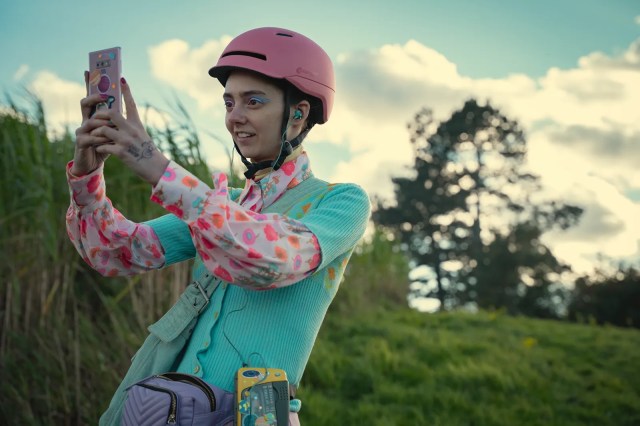
“Sex Education” is set in Netflixland. (Netflix)





Do you remember Adolescence, the Netflix hit that prompted all that soul-searching about teenage boys? The series won many plaudits for the streaming giant, which Ofcom recently revealed is the first choice channel for UK viewers, finally eclipsing the beleaguered BBC. But here’s a question. Where was Adolescence set?
It was produced by the Sheffield independent company, Warp Films, and shot in and around Wakefield. Owen Cooper, the young actor at the center of the story, spoke in his native Warrington accent; his father, played by Stephen Graham, was obviously from Liverpool; only the police investigating the case appeared to be Southern. Well, that’s not so unusual, people do move around the country. Only, nowhere in the script does anyone mention where they are from at all. There’s a sign reading Doncaster Social Services visible at one point, but it seems a bit accidental. This is in contrast to the rootedness of other Warp productions, such as This Is England (set very specifically in the Meadows Estate, Nottingham), or Dead Man’s Shoes (Matlock, Derbyshire).
Well, so what? The point is, this could be any school, any bedroom, any child, perhaps any country too. Only, placelessness is a persistent stylistic choice in Neflix dramas, perhaps their most distinctive feature. Adolescence is set in Netflixland, a borderless zone where the vibe may change but the high-key, low-contrast lighting does not. Just as the streaming platforms have collapsed time, with one episode melting into another in an infinite stream, so, too, have they collapsed space.
A more aspirational Netflixland is showcased in the comedy Sex Education, starring Gillian Anderson as a glamorous sex therapist, shot around the Wye Valley — only its sweeping river views, stunning architectural homes, and American high school evoke Californian as opposed to Welsh levels of affluence; more Santa Cruz-on-Wye than anywhere that actually exists. Similarly, Netflix’s many Harlan Coben adaptations take place in aspirational mid-Atlantic suburbs that seem part-Cheshire, part-Connecticut; the show home Rowan Atkinson destroys in the slapstick Man vs. Bee appears to be located in a screensaver. When England does get to be England, it is an England designed for the American gaze: the unLondon of the sinisterly unfunny genderswap comedy Ladies First; the ludicrous luxury five-story castle that supplants the crap Haywards Heath retirement home in the adaptation of Richard Osman’s The Thursday Murder Club.
As we know, Americans are terrified of Europe — and so it must be made safe, affluent, legible. Where real locations are essential to a story they become vibes, keywords, placeslop, exaggerated versions of themselves: see the macaron Paris of Emily in Paris, the tourist fantasy of My Oxford Year or the InstaSicily of The Leopard. “Plenty of aesthetics but the algorithmic soul (l’anima algoritmica) is obvious,” complained one Italian writer. It’s a glimpse of what the world might look like under a Zuckerberg dictatorship.
Do audiences mind this cultural erasure? Seemingly not, to judge from the Ofcom figures — though it is worth stressing that just about every single British TV show audiences have ever held to their hearts has been as much about place as character. The Peckham of Only Fools and Horses, the Calderdale of Happy Valley, the Derry of Derry Girls, the Oxford of Inspector Morse, the Slough of The Office — these may not be scrupulously realist, but they are all depicted with care and attention by people who clearly know them.
Indeed, arguably the most popular British sitcom of the last 20 years is based on the cross-cultural misunderstandings between a family from Billericay, Essex (population: 34,000) and a family from Barry Island, Glamorgan (population: 56,000). It’s almost impossible to imagine a Netflix commissioner greenlighting Gavin & Stacey today — and yet, this was precisely the kind of hyper-regionalism BBC3 commissioners were after in the mid-2000s. Everyone is, after all, from somewhere. Great television tells us where we are. Netflix tells us we’re nowhere in particular.
It seems quite strange in this regard that the loudest self-proclaimed defenders of British identity and culture also tend to be the ones most intent on eliminating the BBC and Channel 4 as supposed disseminators of liberal wokeness. In fact, British public broadcasters have traditionally (and constitutionally) gone to great pains to reflect Britain’s many different cultures. I’ve never been convinced by David Goodhart’s “Somewheres vs Anywheres” thesis, partly as I’m yet to see any evidence that educated liberal people are any less attached to their regional or national identities than poorer conservative people (try telling that to Andy Burnham). But there is a version of the distinction that carries weight here — between institutions rooted in place, and in the dull, homogenizing forces of international capital for which these places are simply colonies to dominate. For all their flaws, Britain’s public broadcasters are committed to an idea of Britain as a place of many overlapping communities; a program like Derry Girls required someone to give a damn about what it’s like growing up in Northern Ireland. Netflix, Meta, Amazon, Apple, etc see Britain as a market, no more, no less; corporations fundamentally don’t care what their customers’ values are as long as they’re still pressing the relevant buttons to make someone somewhere some money.
Still, the streamer’s dominance is shakier than it appears. Netflix’s share price has fallen 41% over the last 12 months; in mid-July, it experienced a drop so vertiginous that earlier this month, it pulled down the entire NASDAQ. The company has meanwhile declined to release its latest viewer figures, and expensive new shows are flopping. For what it’s worth, I would have deleted my account long ago were it not bundled up with my broadband — as it is for most customers on Virgin, EE, BT or Sky. In other words, most of us aren’t actively choosing Netflix any more than we’re choosing Costa when it’s the only option in a motorway service station.
What does seem strange is that Netflix retained its reputation as a home of “prestige TV” for quite so long. In its heady early days, when it was transitioning from a mail-order DVD business into a streaming service, Netflix co-founder Reed Hastings could convincingly position the company as the natural home for ambitious, prestige dramas in the vein of The Wire, Breaking Bad, The Sopranos and Mad Men — all of which, incidentally, had very strong associations with particular places; and none of which were made by Netflix.
This was the era when literary figures like Zadie Smith were exhorting fellow novelists to study the brilliant plots of Game of Thrones and Hollywood heavyweights such as David Fincher were declaring that the best writing was “happening in television”. In the early 2010s, Netflix commissioners had enough VC cash to throw at weird new projects to see what worked — and it really did produce some gems. BoJack Horseman is perhaps the definitive drama about modern Los Angeles, despite being a cartoon about a depressed horse. But this was before algorithmic programming took over: a tech-driven obsession with metrics, and a determined pursuit of the global average viewer. The contrast with the television Netflix once aspired to emulate is stark. “Fuck the average viewer” was David Simon’s guiding philosophy when he was creating The Wire — a series that obsessively, lovingly, angrily detailed the social and political intricacies of one medium-sized American city.
Indeed, the enshittification of Netflix has been widely discussed within the TV industry for years, though enough people get paid handsomely to produce glossy nonsense that they don’t discuss it too loudly. The writer Naomi Alderman recently complained on Substack that all artistic decisions are now taken by tech people with “too much money and not enough taste”. The taste side of that is clearly a problem; there is no innate feel for which projects and which talent might be worth pursuing. But the “too much money” side is almost as bad, since streaming executives are shielded from the consequences of their terrible decisions — like, say, giving $40 million to Harry and Meghan — in the way that a BBC or Channel 4 commissioner never would be.
The scale of the investment means that, sure, there are still occasionally breakout Netflix hits, usually emanating from some peripheral part of the empire. I’ve heard good things about the Zulu-language South African drama The Polygamist. And there was Adolescence, produced by talent nurtured within the British ecosystem. But then again Adolescence felt refreshing mostly because it was the kind of hard-hitting social-issues drama that the BBC and Channel 4 used to make all the time, with lower production values, for sure, but also a much deeper commitment to reflecting the country back to itself.
The difference now is that the BBC, ITV and Channel 4 are no longer able to commission shows in the way they once were. The influx of US streaming giants has pushed up production costs and increasingly prices publicly funded broadcasters out of the market. Meanwhile the BBC has degraded its own offerings in an attempt to compete — CBBC, once a repository of high-quality, imaginative children’s programs, is increasingly full of brainrot.
Personally, I barely watch TV anymore; Succession (made by HBO) was maybe the last program worth getting excited about. This is clearly a product of my age and eccentricity; but “engagement bleed”, as the streamers term it, is clearly causing panic in the boardrooms. According to Ofcom, young adults watched 11 minutes less on-demand TV last year, abandoning such challenging fare as Netflix’s Worst Roommate Ever for TikTok, Reels, YouTube and Twitch. Disney+ recently signed a content-sharing deal with TikTok in order to weather this transition. Netflix has experimented with adding short-form videos to the site and we can expect more such “snackable content” — a full picky bits picnic of slop.
The inevitable direction of travel for such algorithmic content is not the broad expanses of the nation or the region or even the family but the narrow impulses of the individual. Netflix’s other distinctive technical innovation, besides binge-watching, was introducing individual user profiles for different family members — thus reinforcing the idea that watching TV was something each person does alone. Four family members watching four Netflixes on four individual screens naturally looks better, metrics-wise, than one family watching one screen. The stripping out of any sense of the communal from the home entertainment experience begins to look less like an omission and more like a strategy. It might be good for the stats; but it makes Netflixland a lonely place. An airless shopping mall full of slightly unconvincing luxury dupes; a run of generic fast-food joints in a joyless stadium; a gleaming campus where you can’t quite place anyone’s accent and the trees are all waxy green. Still, there are at least traces of the old civilization around, if you know where to search.
My 12-year-old and I recently discovered Daisy May Cooper’s extremely funny This Country, commissioned for BBC3 in 2017 but which I somehow missed at the time. It’s about a couple of teenagers in a second-rate Cotswolds village near Swindon — but it’s a place familiar to anyone who grew up anywhere slightly crap, which is basically everyone. My son, weaned on Japanese manga and American sitcoms, seems faintly amazed that TV shows can actually be so culturally specific — and might actually have something to say about the places he and his mates come from. But it’s the communal experience of watching it together, sharing the narrative, developing lore around hyper-specific references, that both of us like most. What happens, I wonder, when Netflixland is all we know?