




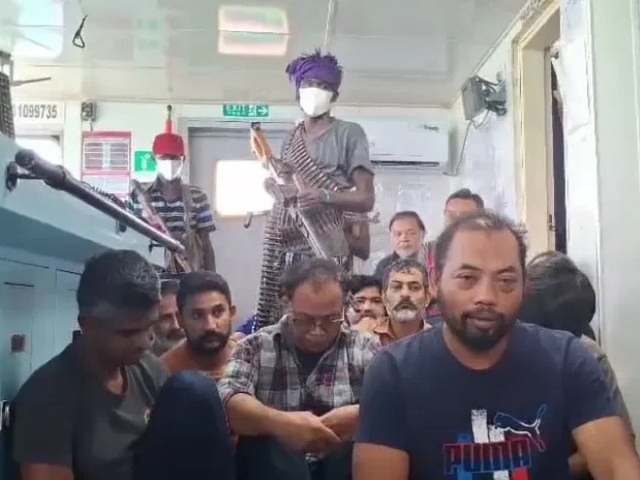
The hostages aboard MT Honour 25. (nayyssny/TikTok)





It’s Groundhog Day in the Gulf. I use an American reference as it’s an American-made calamity. After weeks of stop-start progress, 14,000 of the estimated 20,000 seafarers who had been stuck in the Strait of Hormuz since Donald Trump began bombing Iran have made their escape. Having heard that good news, you could be forgiven for thinking that things had been on the up, at least as far as shipping is concerned.
But with the Trump versus the Mullahs show, nothing is guaranteed. Earlier this month, the International Maritime Organization affirmed the right to freedom of navigation for shipping. But it did so in a very IMO way — formally and a bit pointlessly — prompting Sal Mercogliano, a professor of maritime history, to respond: “Doesn’t do crap. You have to impose freedom of navigation with military force.” In the meantime, the situation for the seafarers who remain in the Strait is perilous — mines, drones, shallow waters — with militias and pirates among the dangers for those who choose to take a different route.
The blunt truth is that no nation has enough seapower to police the ocean. Back in 2010, I went to sea for five weeks on the container ship Maersk Kendal. It was research for my book about international shipping, Ninety Percent of Everything — so named as 90% of, well, everything you own arrives to you on a ship just like it. The mostly Filipino seafarers would greet me each morning with “SSDD, Miss Rose”. Same shit, different day. Now they will probably say, “Different shit, every day.” But even then, they were contending with Somali piracy, which was in full flow. China, the US and a combined EU taskforce had ships patrolling the ocean, but as one admiral told me, the ocean is so huge, it was like having a single police car for all of Western Europe.
When Kendal passed through the Indian Ocean, I was uncomfortably aware that 544 seafarers were being held hostage not far away, just off Somalia. Everyone knew where they were: it’s tricky to hide a ship in the age of satellites and drones. I wondered at the time whether 544 bus drivers or 544 airline pilots being held hostage would get as little attention. But that was naive. The sea is different. You can do things at sea that you can’t do on land. By 2012, Somali piracy had been tamed. At shipping conferences you will hear that this was done by “best management practices” — zig-zagging and such — but that is nonsense. It was because ships started carrying armed guards.
This is the shocking thing about these multimillion pound ships with their multimillion pound loads of oil and containers. They are unarmed. In 2010, the only protection we had on Maersk Kendal was a dummy on the poop deck — as if the Somali skiffs would turn back if they thought there were 22 people on board, not 21 — and a crew member standing on the bridge wings with binoculars.
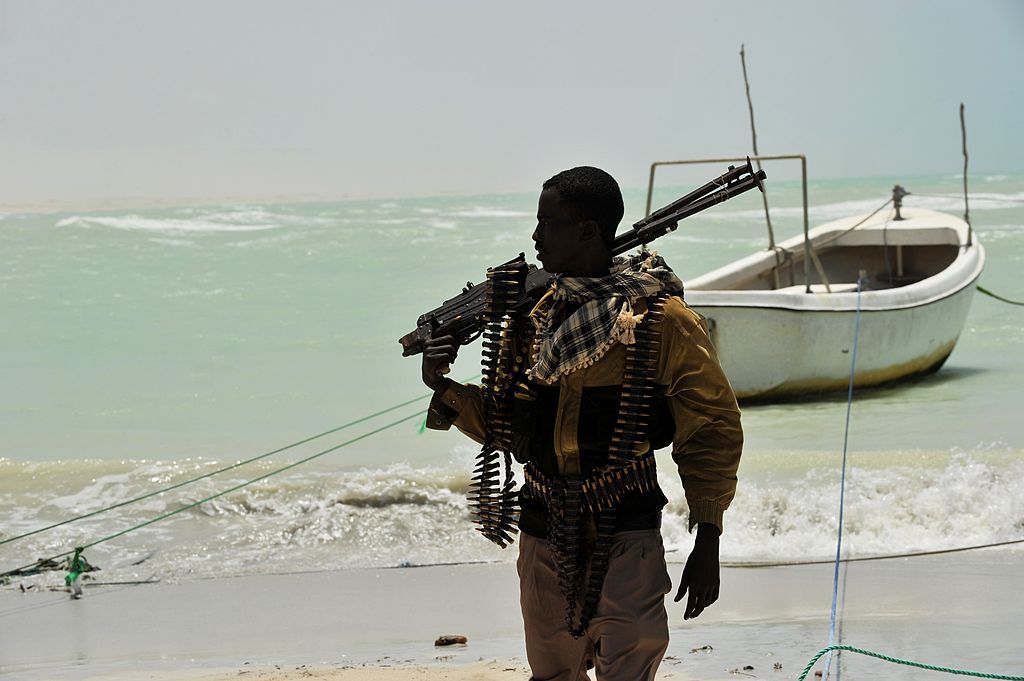
In Hormuz, ships have no protection either. They are easy prey. With the Western navies preoccupied, the Somalis have opportunistically reappeared in the Arabian Sea and western Indian Ocean and now hold hostage four ships and 67 seafarers. The pirates have issued a £3 million demand for the release of MT Honour 25 and released a chilling photo of the crew sitting on the floor of the bridge, with masked pirates and AK-47s as a backdrop.
When Honour 25 was first taken hostage, one of its crew managed to send a voice note to his family in Karachi, Pakistan. His son Muzammil Ahmed Ansari told Al Jazeera what his father, 53-year-old Mehmood, had managed to say. “He said, ‘We are hijacked, reach out to the company, to people, to the government.’ He said there were pirates on the ship, all armed. He panicked, but he said, ‘Don’t worry, ask the government to deal with it.’”
That was in May. Mehmood is still a hostage. Chirag Bahri, who was held hostage by Somali pirates for nearly eight months in 2010, is not surprised Somali pirates have surged. “They are criminals and they want easy money.” With Trump’s catastrophic war against Iran taking all the attention, pirates have taken advantage of the distraction.
If that weren’t enough, the Houthis, a Yemeni militia, popped up again after months of peace, threatening Saudi Arabia-linked ships that pass through the Red Sea. They don’t even have to actually attack: the threat is enough. Already container giants such as the French firm CMA-CGM have told ships to seek shelter, and have canceled transits through Suez. Suddenly if you’re a group or a state with a grievance, maritime chokepoints are a fashionable lever to pull. The Ukrainians are now attacking what they call Russia-linked ships in the Black Sea, although many ships do not carry Russians.
The broader picture is that the Gulf is static and hardly anything is moving. Now the Suez Canal is risky again, as is Bab-el-Mandeb strait, the Red Sea and the Indian Ocean. These all make up the main highways of cargo movements. Where are ships supposed to go? The long way round, probably. It hasn’t yet come to that, but when the Houthis last issued shipping threats, ships began to travel around Africa instead. It’s longer — by 10 to 14 days — and more expensive, but the premiums that insurance companies insist on increasing in war wouldn’t apply and your ship could probably arrive at its destination with both crew and cargo intact.
Meanwhile it’s the seafarers — the truck drivers of the sea — who suffer most. On 11 July, marine engineer Herambh Karmarkar, a 30-year-old man from Pune, wrote to his family in India: “Our ship has safely crossed.” His ship, the Cyprus-flagged CFS Galaxy, was making its way out of the Strait using the Oman route: this way hugs the Omani coastline and is supposedly protected by the US, though it is very difficult to find out what this protection actually consists of. Herambh was wrong. Hours later, Iranians attacked his ship, probably to terrify other ships into taking the northern route near Iran, and paying for the privilege. Herambh was killed.
A glance at the Recent Incidents section on the UK Maritime Operations Centre (UKMTO) website confirms this sort of thing is now routine: Attack 8 August. Attack 7 August. Another attack 5 August. The UKMTO is careful to report when all crew are safe, but still, the media usually report that ships are being attacked. What if we rephrased it? Civilians are being attacked. Ships do not drive themselves, and although a couple of ships have recently been abandoned, about 6,000 seafarers — who are, remember, civilians — are still stuck on their stationary ships, because stopped ships still need maintenance. And they are targets.
How many seafarers have already been killed in this war? Currently the estimate is 17 non-Iranians. Iranians, meanwhile, say they have lost 44 men, including 16 fishermen. If the category of seafarers were to include naval personnel, the number is much higher: when the US nuclear submarine USS Charlotte torpedoed the Iranian frigate IRIS Dena in early March, 104 sailors were killed, according to Iran.
But we expect naval personnel to die in a war. That’s what they signed up for. There is no such commitment in merchant seafarer contracts. Of course merchant seafarers can fight: during the First and Second World Wars, the merchant navy lost more personnel than the Royal Navy, proportionately, and showed astonishing bravery. But in the modern world, merchant seafarers are civilians, and they should get protection. The broader picture, though, is that the proportion of civilian deaths in conflict has been rising for decades. In 2024 alone, according to the UN Human Rights Office, civilian conflict deaths rose 40% globally. So perhaps the deaths of the men who are bringing you your gasoline and cornflakes should be acceptable. You would think so, given how long it took the media to start noticing that ships attacked by drones and missiles had people on them.
The latest surge in violence means most transit attempts have stopped. Figures from the maritime intelligence agency Windward AI show 11 inbound transits and seven outbound, a tiny fraction of the pre-war 140 or so transits a day. However, there are now credible reports of companies offering huge financial incentives for crews willing to undertake a transit. Before the latest attacks, the Sinkor Group, the world’s largest operator of supertankers, offered seafarers six months’ salary for one round trip. Other companies are adding 60 days’ salary to what should be a 30-day round trip.
So has Hormuz changed shipping? Shipping faces constant crises and usually bounces back. But it is hard to see that happening now. For a start, dark transits are way more common than they were before this war began. Russian ships were always good at going dark: this means switching off their AIS (automatic information system), or flying a false flag or inputting false data about their cargo or destination. Now everyone is at it. Since the Houthis decided to threaten Saudi Arabian ships, Saudi ships carrying oil from Yanbu, the port at the end of the Saudi oil pipeline, have gone missing from ship tracking sites: eight turned back, reported Lloyds List, but 11 went dark.
This won’t affect consumers, necessarily — the oil will still be transported, and so will the iPhones and Lego bricks and Toyotas and sugar. But it will affect life at sea. Not everyone at sea is a criminal, but there is no better place to be a criminal than at sea.