




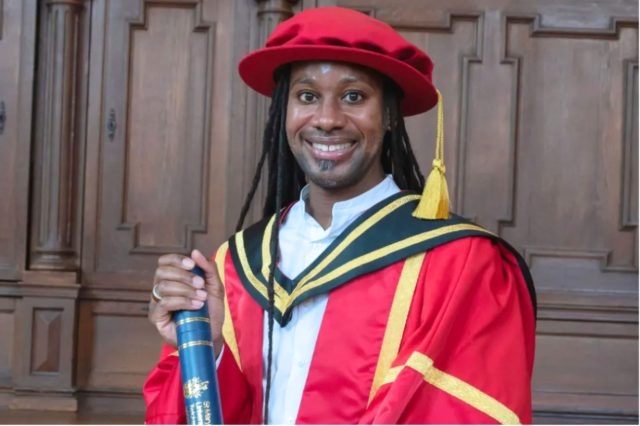
Jason Arday at St Mary's University. (St Mary’s University, London/Youtube)





When I was a fresh-faced undergraduate, newly arrived at Jesus College Cambridge in 2007, I remember listening to a speech by its then-master. He was very, monotonously, clear: the college’s mission was the undiluted and single-minded pursuit of scholarly excellence — with no compromises. To me anyway, the speech seemed so obvious as to lapse into tedium and truism. Of course. Why else would we be there? This was Cambridge, after all.
The master who gave that speech was one of the world’s greatest experts in geo-engineering. His predecessors were similarly renowned in their scholarly fields. He had taken over from David Crighton, an applied mathematician who made important contributions to the study of aeroacoustics. His immediate predecessor was Colin Renfrew, an archaeologist of global fame.
These facts came to mind when I read that the current master of Jesus, Sonita Alleyne, had signed the Good Law Project petition claiming that criticism of alleged plagiarist and serial fantasist Jason Arday was nothing more than one part of a racist campaign to “undermine Black people who hold positions of influence”.
Arday had been made a fellow of Jesus College when appointed Professor of the Sociology of Education at the Education Faculty. If the allegations of malpractice could be batted aside by the standard ritual accusations of bigotry, then clearly the reputation of the college that enthusiastically offered him a fellowship, and its master, would be protected. Whether this was Alleyne’s motivation, or she genuinely believed that Arday was a victim of racist abuse — rather than, say, an ethically challenged connoisseur of Australian soap operas with all the academic heft of a Sun showbiz editor but without their basic literacy — I cannot say for sure. One can draw one’s own conclusions.
Initially, my reaction was simple ire at Alleyne’s total indifference to the extensive evidence of his plagiarism. I had been an undergraduate at Jesus, then an MPhil and PhD student there. I remembered well, as a history postgraduate, being given very stern guidance about how serious plagiarism was, and how negligence or ignorance of citation practices was no excuse. The punishment, it was implied, would be harsh and definitive.
I also remembered that I had known genuine academic wunderkinds, students who had got double firsts, who had not even managed to get funding for a PhD at Cambridge, let alone a college fellowship at Jesus. The appointment of a man who was unable to even punctuate the title of his PhD thesis correctly, and conducted junk “autoethnographic” research, seemed a grave insult to those disappointed friends, not to mention the standards the master during my time had clearly taken so seriously. To accuse anyone who objected to this of “racism” made me feel sick.
Sick, but not surprised. I soon remembered that, following Alleyne’s appointment in 2019, I had wondered what the academic expertise of my alma mater’s new head would be. Quantum dynamics? Medieval Latin poetry? Not quite. She was, in fact, not an academic at all, but a co-founder of a music production company who had become a trustee of many artsy charities and a BBC trust member. She had a degree from Cambridge, but that was it academically.
This seemed, and still seems, bizarre to me. Imagine a media corporation deciding that the natural new appointment for its board was a professor of Greek philology. Obviously, this would never happen. So why did anyone think that someone with close to zero experience of scholarship, university teaching or indeed anything much relevant to academic life should become the master of a venerable Cambridge College? The cynic in me says that the rising tide of identity politics, which appears to have afflicted Jesus worse than most Oxbridge colleges, led to the conclusion that Nothing Else Would Do except the appointment of a black woman. Even this seems hard to understand, given that there are many black women with distinguished academic records who would have been superior choices.
Whether Alleyne’s appointment was gesture politics or not, the college is certainly no stranger to such ethical self-indulgence. It conducted a quixotic, expensive and unsuccessful attempt to remove a chapel memorial to Tobias Rustat, one of its most munificent historical benefactors, due to his investments in the African slave trade. The campaign, spearheaded by Alleyne, failed when a church consistory court decided against the college, giving her the near-unique distinction of failing to convince the modern Church of England to abase itself over the historical slave trade.
The campaign was whipped up in an atmosphere of exaggeration and moral self-flagellation over historical wrongs, driven by a modish obsession with “decolonization”. The point, of course, is that removing a memorial is nice and symbolic and crucially cost free — unlike, for instance, refusing to accept or disperse the “tainted” money that is still paid out from Rustat’s bequest to fund scholarships and grants. This, of course, Jesus have failed to do.
And yet for all its concern with the abuses of 350 years ago, when it comes to contemporary human rights violations Jesus has been far more relaxed. One of its longest standing fellows is Peter Nolan, a well-known apologist for the Chinese Communist Party and its authoritarian dictatorship. Nolan founded and ran Jesus’ China Center for years and cautioned against any debate on the persecution of the Uyghurs. The fact that Nolan and Jesus College have accepted various sinecures, appointments and payments from the Chinese government or government-aligned sources over the years presumably is just a coincidence.
There was, eventually, a review of the college’s cozy relationship with China, but little of the strident moralizing that came so easily when discussing what Rustat did 350 years ago. It seems that the college takes a moral absolutist attitude through time, but a very relativist one through space: Rustat is evil, but the current Chinese government must be respectfully engaged with — no matter how many people it tortures or locks up or puts in labor camps.
In this context, appointing Arday must have seemed like a similar bit of cost-free symbolism, particularly in a university where there are many figures like Alleyne. Many college heads are now hacks, media luvvies, corporate consultants and washed-up state administrators. Such people tend to have a far weaker investment in the standards that have historically made Cambridge distinctive: its non-negotiable commitment to academic standards; its rigorous system of small-group teaching; its decentralized nature. They have ended Cambridge’s relative isolation from the trends that have long beset much of the rest of higher education, not least rampant commercialization and modish progressivism. They find willing allies among even genuine academics whose politics — which usually runs the gamut between post-colonial hard Left and soft-Left liberalism — too often trump their commitment to academic standards.
This has gone hand in hand with the rising power of the centralized apparatus of the university itself, and the ballooning class of managers it employs. The UAS — the university’s central administrative body — has seen its numbers rise by 133% since 2010. Meanwhile, short-term and fixed-term contracts have tended to make academics less secure in their tenure and less likely to see themselves as permanent and secure guardians of the university, instead making them beholden to the whims of a managerial class.
Those who stand up to the hectoring of their administrative overlords face bullying and punishment, as yesterday’s employment tribunal judgment against the university and its vice-chancellor Deborah Prentice demonstrated. Wyn Evans, a professor of astrophysics, accused the university of misogynistic bullying and retaliating against whistleblowers. The tribunal found that “there was a shared desire to close down whistleblowing complaints which might be damaging to Cambridge University and the Institute of Astronomy”.
In short, Cambridge has become more like most other universities. The colleges, the independence and sheer variety of which provided some protection against top-down diktat from a centralized bureaucracy, are gradually losing their power. Insofar as they retain it, they are being colonized by those doyennes of the progressive professional-managerial-
All the while, masterships of colleges are increasingly seen as cozy berths for undistinguished, symbolically useful or failed members of the media-civil service-charity nexus that constitutes the progressive wing of the establishment — or else a respectable backwater for corporate managers. The university chases the high fees brought in by foreign students and the high-profile grants awarded by the research councils and makes its senior appointments accordingly, often doling out professorships to “safe” second raters rather than genuinely world-class talents.
There is some room for hope. Few faculties are as compromised as Education: most still contain many academics who remain committed to the highest academic standards. The college system still exists, and there is strong resistance in some quarters to the new fads. Trinity College recently bucked the trend of appointing luvvies or hacks to masterships, instead appointing a proper botany scholar as its new master. But the vision of a self-governing community of autonomous scholars pursuing the very highest standards of scholarly endeavor, the vision of Jesus masters past, has long since been compromised. Arday is just one symbol of that, and I doubt he will be the last. The reckoning for Cambridge’s recent follies is only just beginning.