




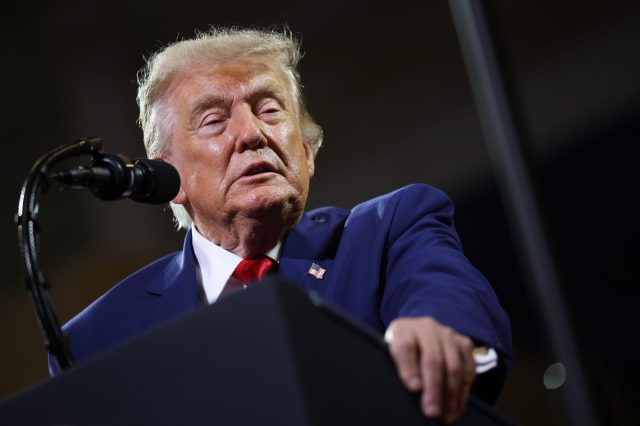
Let Trump be Trump. (Kevin Dietsch/Getty)





In the 2002 movie My Big Fat Greek Wedding, the father of the bride claims that Windex, a US glass cleaning product, can cure all known medical conditions. I was reminded of that scene when I heard Donald Trump prescribe tariffs as a remedy for diarrhea last week. The Center for Disease Control has recently registered more than 4,000 cases of a disease suspected to be cyclosporiasis, an intestinal illness, transmitted through food. The suspect is shredded lettuce, grown in Mexico and exported to Taco Bell fast-food chains across the US. When a reporter asked him about the outbreak, Trump threatened to put a tariff on imported Mexican lettuce to control the spread of the parasite.
The President may not have been serious about the lettuce tariff, but he is serious about tariffs in general. “Tariff,” he once said, “is the most beautiful word in the dictionary.” They are the one-size-fits-all economic policy tool of his administration.
After he menaced Mexican salad, Trump turned his attention to a far more serious parasite — the EU, which he once described as having been created to “rip off America”. Again, he threatened new tariffs, only this time he was not joking. The trigger was a decision by the European Commission to impose two fines on Google totaling $1 billion. The Europeans accused Google of failing to comply with the Digital Markets Act, which forces US tech giants to open up their proprietary ecosystems to competition. Google was prioritizing its own search engine over others. This was not a one-off. The Europeans are messing heavily with the business models of lots of the US tech giants, not just Google. There is another European law, the Digital Services Act, which forces platforms like Facebook and X to moderate their social media content.
All of this has wound up the American President. In retaliation, Trump wants to impose his new tariff on Europe “at the earliest possible moment”, arguing that the EU is robbing US companies of their legitimate profits. I don’t think this is a bluff. Unlike when he imposed his “Liberation Day” tariffs, existing US trade law allows him to do this. It could take up to a year, but this time US law will be on his side.
When the US Supreme Court struck down Trump’s Liberation Day tariff regime in February, the Europeans got a bit overexcited. Some assumed it was a decision against tariffs in general. That was not the case. The Supreme Court declared the legal basis on which Trump had based his Liberation Day tariffs as null and void. But Trump has other legal avenues open to him.
Immediately after the ruling, the Trump administration made two decisions. The first was to implement a temporary regime that allowed the President to impose tariffs of up to 15%, no questions asked, for up to 150 days. That meant the old tariffs would continue for a few more months. That deadline has now expired. The second was to launch an investigation under Section 301 of the 1974 Trade Act against practically all countries in the world. The idea was to resurrect the old tariff regime — one for one — under a new legal cloak.
Section 301 is a formal, tried-and-tested procedure. The actual investigation, however, was absurd. The US accused nearly every other country in the world of failing to match its own human rights standards with respect to imports of goods produced by forced labor. It is quite something to behold the US accusing Norway of not respecting the highest human rights standards. Rarely before has Section 301 been applied so cynically: the human rights accusations were just a front to resurrect the old, defunct tariff structure.
Still, I believe it will pass the legal test anyway because of the separation of powers under US law. It is not the role of a court to decide whether a foreign trading practice is illegal. The courts decide whether the decision followed due process.
From now on, Section 301 will be the legal basis for all of Trump’s tariff policies. That means if he wants to impose heavy tariffs on the EU in response to the fines on Google, he could do so — perfectly legally — by early next year. The EU may drag this out a bit, but I would be surprised if the US legal system ended up siding with the EU on this matter.
When the Supreme Court ruled in February against the Liberation Day tariffs, the average US tariff was about 15%. It has come down a bit since but will now creep up again as the tariff regime hits. In the two-and-a-half years Trump has left in office, I expect average tariffs to rise to above 15%. Trump will always find ways to impose new tariffs, like the one he threatened last week.
Have the tariffs made world trade any fairer? Have they contributed to a reduction in global trade imbalances? Absolutely not. But they are not without effect. The most important is that they are raising around $200-300 billion per year in revenue for the US Treasury. Tariffs are, formally, a tax on US consumers; but exporters from other countries are paying indirectly. The value of Japanese cars sold in the US fell by 24.7% in May last year, compared to the previous year. Yet the number of Japanese cars sold was down only by 3.9%. So the Japanese car companies took a hit on their profits.
Companies that refused to cut export prices have seen a fall in sales. Among these are the Chinese online retailers Shein and Temu, both of which specialize in small items that were once exempt from tariffs. They could post their tiny packages to America because of the so-called de minimis rules — a tariff exemption for goods below a certain price. The week after Trump imposed his tariffs, and ended the de minimis exemptions, Shein observed a 23% fall in its US revenue compared with the preceding week. During the course of 2025, the Chinese trade surplus against the US fell by one third.
So the tariffs did have an effect. But only on the bilateral US-China trade balance. Globally, trade imbalances are still rising. The Chinese have diverted trade from the US to the EU. As a result, the EU’s trade deficit with China increased dramatically. In first six months of this year, it was up by 23.9%.
The EU, in turn, is considering imitating Trump by imposing a tariff to protect European industries from Chinese competition. Remember the European outrage when Trump did this? Trump had a better case back then than the Europeans do now. The US runs a large trade deficit against the rest of the world, whereas the EU runs a persistent surplus. If the EU were to take a tougher stance on trade with China, I would expect China to react by cutting down on European imports and restricting sales to European companies whose supply chains depend on China. Last week, China extended the list of European companies earmarked for export controls to include Rheinmetall, the German defense producer. If we end up with a tit-for-tat trade war, the world will be worse off.
Macroeconomists have long warned us not to focus on bilateral trade balances, but instead to think globally. Trump cares about nothing other than bilateral trade balances. It suits the dealmaker in him. But if we become like him, and the Chinese keep on doing what they have been doing, it will be a lose-lose game for the world.
The EU would end up as the biggest loser of all. This is because the EU, like China, runs trade surpluses; as global trade falls, it will hit the surplus countries more than deficit countries. At the same time, the EU is reliant on Chinese imports for its supply chains, for example in the car industry. A trade war would be a double-whammy: tariffs on European products, and supply shortage of badly needed Chinese rare earths and semiconductors.
A year ago, Trump and Ursula von der Leyen, the European Commission president, agreed a trade deal at Trump’s golf retreat in Turnberry, Scotland. It was an embarrassing moment for von der Leyen, as the deal was entirely dictated by Trump. The EU agreed to cancel all the tariffs it had previously imposed on the US, including a 10% car tariff, and accepted that the US would impose a blanket 15% tariff on all imports from Europe, and a 50% tariff on steel and aluminum. If Trump ends up slapping a new Section 301 tariff on the EU, even that deal would be off. The tariffs would rise. The EU would retaliate. Everybody would be in a trade war.
When one also takes into account the rise in oil prices resulting from Trump’s escalating war against Iran, as well as the rise in public debt throughout the West, it is not hard to imagine a global financial crisis resulting from this mess.
During the Covid pandemic, Trump suggested that chloroquine phosphate — the anti-parasite medication used for fish tanks — could work against the Covid virus. (I wonder whether he had been watching My Big Fat Greek Wedding.) The President himself was wise enough not to take it, but others did. At least one man died. Tariffs are the chloroquine phosphate of the economic world, and they too come with serious side effects.
I expect Trump will get away with it, again. That’s because the US is less integrated into Chinese-sourced supply chains than the EU, and it is better at absorbing shocks. My advice for trade officials, and chemistry buffs: don’t try this at home. Let Trump be Trump.
