




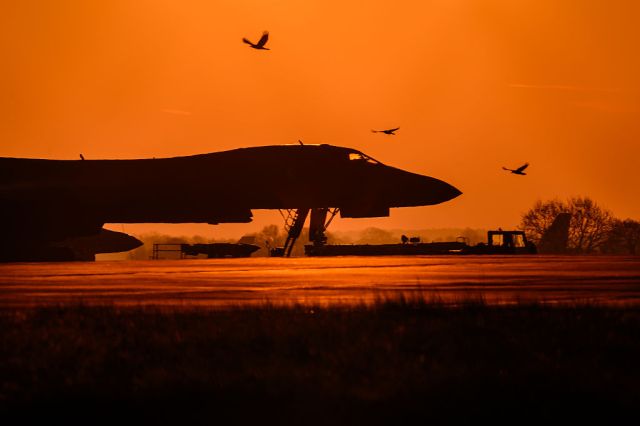
The White House is more willing to dispatch bombers than put boots on the ground. (Leon Neal/Getty)





As the war in Iran enters its fifth month, President Trump is growing increasingly frustrated. He sees few good options to end the war and talks of “lunatics” and “revenge mode”. As I write, he is meeting Netanyahu to add credibility to his implicit threat to the Revolutionary Guards, who now run Tehran very much as the SS did once Hitler died, with no plan other than to keep fighting, and a readiness to hang anyone who disagrees. (On Sunday they publicly hanged 18-year old Erfan Esfandiari in Isfahan, an exemplary victim precisely because of his youth and innocence.)
But there is a way. And to discover how, it is important to recall how this latest bout of warfare started: with June’s botched “Memorandum of Understanding”. This was hurriedly negotiated in chronically treacherous Pakistan by Vice President Vance — whose many talents do not include any expertise about the millenarian ideology of Iran’s current rulers — and Trump’s two favorite businessmen: his son-in-law Jared Kushner, and the real estate lawyer, Steve Witkoff, who habitually closes deals very rapidly by not being too obsessive about the details.
Unsurprisingly, then, the MOU was so loosely worded that it could be read as surrendering the Persian Gulf to Iran — as well as its direct opposite. And it was also inevitable that the surviving Revolutionary Guard officers who now rule Iran would go for the maximum; all along they have boasted about their glorious victories, so they were hardly going to stand down and let America’s Arab and Sunni friends ship out their oil, liquefied natural gas, and fertilizers undisturbed.
So they made an unprecedented and plainly illegal claim of sovereignty over the whole Gulf, together with a demand for transit fees. When Iran started attacking ships to assert its claim, the Trump administration imposed a total embargo on the Islamic Republic’s oil exports, both from their major Persian Gulf terminal on Kharg Island, and from a much smaller terminal at Jask, out on the Indian Ocean coast beyond the Gulf.
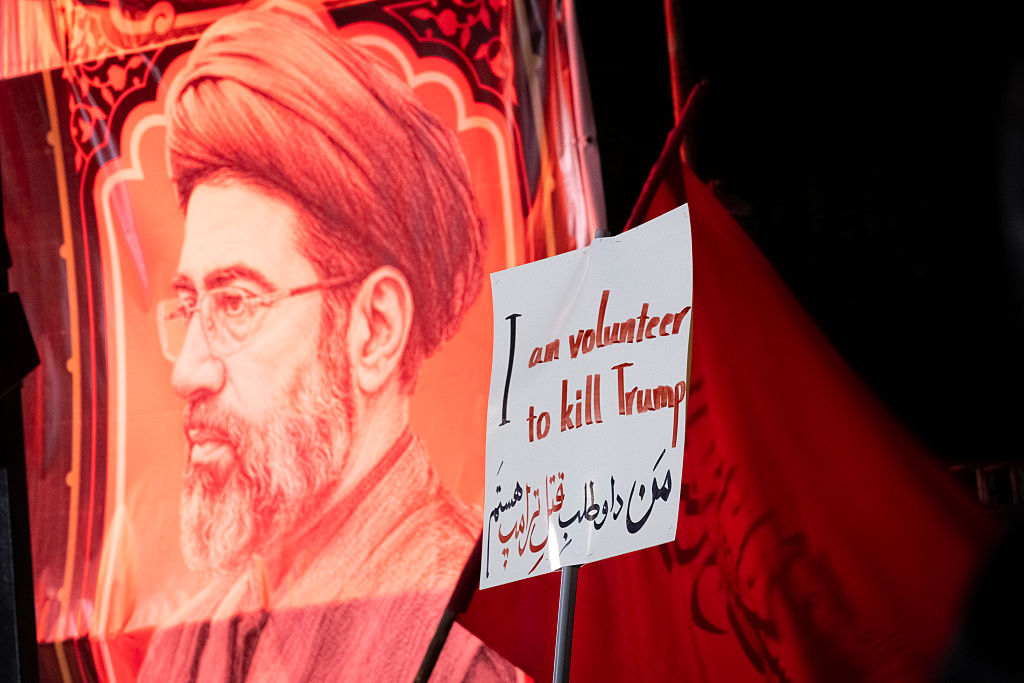
Because Iran’s usable foreign exchange reserves are very small, Trump’s oil export embargo had an immediate impact. Not only did it hamper Iran’s ability to import rocket fuel, drone motors and other such urgent necessities from China, it also slowed its money transfers to Shi’a allies in Iraq, to Hezbollah in Lebanon, and to Yemen’s Houthi militia that controls the country’s Red Sea ports.
Not that this prevented the Houthis from faithfully serving Iran’s interests, and opening up a new front in the war, by threatening ships attempting to pass through the Bab-El-Mandeb straits in the Red Sea. Up to five million barrels a day of Saudi oil exports — almost half of the total Saudi capacity — pass through that waterway, via a pipeline to the Red Sea port of Yambu, itself activated after Hormuz was closed. If the Houthis succeed, it is inevitable that the price of oil will jump even higher than its current $100-a-barrel rate.
Meanwhile, in Iran itself, the stop to oil exports has collapsed the value of the rial. It now costs 1,900,000 rials to purchase one US dollar in Tehran; a year ago it was 590,000 rials. This is the best illustration of the runaway inflation currently being suffered by Iranians.
The inflationary pressure is landing acutely on the salaried of Iran’s two biggest cities, Tehran and Mashad, including the military personnel of the Artesh (the regular armed forces), the Revolutionary Guards, the employees of government ministries and the Bonyads (the Islamic charities that control much of the economy), and the Basij paramilitary security forces. Essential items are unaffordable. In the latter days of each month, these workers and their families must depend on heavily subsidized bread for all their meals.
But for its rulers, as we now know, Iran’s continuing immiseration means nothing at all. Behind the hollow pretense of a ghostly Mojtaba Khamenei, who is equally powerless whether he is alive, dead or comatose, the Revolutionary Guards and Basij auxiliaries are now in sole control, and it is the invocations of their paid “eulogists” (Maddahan), who are not trained clerics but rather but inspirational orators, who spell out their victory plan.
Their message is simple: if the war is pursued vigorously enough, the Twelfth Imam, Muḥammad ibn al-Ḥasan, who has remained hidden from Sunni killers since the year 874, will return as the redeemer, the Al Mahdi, to install Shi’a Islam as the world’s only religion. They insist that Iran is on a path to certain victory. And this, they assert, is simply because its enemies are no better than spoiled children, unwilling to accept any diminution of their sinful and luxurious lives, while Iran’s rulers for their part will accept any hardships, and any number of casualties, to simply resist. And to resist is to be victorious, in their telling.
Since the White House remains infected by its “no-boots-on-the-ground” syndrome, President Trump refuses to risk deploying even a small number of troops to the desert islands in the Persian Gulf to secure its transits, so it might seem that Iran must win.
But in every war, each side has its center of gravity — the one asset that cannot be sacrificed. For Iran, it is the Revolutionary Guard leadership. Since the latest round of fighting began, Iranian missiles and drones have targeted Bahrain, Jordan, Kuwait, Oman, Qatar, Saudi Arabia, Syria and the United Arab Emirates, but, strikingly, not Israel. The Revolutionary Guards could easily draw Israel in by launching missiles towards it, or ordering its Houthi auxiliaries to do so. They have chosen not to.
The reason why is no mystery. The bombing capacity of the United States is far greater, but only the Israelis have demonstrated a consistent ability to find and kill Iran’s top leaders — and a willingness to do so. In Washington’s foreign affairs and intelligence bureaucracies, by contrast, there is a dogmatic opposition to attacks against political leaders. This is a principle valid enough in almost all cases; in all the decades of Arab-Israeli warfare there was no attempt to attack state leaders by either side. But when a leadership is willing to impose unlimited sacrifices on its own population, it is no use inflicting more hardship on that same population — and the leaders are the only valid targets. The argument recently advanced, that US negotiations were hampered by the killing of Iran’s more experienced leaders, is spurious; experienced or not, they had publicly and loudly refused any real solution: as they had to, in fear of the Revolutionary Guards.
Yet American strategy continues to target the country’s economy and infrastructure rather than the regime itself. The very latest word from Trump is that he will order the destruction of a major bridge — and highly mountainous Iran depends on its bridges — for every ship that is hit in the Persian Gulf. But destroying bridges would only raise the cost of war; removing the Revolutionary Guard leadership could end it. It would immediately comfort the desperate, oppressed population, and might sooner or later bring to power new leaders less eager to enjoy the luxuries of Islamic martyrdom.
Professor Edward Luttwak is a strategist and historian known for his works on grand strategy, geoeconomics, military history, and international relations.
 ELuttwak