




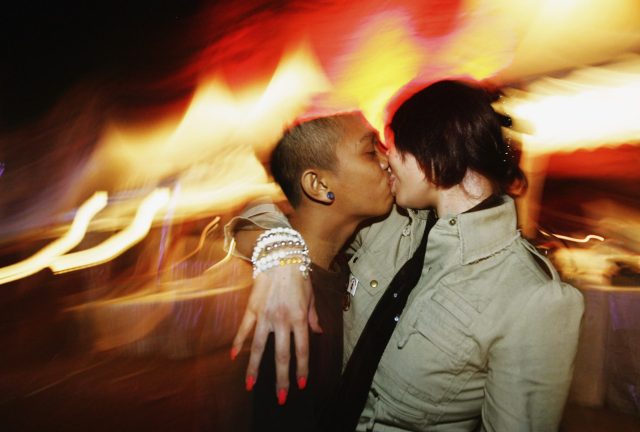
'Nobody can tell now whether a current identity will stick; not even its owner.' (Dimas Ardian/Getty)





Like Aristotle, our Labour overlords take a firm line on the question of essence versus accident in the human soul. A desire to stuff your face with cake is fixable with injections. Ardent petrolheads can be bribed into buying electric cars. Reform voters can be shamed out of their political attraction to Nigel Farage. But a sexual orientation or gender identity is for life.
Such is the unstated implication of the Conversion Practices draft bill, published last week. Two supposedly core, immutable elements of the human person are identified, for which corrective drugs, bribes, or shaming are all presumed diabolical — though these are completely fine to use for more flexible attitudes elsewhere. To try to alter the pattern of someone’s sexual desires, by exerting psychological or emotional pressure or worse, risks becoming a “conversion practice”. The same goes for trying to dissuade someone from a heartfelt profession of gender identity. Past a certain threshold, the police and courts must get involved.
This bill is already receiving much hostile comment, both for its performative aspect — violent and abusive acts are already punishable — and its absurd overreach into understandably heated family discussions about life-changing hormones and surgery. Accompanying notes to the draft try to make a virtue of the chillingly authoritarian focus upon “verbal or non-violent physical acts”. Offenses include practices causing “serious alarm and distress” and “serious harm to mental health”, both of which are too vaguely specified to protect loving parents from police investigation for speaking their mind. The wording is also unlikely to induce religious clergy to express honest and well-meant thoughts about the wisdom of homosexuality or medical transition. Thankfully, at least, there is a carveout for healthcare professionals, but it remains unclear why conversations perfectly acceptable in the doctor’s surgery or therapy space must be harmful at home or in church.
But not much has been said about one unexpected implication of the bill: that conversion practices involving straight people are just as harmful as those involving gay or trans ones. The intention to cause a heterosexual or “cis” person to become homosexual or trans is to be treated in just as draconian a manner as the inverse case. In theory at least, progressive parents who preach the gospel of gender affirmation a little too enthusiastically risk criminal investigation later, when their children have second thoughts — a possibility which, you have to admit, is darkly funny. The idea that there might also be criminal liability for the hundreds of lanyard-wearing youth workers out there, still working very hard to cement the idea of medical and social transition into deeply unworldly heads, is even more delicious.
But these enticing visions also point to an ambiguity at the heart of the draft legislation; namely, how are third parties supposed to know for sure that a professed sexual orientation or gender identity is permanent, as opposed to a temporary form of experimentation? It would be ironic if the first parent prosecuted for trying to “convert” her child from X to Y turned out later to have been right about the merely transitory presence of the X-ness all along. Unless authorities can answer this question, the law will be unworkable; and I suggest that they can’t.
Since we cannot look into minds directly to find some bedrock, a proxy method must be found. The original epistemic formula, implicit in early gay-rights activism though rarely spelled out, was that you knew a person must be same-sex-attracted if he said he was, because there was no good reason for him to be confused about this, or to pretend. Back in the day, the social context was so hostile and punishing for gay people, it would be irrational for someone to say they were gay when they were not. This meant you could usually take the act of coming out as accurately revealing the state of profound and permanent inner feelings.
Academics chimed in with essays on “heteronormativity” and “compulsive heterosexuality” in society, implying that if a same-sex attraction ever did emerge against such oppressive odds, it could only be a sign of true inner authenticity: a rare delicate flower, improbably growing on stony ground. But conversely, the surrounding atmosphere of homophobia and the heavy expectation of normality made professions of a straight sexual orientation unreliable. In this case, unlike the other, there was good reason to lie to others about who you really were, or even lie to yourself. Despite your protestations, onlookers couldn’t be sure; and nor, for that matter, could you.
When transactivists came along in the Nineties, effectively they adopted the same strategy: you can tell someone is “really” trans if she says she is, because it would be crazily self-defeating to lie. For decades, LGBT activists have kept up this narrative of intense cultural persecution, even as the UK became one of most accepting countries for sexual minorities in the world. Indeed, the Conversion Practices bill itself is the fruit of furious myth-making, with lobby groups suggesting to politicians that Britain is riddled with dastardly ECT-wielding doctors and stern-faced religious exorcists, blithely ignoring the rainbow flags draped all over the Royal Colleges and the Church of England.
As gay and trans identities have become extremely popular in young people, the preferred strategy has not adjusted. According to rainbow dogma, such people can only be expressing authentic realness when they announce their identities, whereas those who say they are straight or “cis” may just be blindly going along with the normie flow. Professed heterosexuality is always suspicious and can legitimately be challenged, in case there is a less conventional, more socially oppressed orientation trembling shyly underneath, waiting to be coaxed into the sunlight.
But by including legal protection for straight people, the Conversion Practices bill produces a reductio ad absurdum of this whole approach. The logic of infallible authenticity, as applied to heterosexual identities, patently collapses; for almost every gay person started off by sincerely self-interpreting as straight. Things are even worse with asexual identities which — ludicrously — are also protected by the bill, according to the accompanying notes. As a concerned mother worried about your lonely son, it seems you will not be permitted to try to robustly argue him into trying to find a girlfriend, if he is telling you at the time that he is asexual. Otherwise, though, it is fine. But since, with the right sort of encouragement, today’s depressed asexual might easily become tomorrow’s happy lothario, why on earth should the law protect awkward teenagers from what they don’t want to hear?
Ultimately, the point extends to gay and trans identities too. These days, we don’t so much have compulsory heterosexuality in youth culture as compulsory queerness, and it no longer makes sense to say that the only plausible reason a young person would tell herself she was gay or trans, is if she “really” was. There are several alternative explanations available, including that a non-binary teaching assistant suggested she might be; or that she thinks it sounds cooler and more likely to win her friends than the boring straight alternative. This associated glamour can make self-interpretation confusing, and lead to false positives; not something that could have been said of the typical gay experience in the Sixties.
The insuperable problem here is that nobody can tell now whether a current identity will stick; not even its owner, and especially not when she is young and naive. And of course — a bit like television channels — though there used only to be two or three, there are now so many more to choose from. Ironically, gender studies academics used to stress this impermanence before it became inopportune to do so, always banging on about the endless flexibility of constructions of the self. What seems lifelong today may turn out to be temporary, and vice versa; in which case it cannot be remotely helpful to criminalize the verbal attempts of others to persuade you to take a different path. Critical discussion might feel rude, upsetting, or intrusive, but none of that means it is the business of the law to rule it out. And in fact, with the presumption of your own infallibility about yourself removed, attempts to “convert” you may turn out to be perceptive recognition of what there is, or what still could fruitfully be.
The fantasy of an immutable orientation or identity, offering a key to your true nature, sits awkwardly with human powers of self-interpretation and self-creation. For as long as you are alive, your current understanding of yourself might change, because of social influence or personal reinterpretation or something else entirely. No amount of felt certainty that this won’t happen can rule the possibility out. Life is full of surprises. And sometimes conversion from one set of outworn ideas or feelings to another can be a form of personal salvation.
