




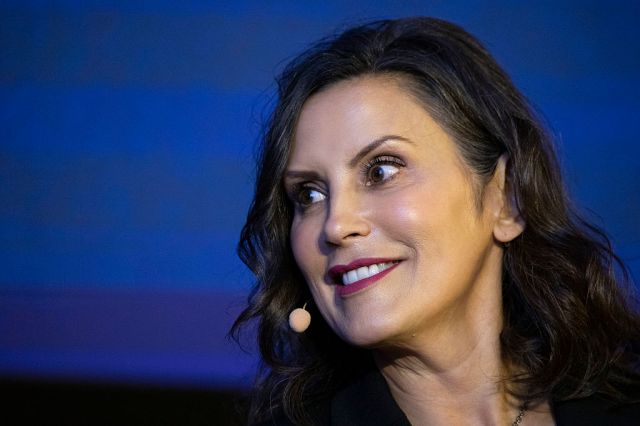
Whitmer is a viable presidential contender for 2028. Credit: Getty





In the summer of 2020, Gretchen Whitmer, the governor of Michigan, was very close to becoming vice president of the United States. Then-candidate Joe Biden had won the nomination and was vetting running mates. Whitmer — “Big Gretch,” as she was affectionately known in Democratic circles — had won plaudits for standing up to President Trump during the pandemic. She was, for a certain kind of liberal, the ideal veep for the elderly Biden: telegenic, swaggering, relatively young, and able to win over the Midwestern working class.
Ultimately, Biden settled on his vice president, Kamala Harris, following through on his post-George Floyd aim to add a nonwhite politician to his ticket. Harris had flamed out as a presidential contender and ended up an ineffectual VP; her struggles in the White House incentivized Biden, despite his senility, to attempt another presidential run. If the physicists are correct, surely there is an alternate universe in which Vice President Big Gretch eased out Biden in early 2024, seized the nomination, and stopped Trump in his tracks.
But we don’t live in that universe. In ours, Whitmer has remained governor of Michigan, where she’s waffled on whether she will run for president come 2028. On paper, she would be viable: a two-term governor from a swing state with a real track record of beating Republicans. If she did take the plunge, she would receive plenty of media attention and wouldn’t struggle to fundraise. Unlike California’s Gavin Newsom, she doesn’t govern a state that produces many unflattering headlines. Opponents couldn’t point to any great homelessness crisis, natural disaster, or affordability crunch occurring on her watch.
A Whitmer presidential campaign would, however, be a test case for a kind of politics that is growing more alienating by the day: relentless and unapologetic support for artificial intelligence. If Whitmer ran for president, she’d be the pro-AI candidate in whatever pro-AI lane exists. Few governors have catered more to the industry than Whitmer, whether it is championing tax breaks or ramming through massive data-center projects that have drawn local backlash — the kind that, shockingly, hasn’t seemed to rattle Whitmer at all. In 2026, developers have scoped out at least 16 data-center sites in 10 Michigan counties, according to an MLive tally. A massive $16 billion data center in Saline Township, which just broke ground, has been a signature Whitmer project, generating intense grassroots opposition.
Across America, Democratic and Republican politicians are growing more skeptical of AI. Red states like Florida, Utah, and Oklahoma have enacted regulations on energy use for data centers, as have deep-blue ones like California and Washington. New York passed a one-year moratorium on data-center buildouts. Maine, Idaho, Nebraska, Oregon, and Washington now regulate what chatbots can communicate to human users. The polling points the way toward more aggressive regulation: half of all American adults say the increased use of AI in daily life makes them feel more concerned than excited, according to a Pew survey from last year. Merely 10% say they are more excited than concerned.
Yet the term-limited Whitmer has been a tireless AI champion, as has the Democratic frontrunner to replace her in the governor’s mansion, Jocelyn Benson. Read any release from Whitmer’s office, and it is obvious that she views the AI expansion as a job-creating opportunity that can’t be passed up. The Saline Township data center being built by Oracle and Related Digital, she promises, will yield 2,500 union construction jobs, more than 450 ongoing jobs on the site, and 1,500 more across the county. “This investment from Oracle and Related Digital sends a simple message to anyone who wants to build the future — you can build it in Michigan,” she enthused.
Yet there are several intractable problems with data centers that Whitmer has mostly waved away or vaguely promised to address in the future. Electricity bills can surge. The water supply can be endangered. There is the noise and pollution generated from the diesel-powered backup generators. And there is a great risk, too, if AI amounts to a bubble. Hundreds of billions have been spent on a technology that remains unprofitable, and if a reckoning ever comes, towns and rural areas across the country will be left holding the bag: half-built centers, farmland wrecked for no purpose.
Hence, why prominent politicians of the Left and the Right have grown more skeptical of AI. The likes of Sens. Bernie Sanders and Josh Hawley — representing the socialist Left and the populist Right, respectively — have positioned themselves as fierce industry opponents. Candidates for office have seen their fortunes rise just on the strength of their willingness to regulate AI. But Whitmer is cut from a different cloth. In some sense, this might be because she represents an older wing of the Democratic Party, one that remains deferential to corporate power. As both Harper’s and the nonprofit news site Bridge Michigan have pointed out, Whitmer has, since taking office in 2019, spent nearly $1 billion in taxpayer cash on corporate incentives that have delivered on only a fifth of the promised jobs. In 2024, she backed legislation to grant total exemptions on sales and use taxes for large-scale data centers, overcoming opposition in the state legislature.
In Michigan, AI companies have forged a close relationship with the dominant utility, DTE Electricity, which is eager to do big business powering the data centers. While Michigan Attorney General Dana Nessel, a Democrat like Whitmer, has lambasted DTE for its frequent demands for rate hikes, Whitmer hasn’t been nearly as outspoken. DTE is a prolific donor in the state; Whitmer has been, naturally, a beneficiary of its largesse, bagging at least $550,000, according to Detroit News. Jocelyn Benson — the secretary of state and Whitmer’s likely successor — is married to Ryan Friedrichs, a vice president for Related Companies, not only the firm behind the Saline Township data center, but a major donor to Benson’s campaigns.
Top Michigan Democrats are compromised enough by the data-center and utility lobbies that it fell to Tom Leonard, a former leading contender for the GOP gubernatorial nomination, to speak out against AI’s conquest of the state. Leonard called for an end to tax breaks for data centers, as well as a one-year moratorium on building new facilities. He has since dropped out, and if Michigan experiences a blue wave akin to the 2018 midterm that swept Whitmer to the governor’s mansion, Benson will probably end up the next governor.
And while the next US senator from Michigan will have far less say over the future of data centers than the governor, the fight over AI has divided the Senate primary, too. Abdul El-Sayed, the Sanders-backed progressive candidate, has called for AI companies to be regulated as public utilities and criticized his rival, state Sen. Mallory McMorrow, for supporting Whitmer-endorsed data-center tax breaks in the legislature. Meanwhile, Haley Stevens, the congresswoman who is the most conservative of the three Democratic contenders, has generally defended the AI industry in the context of national security and competing with China.
For Democrats nationally, especially those who over the years have fawned over Whitmer and the political operation she’s built in Michigan, there will be the question of what kind of party they want to form. If Whitmer plunges into the presidential race, she will be the Democratic warrior for AI. If she doesn’t, others might take up the cause in the name of innovation. But they would be wise not to ignore actual voters. An AI revolt is brewing in Michigan, and it is headed anywhere else where data centers are proliferating. The AI Democrat, like the AI Republican, may only be able to survive for so long.
