




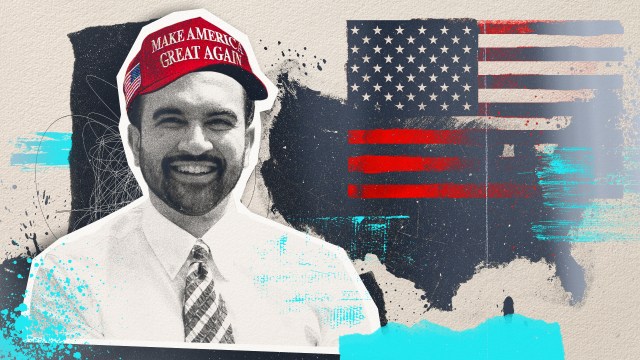





Zohran Mamdani won’t be able to eat the Democratic Party alive. The man who would probably be, on the basis of raw political talent, the most thrilling of the 2028 presidential contenders can never be president. That’s the only silver lining for the centrists and conservatives who revile the 34-year-old Democratic Socialist mayor of New York City. He was born in Uganda and is thus constitutionally ineligible. What this means is that, for the American Left, the trick Donald Trump pulled off on the Republican side of the ledger will not be immediately repeated. (Disclosure: In 2018, when I ran for office, Mamdani was my campaign manager.)
But the Democratic establishment should only take so much heart in this. A quirk of history has kept the mayor of New York from seeking the presidency. However, the Democratic establishment is every bit as frail as the GOP establishment was a decade ago, and Mamdani-backed candidates won a string of remarkable victories in New York’s congressional and state primaries in late June.
Today, the Democratic establishment is finding the bottom the Republican old guard reached in the 2010s, just before a fading reality TV star romped through the primaries and proceeded to remake the party in his own image. Chuck Schumer and his ilk are almost as limp as Jeb Bush was in 2016, when he promised a shock-and-awe campaign but was humiliated on debate stage after debate stage. The odds are better, right now, of Schumer becoming the Senate Majority Leader in 2027 than of him surviving a primary in his own state in 2028.
Trump and Mamdani are chummy because Trump understands, intuitively, that the Democratic Socialist, immigrant Muslim represents the Left version of himself. The two men may agree on nothing politically, but they know what it is like to confront the full wrath of their respective parties’ establishments. They carry battle scars from slaying scions of political dynasties that were once very popular (Bush, Cuomo), and they know the feeling of winning nominations while party elites withhold endorsements. Trump, of course, is the Republican Party elite now, while Mamdani, only six months in office, is a generational star who still can’t get more than a grudging acknowledgment from Schumer, or Hakeem Jeffries, who is probably going to be the House Speaker next year.
But Jeffries and Schumer, for different reasons, represent a political approach that is fast falling out of vogue. Schumer is 75, and his kitschy, cable TV hucksterism and Israel-cheerleading is alienating to a vast majority of voters under the age of 40. Jeffries is much younger and may well have a future leading the Democrats, yet his own style has failed to resonate with the party’s base. He is not revered like Nancy Pelosi. Very few Democrats beyond the members of his caucus are excited for him to lead the House. His own Israel boosterism has made him the target of young progressives, and rank-and-file voters still feel that he hasn’t aggressively confronted Trump enough.
It is easy to forget that the base of the Democratic Party was once much more comfortable with its establishment wing. Bernie Sanders could not win the Democratic nomination because, for all the ways party apparatchiks and the DNC might have foiled him, he never won over enough voters to overcome Hillary Clinton or Joe Biden. Ten years ago, many Democrats liked the former First Lady and Secretary of State. She was not a great political talent, but enough voters in the primaries didn’t want to take a chance on a socialist senator from Vermont.
That era is gone. No true frontrunner exists for the 2028 Democratic nomination. No Clinton or Obama can tip the scales. If Kamala Harris wants to run, she’ll have to get in the muck with everyone else and hope she can survive a grueling primary season. The establishment was desperate to coronate Clinton in 2016 and Barack Obama helped engineer Biden’s 2020 victory, convincing the center-Left candidates in the field to drop out and consolidate against Sanders. The establishment won’t have that power, in this election cycle.
Socialist candidates can win today because there are no more effective Red Scares and fewer and fewer voters remember the Soviet Union. Democratic Socialists are economic populists, and there is a growing share of the Democratic electorate that responds to this messaging. Mamdani’s Democratic Socialists of America undertakes actual political organizing — the sort Obama abandoned once he became president — and its candidates benefit from an establishment that decided it wasn’t worth the effort to knock on doors or pass out leaflets in the streets. DSA is filling a void. The party elites are only now understanding how threatened they are.
This doesn’t mean DSA is taking over the Democratic Party tomorrow. Members of its ranks still espouse fringe views around defunding the police and abolishing prisons. So far, there is little evidence DSA can win in districts with large numbers of independent or Republican voters. That was Trump’s original magic — to cross over, to create a coalition. But maybe, someday, the socialists can. After Mamdani, who can say what’s not possible?
At the minimum, the far-Left is going to rack up more victories in Democratic primaries. Jaime Harrison, the former chair of the DNC, proclaimed recently that Leftists and socialists who “hate the Democratic Party” should not “run for our nomination.” “Don’t use our resources. Don’t rely on our volunteers,” Harrison posted on X. “Don’t use our infrastructure. Don’t ask Democrats to invest their time, money, and energy in your campaign.” It was a laughable statement — not only because Harrison was the DNC chair who hoped to deceive the American people over Biden’s fitness to seek another term, but because it revealed a belief in a politics that effectively no longer exists. There are no Democratic Party “volunteers,” nor truly any “infrastructure.” Candidates are responsible for recruiting their own volunteers and building out their own get-out-the-vote operations. The DNC can, on certain national campaigns and the presidential race, assist, but the Democratic Party in America — like the Republican Party — is effectively a shell organization, a ballot line that anyone, with enough effort, can occupy.
That’s how Mamdani became the Democratic mayor of New York City and Trump became the Republican president of the United States. This is not a parliamentary democracy. Parties do not select candidates, control lists, or charge membership fees. Party lifers like Harrison sometimes like to pretend they do this, or that they have a right to say what a “Democrat” is. At some point, a Trump-like contender will subvert the Democratic Party at mass scale. There isn’t much to head off this possibility; it isn’t like there’s an all-powerful shadow establishment that can rally behind one candidate and squelch the powerful insurgent. Mamdani proved, at the local level, that overcoming this opposition is possible with enough charisma and organization. And his victory shouldn’t be undersold because it was in one city: if New York City were a standalone state, it would be one of the 15 largest, close in size to Virginia. Sanders, were he running in New York City, might have even won were he ten years younger or a bit more palatable.
Either way, men like Harrison, Schumer, and Jeffries will have to adjust to the new order. They will not control the destiny of the Democrats much longer. The clock is ticking.
